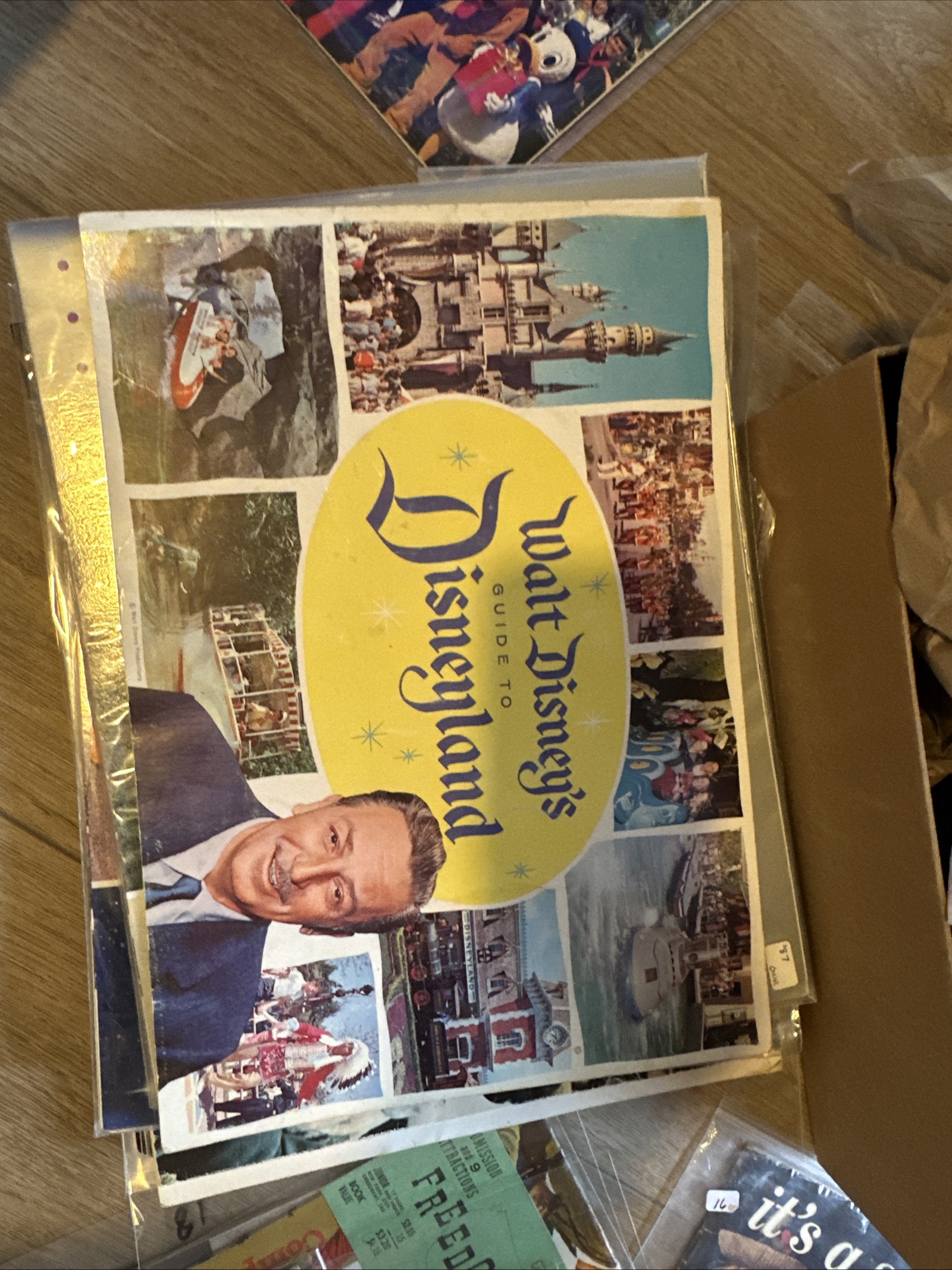
A Window Into the Happiest Place on Earth — Circa 1964
There are certain objects that don't merely document a moment in history — they are that moment, pressed flat and sealed in paper and ink. This original souvenir guidebook from the 1964–1965 edition of Walt Disney's Guide to Disneyland is precisely that kind of artifact. Measuring a generous landscape-format 8 by 11 inches, it opens like a stage curtain onto a version of Disneyland that most guests today can only imagine: a park still mid-invention, still bearing the personal fingerprints of the man whose name graces the cover.
The front cover sets the tone immediately. A bold yellow oval frames a collage of park photographs — Walt Disney himself appears among them, a reminder that in the mid-1960s the park and its creator were inseparable in the public imagination. Mickey Mouse and Donald Duck anchor the iconography, joined by a view of Cinderella Castle gleaming in the California sun. It is a cover that communicates pure optimism, the confident graphic language of an America that still believed the future would look exactly like a monorail gliding over a sparkling lagoon.
The Tower of the Four Winds and a Park in Transition
What makes the 1964–1965 edition particularly precious to serious collectors is the presence of one extraordinary detail: the Tower of the Four Winds. This kinetic sculpture — a soaring, spinning confection of aluminum wings and mobiles — was commissioned for the Illinois pavilion at the 1964–65 New York World's Fair, where Disney's "it's a small world" attraction made its debut before being relocated to Disneyland. The Tower stood outside that pavilion as a landmark of mid-century optimism and modernist whimsy, and it was dismantled after the Fair closed. No physical trace of it survives today.
To find it depicted in this guidebook is to hold a piece of evidence — a contemporary printed record of something that existed briefly and beautifully, then vanished. For collectors who specialize in World's Fair crossover material or in the early history of "it's a small world," this single image elevates the guidebook from charming souvenir to genuine primary source.
The typography throughout carries the mid-1960s T-style logo that Disney used during this era — a distinctive letterform treatment that design-conscious collectors recognize as a reliable dating marker. It places the guide squarely in that sweet spot between Disneyland's first decade of rough-hewn wonder and the more polished corporate identity that would emerge by the 1970s.
What the Park Looked Like Then
Flipping through a guidebook like this is a gentle act of time travel. The Jungle Cruise — depicted here — was still a ride that traded heavily on the novelty of its mechanical animals and the earnest adventure-serial tone Walt personally championed. The Monorail, barely a few years old, represented genuine futurism rather than nostalgic retro-futurism. Tomorrowland was in the midst of a major reimagining that would culminate in the 1967 "New Tomorrowland" expansion, meaning this guide captures the in-between moment: a land still partly defined by its 1955 opening vision.
These guides were practical objects — park maps, attraction descriptions, dining suggestions — but they were also aspirational ones. Western Publishing, which partnered with Walt Disney Productions on a wide range of print merchandise during this period, brought a high standard of color printing and graphic design to the souvenir trade. The result was a guidebook that felt worth keeping, worth tucking into a scrapbook or a bureau drawer, worth pulling out decades later to show grandchildren what Disneyland looked like before they were born.
Condition, Provenance, and the Collector's Eye
This example presents in excellent condition for its age. The copy is described as clean and flat, without the spine stress that so commonly mars landscape-format publications of this era — a direct result of the way guides were shoved into bags, sat upon, and folded open against their natural grain by excited park visitors. Finding one that has escaped that fate is genuinely uncommon. It has been stored in a protective plastic sleeve, which speaks to prior ownership that understood what it held.
This guidebook comes to us as part of a larger Disney estate collection — a trove assembled by someone who lived through these years as a devoted fan and careful keeper of the things that mattered to them. Objects like this one carry that quiet weight. They were not acquired as investments. They were saved because someone loved Disneyland, loved Walt Disney, loved the feeling of possibility that the park represented. That emotional history is part of what you hold when you hold this guide.
For the collector focused on Disneyland ephemera, on World's Fair material, on mid-century Disney print history, or simply on the years when Walt was still alive and the park was still his living laboratory — this is a find worth celebrating. Clean, dated, historically specific, and connected to one of the most storied chapters in American entertainment history.
Thinking of selling? Get a free, no-obligation offer.
One direct offer on your entire Disney collection — no commission, no auction wait. We help arrange the shipping.