A Cover That Changed Television History
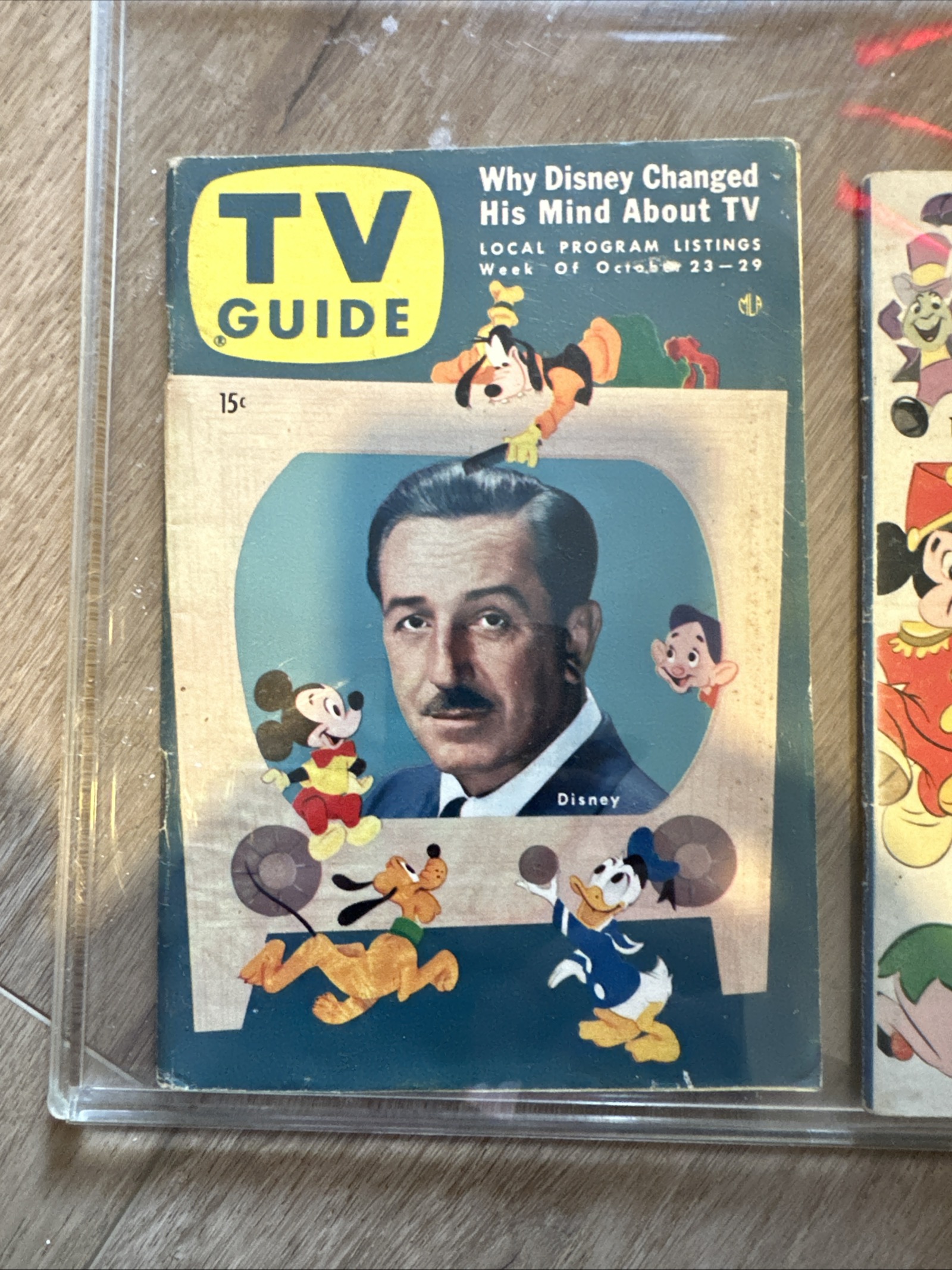
In the autumn of 1954, television was still a young and slightly suspect medium — the kind of thing serious Hollywood studios viewed with open suspicion. Then Walt Disney did something nobody expected: he embraced it completely, and he put his own face on the cover of TV Guide to prove it. This original issue, dated October 23–29, 1954, captures that electric moment frozen in ink and paper. Walt's portrait is set inside a vintage television-set frame on a rich dark teal background, flanked by the beloved characters who made his name — Mickey Mouse, Donald Duck, Pluto, Goofy, and the irrepressible Dopey — all rendered in the warm, confident line art of the classic Disney studio style. The bold yellow TV Guide logo anchors the composition with mid-century graphic punch.
The Story Behind the Headline
The cover story — "Why Disney Changed His Mind About TV" — was not just entertainment gossip. It was the announcement of a seismic shift. Walt had famously resisted the small screen, protective of the cinematic prestige his studio had spent decades building. What changed his mind was a combination of necessity and vision. Disney needed financing and a distribution partner to build Disneyland, the theme park he had been dreaming about for years. ABC, then the weakest of the three major networks and hungry for prestige programming, offered a deal: in exchange for a weekly anthology program, the network would help fund the park. The result was Disneyland, the television series, which premiered on ABC on October 27, 1954 — just days after this very issue hit newsstands.
The timing is not a coincidence. This TV Guide was, in effect, the promotional launchpad for one of the most consequential partnerships in American entertainment history. Walt used the show's four rotating segments — Fantasyland, Tomorrowland, Adventureland, and Frontierland — as both a showcase for Disney's film library and a marketing engine for the park under construction in Anaheim. Disneyland the TV show was a ratings phenomenon from its very first episode, and it helped transform ABC into a credible network almost overnight. It also permanently legitimized television as a platform worthy of Hollywood's finest creative talent.
Why Collectors Prize This Issue
Early TV Guide issues — especially those from the first two years of the magazine's national run, which began in 1953 — are among the most sought-after pieces of American pop-culture ephemera. Triangle Publications, the original publisher, printed these small-format weeklies on modest paper stock never intended for long-term preservation, which means surviving copies in good condition grow rarer with every passing decade. A Walt Disney cover from October 1954 sits at the intersection of three powerful collector categories: Disney memorabilia, early television history, and vintage print ephemera. Few single artifacts speak to all three with this kind of authority.
What makes this particular copy additionally interesting is the MLA stamp visible on the cover — a detail that tells a quiet story of its own. Library and institutional stamps are the fingerprints of a magazine that survived precisely because someone, somewhere, decided it was worth keeping. Many of the best-preserved early TV Guides in existence today passed through exactly this kind of institutional custody before finding their way into private collections. It is a mark of history, not a flaw.
From Estate Collection to Your Shelf
This copy comes to us as part of a larger Disney estate collection — an assemblage gathered by someone who understood that Disney's story is told not only through animation cels and theme-park souvenirs, but through the newspapers, magazines, and promotional materials that documented the company's milestones in real time. Holding this issue is holding a piece of October 1954: a week when Walt Disney stepped in front of a camera and, in doing so, reshaped how Americans spent their Wednesday evenings for the next decade.
At roughly five by seven and a half inches, the magazine fits easily in a document sleeve or display frame. The classic character grouping on the cover — Mickey, Donald, Pluto, Goofy, and Dopey gathered around their creator — reads as both a corporate calling card and a genuine expression of affection. These were Walt's characters, and he wore them proudly on a national magazine cover at the very moment he was betting everything on a new medium and a new kind of destination. Seventy-plus years later, that bet looks rather good.
Whether you are building a focused Walt Disney portrait collection, a timeline of early Disney television, or simply want one of the most historically loaded pieces of 1950s print ephemera available, this issue earns its place. It does not merely depict a moment — it was the moment.
Thinking of selling? Get a free, no-obligation offer.
One direct offer on your entire Disney collection — no commission, no auction wait. We help arrange the shipping.