A Snapshot of the Golden Age of Television
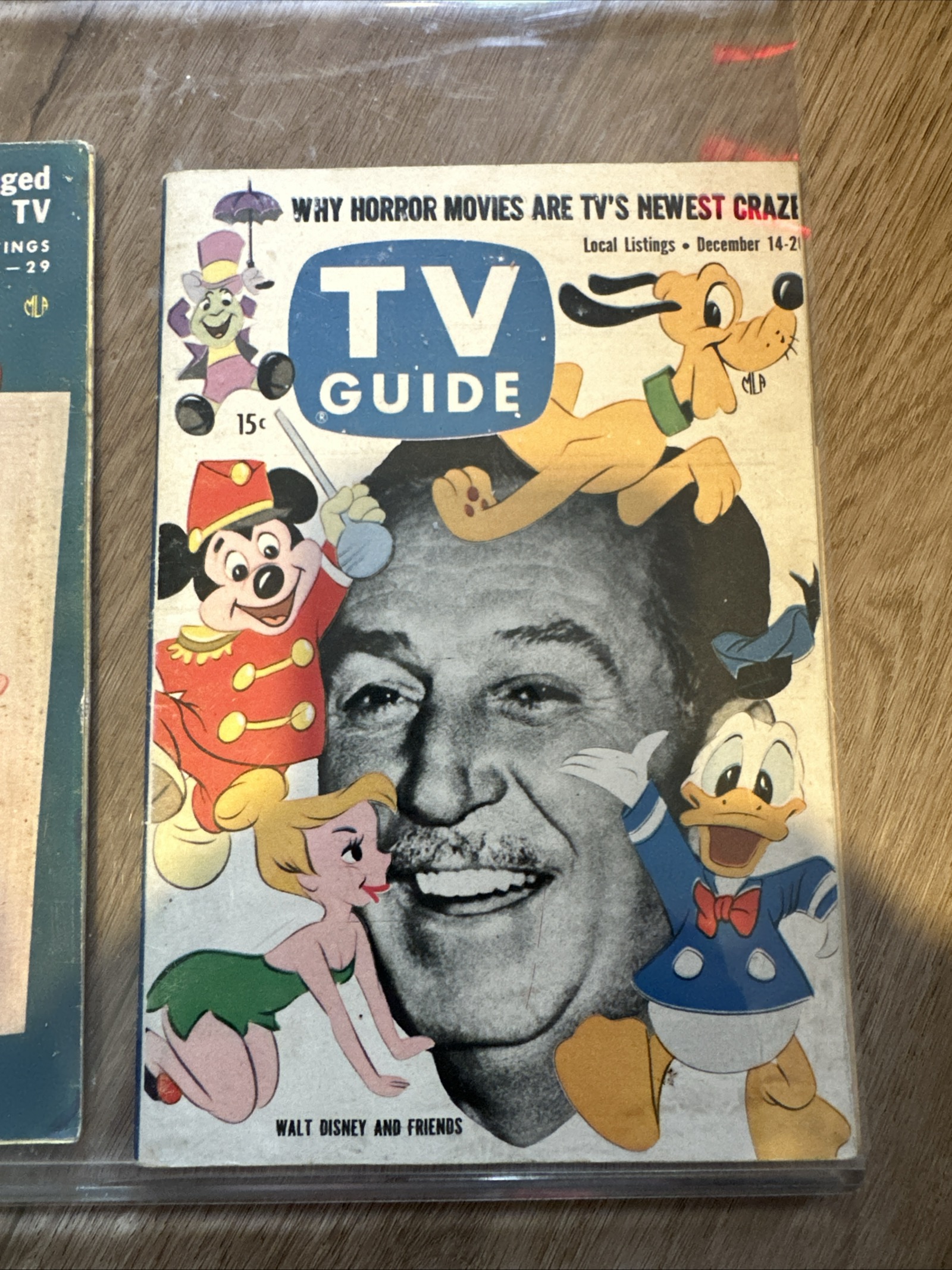
Long before streaming queues and on-demand libraries reshaped how America watched television, families gathered around a single set and consulted one small but indispensable publication to plan their week: TV Guide. This particular issue, dated December 14–20, 1957, is a genuine artifact of that era — a moment frozen in ink and paper when Walt Disney himself was one of the most recognizable faces on the American small screen. The cover features a black-and-white portrait of Walt Disney surrounded by color character illustrations: Mickey Mouse, Donald Duck, Pluto, Tinker Bell, and Jiminy Cricket. It is, simply put, a gathering of icons on a single cover no larger than 5 by 7.5 inches.
Walt Disney on the Air: The Television Revolution
By December 1957, Walt Disney's relationship with television was already a landmark story in entertainment history. The anthology series that bore his name — originally launched in 1954 under the title Disneyland on ABC — had made Walt a weekly guest in living rooms across the country. He had leveraged television not as a fallback but as a forward-thinking promotional platform, using the medium to drum up excitement for Disneyland the park, to share nature films and True-Life Adventures, and to introduce beloved characters to an audience wider than any movie theater could hold. By the time this issue hit newsstands in mid-December 1957, the show had migrated to NBC and been renamed Walt Disney Presents, and Walt's on-camera presence as host and storyteller had made him a trusted, avuncular figure to an entire generation of American children. A Walt Disney cover story in TV Guide during the Christmas television season was not just fitting — it was almost inevitable.
The supporting cast on the cover reflects exactly the constellation of characters Disney had built into cultural touchstones over three decades. Mickey Mouse, the original spark of it all, remained the studio's most enduring symbol. Donald Duck, with his irascible temper and inexhaustible comic energy, had been delighting audiences since the 1930s. Pluto, loyal and expressive without ever uttering a word, embodied the studio's mastery of personality animation. Tinker Bell had become the magical on-screen hostess of the television program itself, sprinkling pixie dust across the opening titles and cementing her image as a symbol of Disney enchantment. And Jiminy Cricket — conscience, narrator, and moral guide from the 1940 masterpiece Pinocchio — rounded out a group that together represented the full sweep of Disney's golden creative era.
Why Collectors Prize This Issue
Regional editions of TV Guide were printed in enormous quantities each week, and yet surviving examples from the late 1950s in clean, collectible condition have become steadily harder to find. Paper degrades, corners crease, mailing labels scar covers, and most copies simply disappeared into recycling bins or attic boxes that never survived another decade. This copy carries its nearly seventy years gracefully: light yellowing and foxing — the faint brown spotting that develops naturally as paper ages — give it the honest patina of its era without detracting from its readability or display appeal. Crucially, it has no mailing label, meaning the cover art is fully intact and unobstructed, a detail that matters enormously to collectors who intend to display or frame the piece. It has been protected in plastic, a sign that someone along the way recognized its value and treated it accordingly.
For Disney memorabilia collectors, this issue hits several desirable notes simultaneously: a personally identifiable Walt Disney image (rather than just a character), a pre-1960 date that places it firmly within the classic studio era, a Christmas-season issue with its attendant nostalgic resonance, and a genuinely iconic lineup of characters. It occupies an appealing niche between vintage ephemera collecting and Disney character collecting — the kind of crossover piece that draws interest from multiple communities.
From the Estate Collection
This copy comes to us as part of a larger Disney estate collection — one of those remarkable accumulations built by a dedicated enthusiast over many decades. Items like this TV Guide were not bought as investments; they were saved because someone understood instinctively that they were worth keeping. The care shown in storing this copy — the protective sleeve, the absence of folds or tears to the cover — speaks to that sensibility. It is a piece that was loved before it was collectible, which is often the truest mark of authenticity.
Whether you are drawn to the history of early American television, to the legacy of Walt Disney as a personality rather than merely a studio brand, or simply to the charm of mid-century graphic design and holiday nostalgia, this TV Guide offers something genuinely rare: a clean, display-worthy window into a specific and beloved moment in American cultural life. A perfect addition to any Disney study, media room, or curated collection of classic memorabilia.
Thinking of selling? Get a free, no-obligation offer.
One direct offer on your entire Disney collection — no commission, no auction wait. We help arrange the shipping.