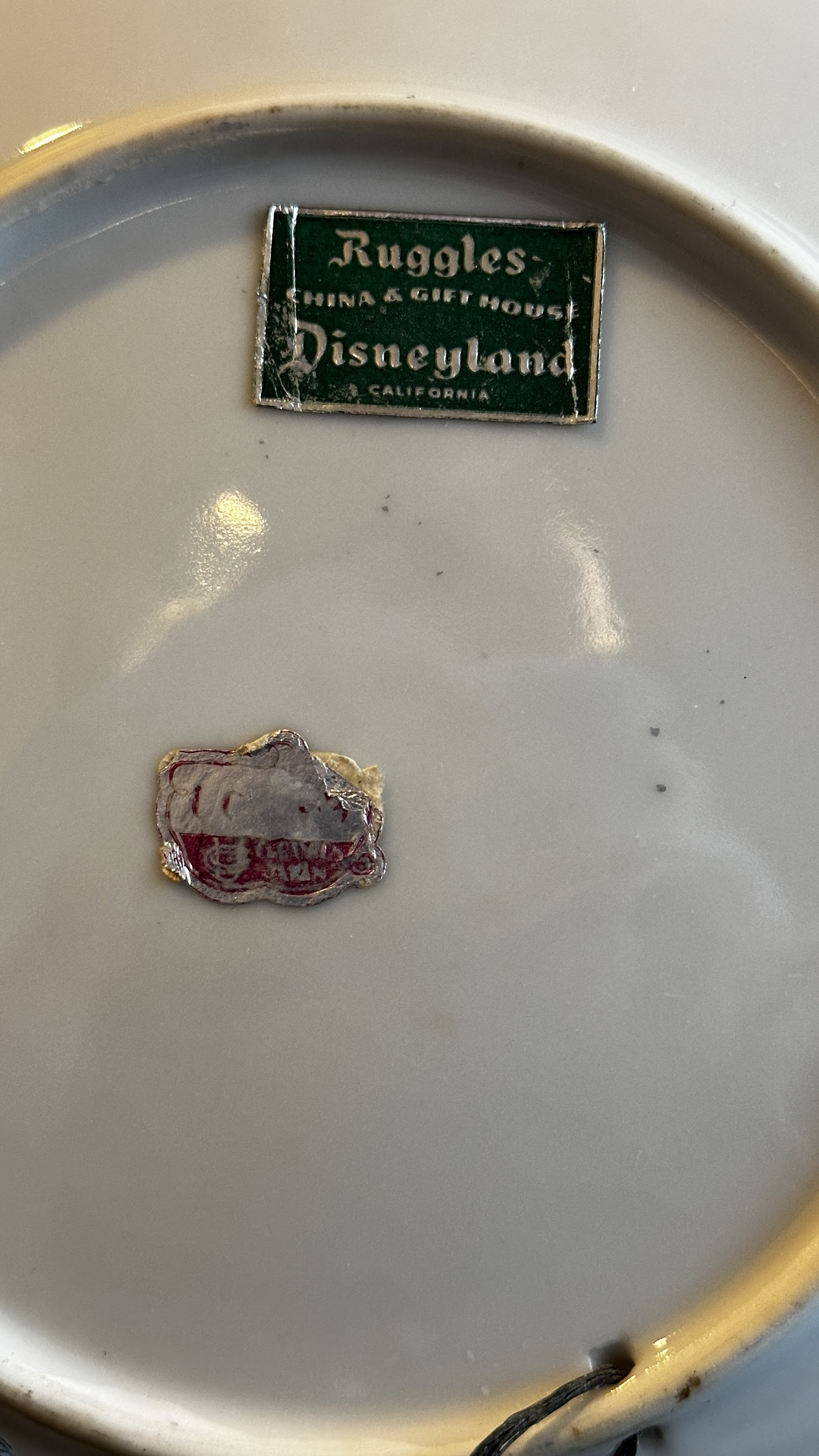
A Plate Born in the Golden Age of the Magic Kingdom
There are souvenirs, and then there are relics. This white ceramic Disneyland souvenir plate, produced by the Ruggles China Gift House and dating to the window of 1955 through 1964, belongs firmly in the second category. It arrived at a moment when Disneyland itself was still a novelty — a place that Walt Disney himself had to convince bankers, journalists, and a skeptical public was not the fever dream of a cartoon man who had lost his mind. The park opened on July 17, 1955, and within months it was clear something genuinely new had entered the American imagination. Visitors wanted to bring a piece of it home. Plates like this one were the answer.
Ruggles China and the Spirit of Main Street, U.S.A.
The Ruggles China Gift House was one of the original retail tenants along Main Street, U.S.A., the idealized turn-of-the-century American streetscape that greets every guest the moment they pass under the train station. Walt designed Main Street as a deliberate act of memory — scaled at five-eighths of real life, perpetually clean, perpetually welcoming, smelling faintly of popcorn and fresh-baked cookies pumped through hidden vents. Ruggles fit perfectly into that vision. The shop offered fine and decorative ceramics at a moment when china gift shops were a fixture of American domestic culture, and a souvenir plate was among the most respectable, displayable tokens a guest could carry home to a spouse or a grandmother who had stayed behind.
White ceramic was the material of choice for a reason: it carried decoration crisply, it photographed beautifully in the pattern-transfer printing techniques of the era, and it communicated permanence. This was not a paper pennant or a rubber toy. This was something meant to be hung on a wall or set in a display cabinet, meant to prompt a story every time a visitor asked about it. "We went to Disneyland," the plate said without words, "and it was extraordinary."
Why the 1955–1964 Window Matters to Collectors
The first decade of Disneyland's existence occupies a special place in the collector market — and in American cultural history. These were the years before the park became a global institution, before it was reproduced in Florida and Tokyo and Paris. It was still singular: one park, one address, one Anaheim, California postmark. Merchandise from this era carries what serious collectors call Opening Day adjacency — it was made and sold while the paint on Sleeping Beauty Castle was still relatively fresh, while Frontierland felt genuinely new, while Walt himself walked the grounds on weekend mornings in civilian clothes to watch how guests used the spaces he had built.
Ceramics from this window are particularly desirable because they are inherently fragile. Plates get broken. They get stacked carelessly in kitchen cabinets and chipped against everyday dishes. The ones that survive intact, especially those that carry clear manufacturer identification like the Ruggles mark, represent a small fraction of original production. Each one that surfaces in an estate collection is a minor miracle of domestic preservation — someone, somewhere, kept this safe for sixty-plus years.
From an Estate Collection to a New Custodian
This plate came to us as part of a larger Disney estate collection, the kind of assemblage that accumulates over a lifetime of deliberate affection. Whoever gathered it understood that early Disneyland merchandise was not just gift-shop output — it was documentation. Each piece captured a specific moment in the park's evolution, a specific retail relationship, a specific aesthetic sensibility. The Ruggles plate represents the earliest chapter: the park's first decade, Main Street at its most intimate, and a ceramic tradition that predates the mass-market souvenir explosion that would come in later decades.
For the collector who focuses on Disneyland history rather than individual characters or films, this is a cornerstone piece. It asks to be displayed alongside period photographs, vintage park maps, and other Opening Day-era ephemera. It is the kind of object that anchors a collection thematically and chronologically, a fixed point from which everything else can be organized. Whether it lives in a dedicated display case, hangs as part of a souvenir plate wall, or anchors a shelf of early park memorabilia, it carries the quiet authority of genuine age and genuine place.
Thinking of selling? Get a free, no-obligation offer.
One direct offer on your entire Disney collection — no commission, no auction wait. We help arrange the shipping.