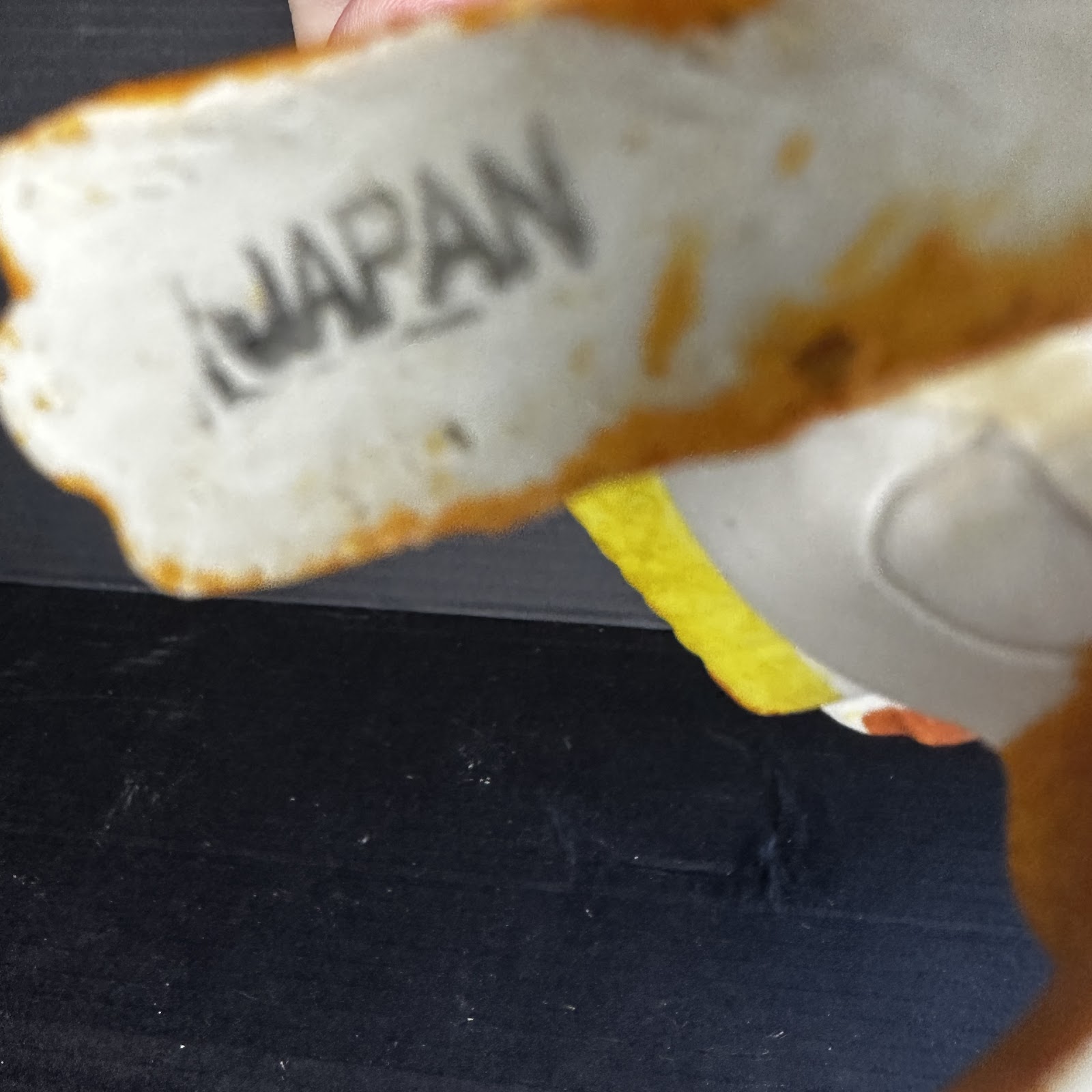
A Tiny Shard of a Much Bigger Story
Not every piece in a Disney collection arrives pristine, boxed, and mint-on-card. Some arrive as the honest, weathered survivors they are — fragments of a larger object that once delighted a child, sat on a grandmother's shelf, or anchored a bedroom windowsill for a decade before life moved on. This small ceramic fragment, bearing the unmistakable "JAPAN" stamp on its unglazed base, is exactly that kind of survivor. Measuring roughly two inches by one inch, it comes to us from a larger estate collection, and while it has clearly seen the passage of time, it carries with it the quiet charm of mid-century Disneyana manufacturing at its most earnest.
The yellow, brown, and white color palette points toward one of two beloved Disney characters — most likely Pluto, Mickey Mouse's loyal and expressive canine companion, or perhaps Winnie the Pooh, the honey-loving bear from the Hundred Acre Wood. Either attribution places this piece squarely within a golden era of Disney licensing, when Japanese ceramic workshops produced thousands of small figurines for the American gift and souvenir market.
The Golden Age of "Made in Japan" Disneyana
Throughout the postwar decades and into the 1970s, Japan became the engine of the global novelty ceramics trade. American importers and Disney licensees worked with factories — many of them small, family-operated workshops in the Nagoya and Aichi regions — to produce affordable, hand-painted bisque and glazed porcelain figures for the US market. These pieces filled five-and-dime stores, gift shops, and Disney park souvenir stands from coast to coast.
The cold paint technique visible on the brown areas of this fragment was common in the era: pigment was applied after firing rather than under a glaze, which gave the pieces bright, vivid color at the cost of long-term durability. Decades of handling, humidity, and ordinary household life cause that cold paint to flake — which is precisely what we see here. Far from diminishing the piece, this aging is itself a form of documentation. It tells you the figurine was lived with, not stored away.
The "JAPAN" mark, stamped on the unglazed underside, is a hallmark collectors learn to recognize immediately. Pre-1970s pieces are often marked simply "Japan" in ink or impressed lettering; 1970s production frequently shifted to stamped marks. The specifics of the mark can help narrow manufacture dates, and for serious researchers of Japanese Disneyana, these small details matter enormously.
Pluto and Pooh: Characters Worth Collecting
If the character is Pluto, the piece connects to one of Disney's oldest and most enduring figures. Introduced in 1930, Pluto became Mickey's devoted dog and one of the rare Disney characters defined entirely through pantomime — no speech, only expression and physicality. His warm yellow coloring and floppy ears translate well to ceramic form, and Pluto figurines were produced in enormous quantities throughout the mid-century decades. He remains a stalwart of classic Disney collecting.
If the character is Winnie the Pooh, the timeline fits perfectly. Disney's Pooh — adapted from A.A. Milne's beloved books — debuted in animated featurettes beginning in 1966, with The Many Adventures of Winnie the Pooh arriving as a feature compilation in 1977. By the mid-to-late 1970s, Pooh merchandise was everywhere, and Japanese ceramic licensees were producing Pooh-themed figures in abundance. The yellow and brown palette aligns naturally with Pooh's honey-colored fur and his iconic red shirt.
Either way, this fragment sits at the intersection of two great collecting traditions: vintage Japanese ceramics and classic Disney character merchandise.
Estate Provenance and the Value of Imperfect Pieces
This piece comes to us as part of a larger Disney estate collection — one of those wonderful accumulations assembled over a lifetime of genuine affection for the Disney brand. Estate collections tell stories that pristine retail stock never can. They show what people actually bought, actually loved, and actually kept through moves, renovations, and decades of change.
The condition here is honestly poor: significant chipping on the edges, cold paint flaking on the brown areas, surface grime, and structural loss consistent with the piece being a fragment rather than a complete figure. We present it as exactly that — a fragment, a shard of ceramic history. For the advanced collector, pieces like this serve as reference specimens, paint-color comparisons, or simply as affordable entry points into the study of mid-century Disney ceramics manufacturing. The "MADE IN JAPAN" stamp alone has documentary value for researchers of the era.
In a collection full of showpieces, every fragment still has something to say. This one says: a child once loved this, and somewhere along the way, the object outlasted everything except the memory it represents.
Thinking of selling? Get a free, no-obligation offer.
One direct offer on your entire Disney collection — no commission, no auction wait. We help arrange the shipping.