A Ticket to Ride: When School Supplies Smelled Like Magic Kingdom
In the years immediately following Disneyland's grand opening on July 17, 1955, the park wasn't just a place — it was a feeling, a shared national dream that spilled out of Anaheim and into every corner of American life. Lunch boxes, pennants, coloring books, and yes, pencil cases carried the Disneyland name into classrooms from coast to coast, transforming the mundane act of sharpening a pencil into a small daily brush with fantasy. This vintage cardboard pencil case is precisely that kind of artifact: a humble school supply elevated by the full weight of Walt Disney's visionary brand at the exact moment it was becoming a cultural juggernaut.
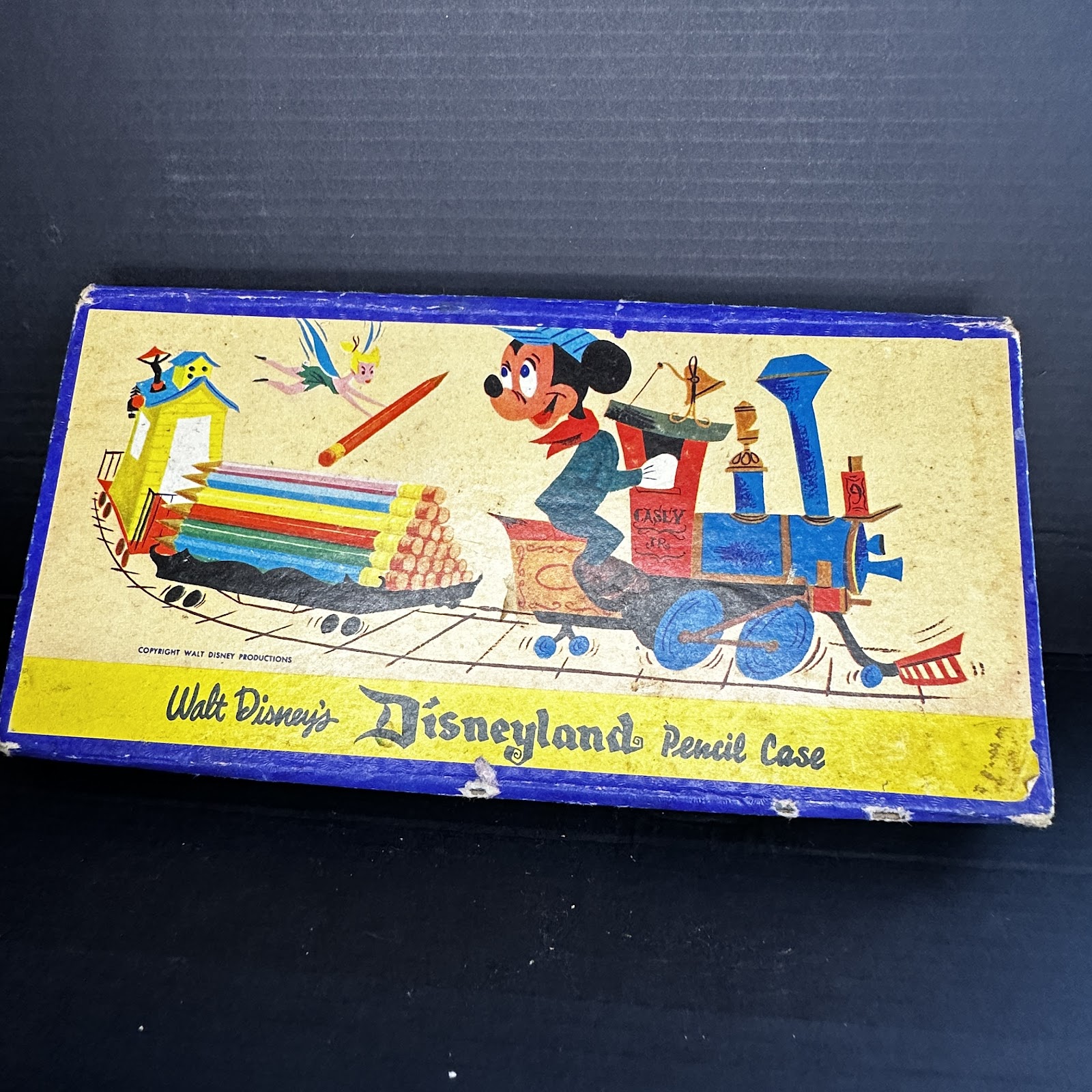
Measuring approximately 8.5 inches long by 4.5 inches wide and just an inch deep, this piece was designed to tuck neatly into a child's satchel alongside a geography textbook and a bag lunch. Its lithographed paper wrap — the production method of choice for affordable, high-color licensed goods of the era — reproduces in cheerful, saturated hues a scene that feels almost cinematic in its composition. At its heart sits the Disneyland logo, rendered in the stylized gothic script that Walt himself championed as a mark of distinction, flanked by two of the park's most beloved icons.
Mickey, Tinker Bell, and the Casey Jr. Connection
The imagery on this pencil case is a carefully curated miniature pageant of Disneyland's early identity. Mickey Mouse — the irreducible core of the entire Disney enterprise — appears here not in his familiar tuxedo and white gloves, but dressed for action: a blue engineer's cap, a jaunty red neckerchief, and the confident posture of a man in command of a locomotive. That locomotive is Casey Jr., the irrepressible little circus train from the 1941 animated feature Dumbo, who huffed and puffed his way up impossible grades on sheer determination. Casey Jr. had a second life at Disneyland itself, where the Casey Jr. Circus Train attraction opened in 1955 as one of Fantasyland's original rides, carrying young guests in colorful circus-car gondolas around a miniature storybook landscape.
Joining them on this small stage is Tinker Bell, depicted mid-flight, clutching an oversized pencil in the way she might brandish her wand — transforming the ordinary implement into something enchanted. Tinker Bell's association with imagination and creative magic made her the perfect mascot for a school supply, and her prominent role here reflects the moment in the mid-1950s when she became one of Disney's most widely recognized symbols, thanks in large part to her nightly television appearances introducing Disneyland, Walt's landmark ABC series that premiered in 1954.
The Era It Comes From
Licensed Disney merchandise in the 1955–1960 window occupied a fascinating cultural space. The Disneyland park was still a revelation — a place most American families had only read about in Life magazine or glimpsed on their black-and-white television sets. Manufacturers who held Walt Disney Productions licenses understood that slapping the Disneyland name on a product wasn't just marketing; it was aspirational currency. A child who couldn't yet make the trek to Anaheim could at least carry a piece of the dream to school every morning.
Cardboard pencil cases of this type were mass-market goods, manufactured to a price point that put them within reach of nearly any family. The construction — a rigid cardboard shell with a glued lithographed paper overlay and a simple hinged lid — was standard for the era and is also the reason so few have survived in pristine condition. The materials were never meant to outlast a school year, let alone seven decades. That so many of these pieces were used hard, loved thoroughly, and still endure speaks to something powerful in the original design.
Condition, Character, and the Collector's Eye
This example carries its age with the honest patina of a genuinely used childhood treasure. The blue perimeter edges show heavy scuffing and paper loss, the corners have experienced some crushing, and there is visible yellowing, toning, and general grime consistent with decades of storage. Several dark spots suggest minor staining. These are not flaws that diminish the piece's historical interest — they are the biography of the object, evidence that some child once opened this case every morning to retrieve crayons or pencils before a school day.
For collectors focused on early Disneyland park memorabilia, pre-1960 licensed paper and cardboard goods represent a category that is simultaneously abundant in variety and genuinely scarce in high-grade examples. The survival rate for lithographed paper items from this era is low by nature; what remains tends to show exactly this kind of honest wear. The lithography itself — the color saturation, the confident line work, the Disneyland logo in its original gothic treatment — remains legible and visually engaging despite the passage of time. This piece came to us as part of a larger Disney estate collection, and it carries with it that particular quality of items that were kept not because they were valuable, but because they were loved.
Whether you collect early Disneyland park ephemera, Casey Jr. and Dumbo character pieces, Tinker Bell memorabilia, or simply the broader category of mid-century Disney school supplies, this pencil case offers a direct, tangible connection to the first golden years of the Happiest Place on Earth.
Thinking of selling? Get a free, no-obligation offer.
One direct offer on your entire Disney collection — no commission, no auction wait. We help arrange the shipping.