A Relic from the Golden Age of Mickey
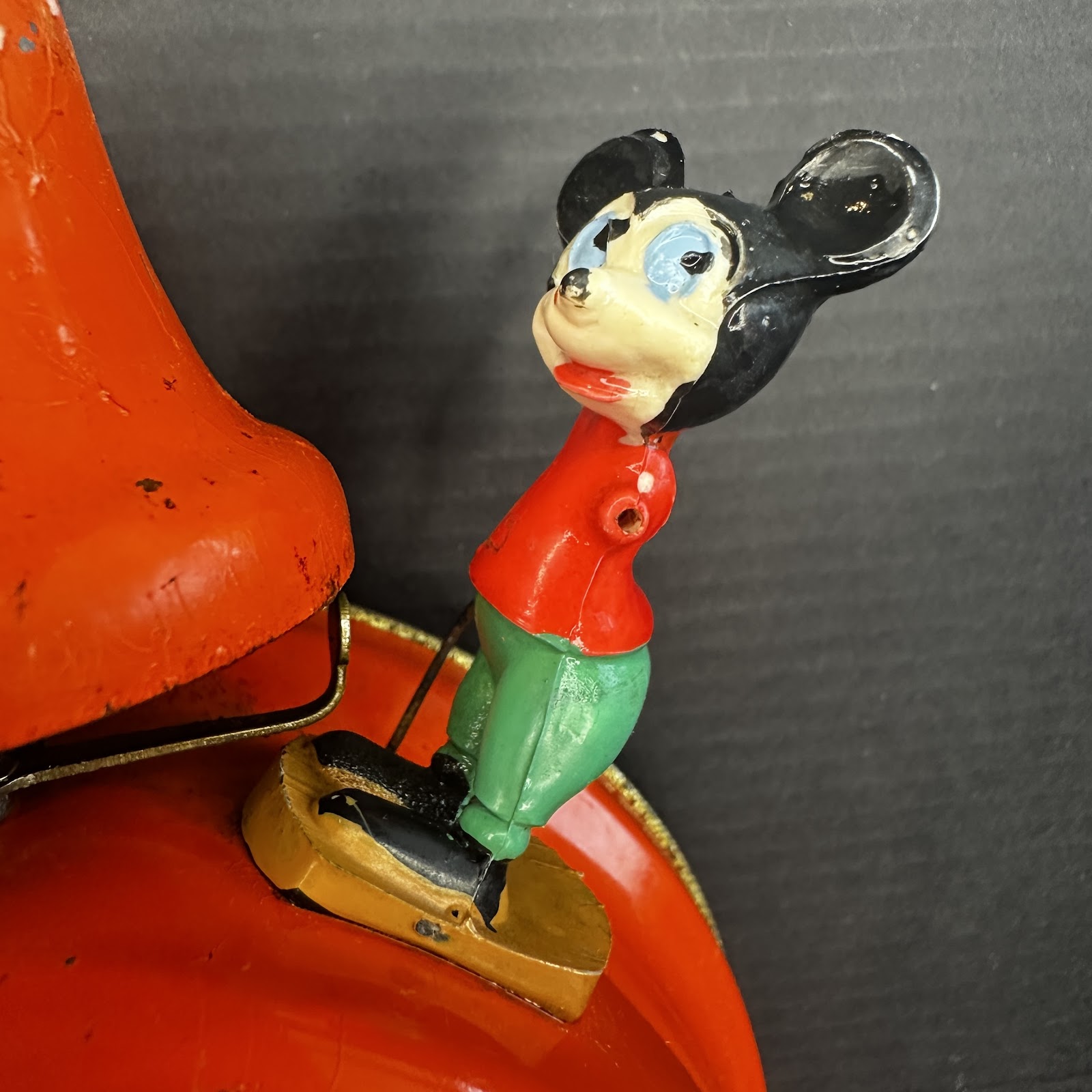
Long before Mickey Mouse became the global icon he is today, he appeared in a very different form — wide-eyed, rubbery-limbed, and brimming with a mischievous, almost otherworldly energy. This extraordinary fragment of early Disney merchandising history captures that spirit in physical form: a pre-war celluloid and early plastic figure component depicting the beloved "Pie-Eyed" Mickey Mouse, complete with his characteristic blue pupils, bright red shirt, and vivid green pants. Mounted on a gold-painted metal bracket fastened to a red tin base, this piece once served as the animated centerpiece of a larger mechanical wind-up toy — very likely a tricycle or seesaw contraption of the kind that delighted children across the world in the 1930s and 1940s.
The Pie-Eyed Era and Its Manufacturers
The "Pie-Eye" Mickey — so named for the circular, pie-slice pupil design that defined his look from roughly 1928 through the late 1930s — is among the most sought-after visual styles in all of Disney collecting. This early character design, drawn directly from the hand of Ub Iwerks and refined in Walt Disney's earliest shorts, carried an irreverent, almost feral charm that the more polished Mickey of the postwar years would gradually leave behind. Toys produced during this window were manufactured under license by a variety of European and Asian firms, with Germany and Japan dominating the pre-war market. Japanese celluloid toys in particular were produced in enormous variety during this era, often featuring brilliant painted colors applied directly to the lightweight, slightly translucent material. German manufacturers favored somewhat sturdier construction, frequently combining celluloid figures with elaborate tin lithograph bases and mechanical actions. This piece, with its tin base and bracket mounting, is consistent with production practices common to both traditions, though its exact origin remains tantalizingly unattributed — a detail that, if anything, adds to its mystique.
Reading the Wear: A Survivor's Story
Part of what makes this figure component so compelling is precisely what it has endured. Both arms are now absent, with the original shoulder attachment holes remaining as silent evidence of the animated gestures Mickey once made. The ears and shoes show heavy paint chipping, and the face carries the fine network of cracks known as "crazing" — a natural consequence of aging celluloid that collectors recognize as an honest hallmark of genuine pre-war manufacture rather than later reproduction. The gold-painted metal bracket and red tin base retain their structure, grounding the figure and suggesting how it once functioned within a larger assembly. There is no visible copyright marking on the piece, which is entirely consistent with the informal, often loosely licensed character merchandise produced outside the United States during this period, particularly before Disney's international licensing program became more formalized in the late 1930s.
This is not a pristine showpiece. It is something rarer: a survivor. An object that has passed through hands, survived decades of storage, and arrived in the present carrying the physical memory of the children who played with it. For the serious collector, that authenticity is irreplaceable.
Why This Piece Belongs in a Serious Collection
Pre-war Mickey Mouse mechanical toy components are genuinely scarce. Complete wind-up toys from this era in working condition are extraordinary finds; fragments and components like this one represent the more accessible — but no less historically significant — end of the same collecting universe. This piece speaks directly to the formative years of Disney's commercial presence, when Mickey Mouse was not yet a corporate property but a cultural phenomenon being interpreted by craftspeople around the world, each adding their own local sensibility to the character's form.
This figure comes to us as part of a larger Disney estate collection, a body of material assembled over many decades by a dedicated collector whose eye for early character merchandise is evident throughout. Pieces like this rarely appear individually on the market; they tend to surface as part of exactly these kinds of collections, where one enthusiast's lifetime of searching is passed forward to the next generation of stewards.
Whether displayed in a dedicated pre-war Disney cabinet, studied as a material artifact of early twentieth-century toy manufacturing, or simply kept as a tangible connection to the earliest years of Mickey Mouse's extraordinary life, this figure component is a genuine piece of animation history. Its imperfections are its credentials.
Thinking of selling? Get a free, no-obligation offer.
One direct offer on your entire Disney collection — no commission, no auction wait. We help arrange the shipping.