Where Two American Dreams Met on the Open Road
There is a particular alchemy that happens when two icons of postwar American optimism appear on the same page. This Schwinn Takes a Trip to Disneyland promotional catalog — a digest-sized paper artifact from the late 1950s — is precisely that kind of collision. Schwinn Bicycle Company, then the undisputed king of the American bicycle market, partnered with Walt Disney Productions to produce a piece of promotional literature that sold not just bicycles, but an entire vision of what family life in the Atomic Age could look like: clean, colorful, brimming with possibility, and pointed straight at the castle gates of the happiest place on Earth.
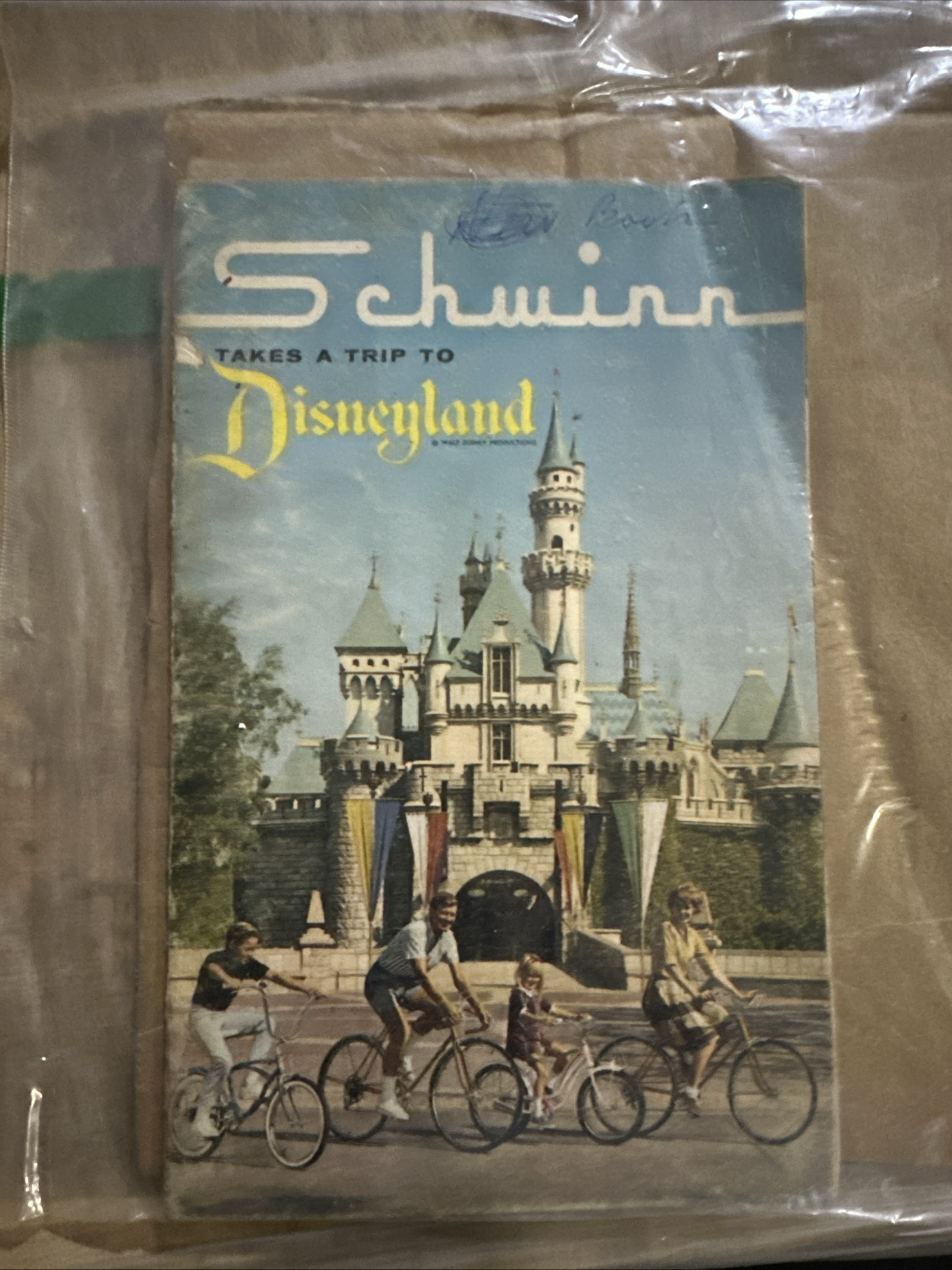
The cover says it all. A multi-color lithograph places a classic American family — the kind Schwinn built its brand around — in front of Sleeping Beauty Castle at Disneyland, rendered in that instantly recognizable stylized 1950s park font. The Schwinn script logo floats proudly alongside. This is not an advertisement; it is a manifesto for mid-century family joy.
The Era That Made Both Legends
Disneyland opened its gates in Anaheim, California, on July 17, 1955, and within a year it had already become the defining cultural landmark of postwar America. Sleeping Beauty Castle — still relatively new in the 1956–1960 window this catalog occupies — was the park's visual anchor, the image Walt Disney himself chose as the emblem of everything the park promised. Seeing it on the cover of a Schwinn catalog was not accidental. Both brands were chasing the same customer: the suburban family with a station wagon in the driveway, a new tract home, and children who deserved the best.
Schwinn was at the height of its cultural dominance during these same years. The Chicago-based manufacturer had pioneered the balloon-tire bicycle and was producing models — the Black Phantom, the Hornet, the Starlet — that children across America coveted with a ferocity usually reserved for sports heroes. A Schwinn under the Christmas tree was a rite of passage. Pairing that brand identity with Disneyland was a marketing masterstroke: two experiences every American kid wanted, united in a single piece of beautifully printed ephemera.
The Artifact Itself — Paper Time Capsule
At approximately 5.5 by 8.5 inches in the classic digest format, this brochure is modest in size but outsized in charm. The multi-color lithography on the cover reflects the printing ambitions of the era — vivid, saturated hues were a deliberate signal of modernity and quality. Inside, collectors expect the kind of aspirational lifestyle photography and bicycle lineup spreads that defined Schwinn's marketing language throughout the 1950s.
As with any piece of paper ephemera that has crossed more than six decades, this catalog carries the honest marks of its journey. There is creasing along the spine, corner wear at the edges, and general surface aging consistent with a pamphlet that once lived in a drawer, a garage, or perhaps a dealer's display rack. Possible light foxing or water spotting is noted as well — the kind of atmospheric aging that archivists call patina and collectors recognize as proof of genuine age. Most intriguingly, a significant inscription in blue ink runs across the top — the name "Arthur Brown," written in a hand that belongs to another era entirely. That handwriting is not a flaw; it is a ghost. Someone held this catalog, picked up a pen, and left their name. The object carries their trace now, as it carries the trace of every year since.
Why Collectors Seek This Crossover Piece
Disneyland ephemera from the park's first decade — the Sleeping Beauty Castle years — commands deep interest among Disney collectors for one simple reason: almost none of it was meant to last. Promotional brochures were printed to be handed out, read, and discarded. A surviving example from this window, 1956 to 1960, represents a genuine survivor, not a reproduction or a souvenir designed for preservation. It existed to sell bicycles and park dreams, and it did its job and moved on — except for the copies that somehow made it through.
For bicycle collectors, the Schwinn angle is equally compelling. Schwinn promotional literature from the 1950s is a dedicated sub-category unto itself, and pieces that tie the brand to a specific cultural partnership — especially one as iconic as Disneyland — are rarer than standard catalog pages. The cross-collectibility here is real and recognized: this item speaks fluently to the Disney paper ephemera collector, the Schwinn cycling enthusiast, the mid-century Americana curator, and the Disneyland opening-decade specialist all at once.
This piece comes to us from a larger Disney estate collection — one of those wonderful accumulations where items arrived from many directions over many decades, gathering quietly until the collection itself became a chronicle of Disney's cultural reach across American life. That a Schwinn bicycle catalog found its way into such a collection tells you something about how broadly Disney's early years touched the material culture of postwar America. It was not just in the parks and the films; it was in the garage, on the lawn, under the Christmas tree.
For the right collector, Schwinn Takes a Trip to Disneyland is exactly the kind of find that stops a scroll and starts a story.
Thinking of selling? Get a free, no-obligation offer.
One direct offer on your entire Disney collection — no commission, no auction wait. We help arrange the shipping.