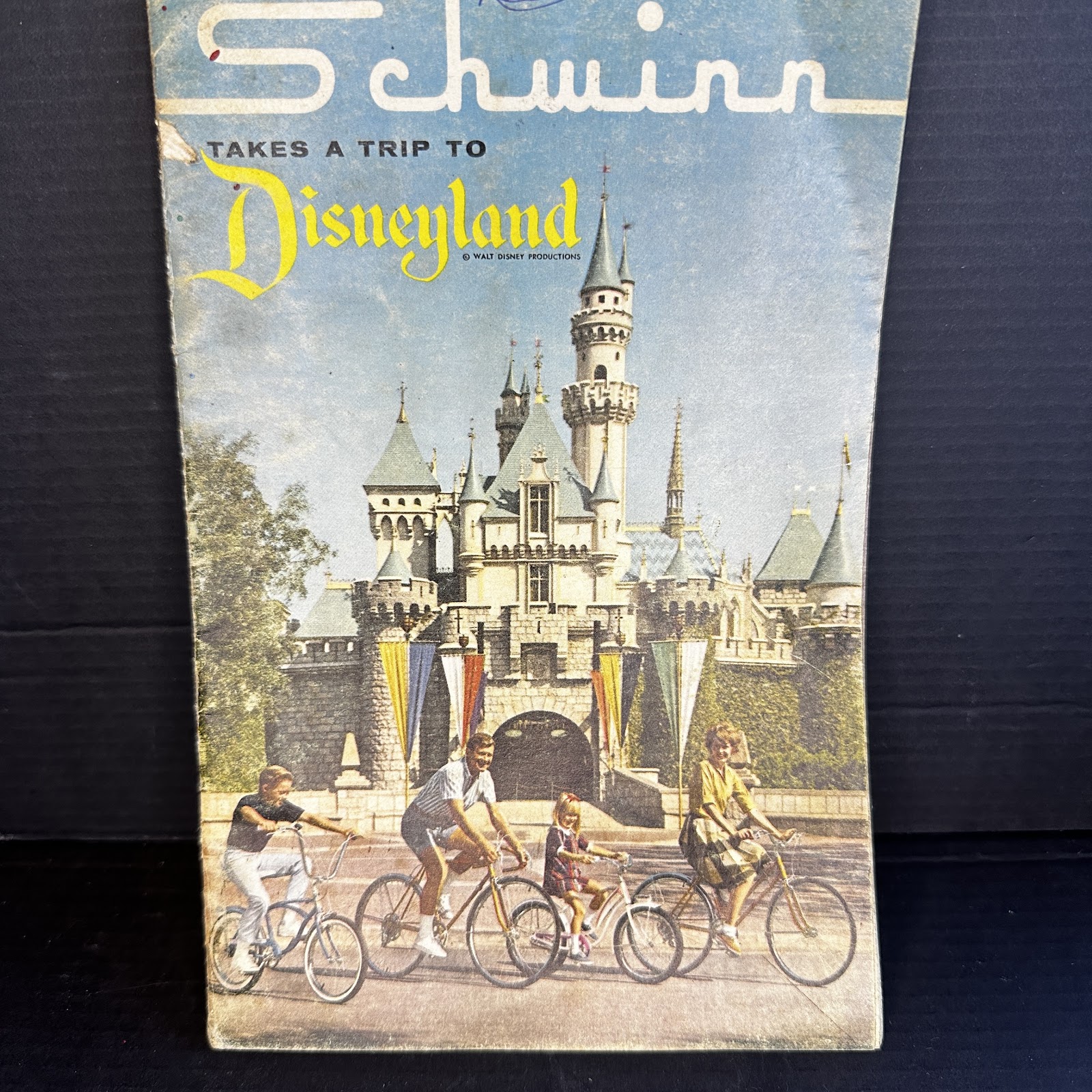
Where Two American Icons Rolled Into One
Few partnerships from the postwar golden age of American consumer culture feel as perfectly matched as Schwinn and Disneyland. Both were quintessentially American dreams made tangible — one a shimmering kingdom built from orange groves in Anaheim, the other a Chicago-born bicycle that had become the ride of choice for an entire generation of children. This promotional booklet, produced jointly by the Schwinn Bicycle Company and Walt Disney Productions, is a small paper artifact that captures the spirit of that alliance in vivid, comic-story form.
Dating to roughly 1958–1965, the booklet carries the unmistakable © Walt Disney Productions copyright — that clean, authoritative mark that places it firmly in the pre-1986 era when Walt himself still walked the studio lot. It is a period when Disney licensing was selective and carefully guarded, which makes any co-branded piece from these years especially resonant for collectors.
A Comic-Style Road Trip Through the Magic Kingdom
Inside, a wholesome American family — father, mother, son, daughter — makes their pilgrimage to Disneyland on their Schwinn bicycles. The story unfolds in the breezy comic style that defined mid-century promotional literature: clean line art, bright primary colors, optimistic dialogue, and just enough plot to move the eye from one Schwinn model to the next. Mickey Mouse makes his appearance as the unmistakable ambassador of Disneyland, lending the booklet the official Disney seal of enchantment.
The bicycle models glimpsed through the pages include Sting-Ray style designs — a detail that anchors the later end of the date range, since the Schwinn Sting-Ray debuted in 1963 and immediately rewrote what American kids expected from a bicycle. Banana seat, high-rise handlebars, and a low-slung frame that felt more like a chopper motorcycle than anything your parents had ridden: the Sting-Ray was a cultural earthquake, and seeing it tied to the Disneyland dream only amplified both brands' hold on the imagination.
The Object Itself: Condition and Character
This copy measures approximately 8.5 by 5.5 inches — a comfortable, hand-held size that was meant to be picked up at a Schwinn dealership, tucked into a jacket pocket, and carried home to be read on the living room floor. The glossy paper cover gives way to matte interior pages, and the whole thing is held together with stapled binding in the classic saddle-stitch fashion of the era.
As with virtually all paper ephemera that has traveled six decades, this booklet bears honest signs of its journey. There is visible shelf wear along the left spine, minor corner creasing, and light foxing or spotting along the top edge — the kind of gentle patina that archivists call "honest age." A small amount of surface scuffing is present on the cover, and blue ink markings appear at the top edge. Despite all of this, the colors remain relatively vibrant, and the cover image — that cheerful family of four posed with their Schwinns — still pops with the optimism of an era that genuinely believed in the open road and the magic waiting at the end of it.
This piece arrived as part of a larger Disney estate collection, the kind of carefully accumulated assemblage that surfaces only occasionally. Estate collections like this one tend to preserve items in the condition they were actually lived with — not sealed away in mylar from the moment of purchase, but loved, used, and then set aside. That context adds a layer of authenticity that no mint-condition reproduction can replicate.
Why Collectors Seek This Piece Out
Schwinn-Disney crossover items occupy a narrow, fascinating niche that pulls from two fiercely loyal collector communities at once. Schwinn enthusiasts — particularly those chasing Sting-Ray and mid-century bicycle culture — recognize this booklet as a rare piece of brand history from their marque's most culturally potent decade. Disney ephemera collectors, meanwhile, prize any pre-1986 Walt Disney Productions copyright piece as a window into the studio's first golden licensing era.
Promotional booklets and catalogs are inherently fragile survivors. They were printed to be distributed for free, read once or twice, and discarded. The survival rate for paper ephemera of this kind is low, which means copies in any displayable condition are genuinely scarce. Add the Disneyland tie-in, the Sting-Ray visual, Mickey Mouse's cameo, and the joint Schwinn/Disney copyright imprimatur, and you have a piece that tells a rich story in a very small package.
Whether displayed flat behind glass, tucked into a binder of mid-century Disney paper goods, or simply kept as a conversation piece on a shelf of vintage Americana, Schwinn Takes a Trip to Disneyland is the kind of object that rewards a second look — and a third. It is a reminder that some of the most evocative artifacts of the past were never meant to last. The fact that this one did is its own small magic.
Thinking of selling? Get a free, no-obligation offer.
One direct offer on your entire Disney collection — no commission, no auction wait. We help arrange the shipping.