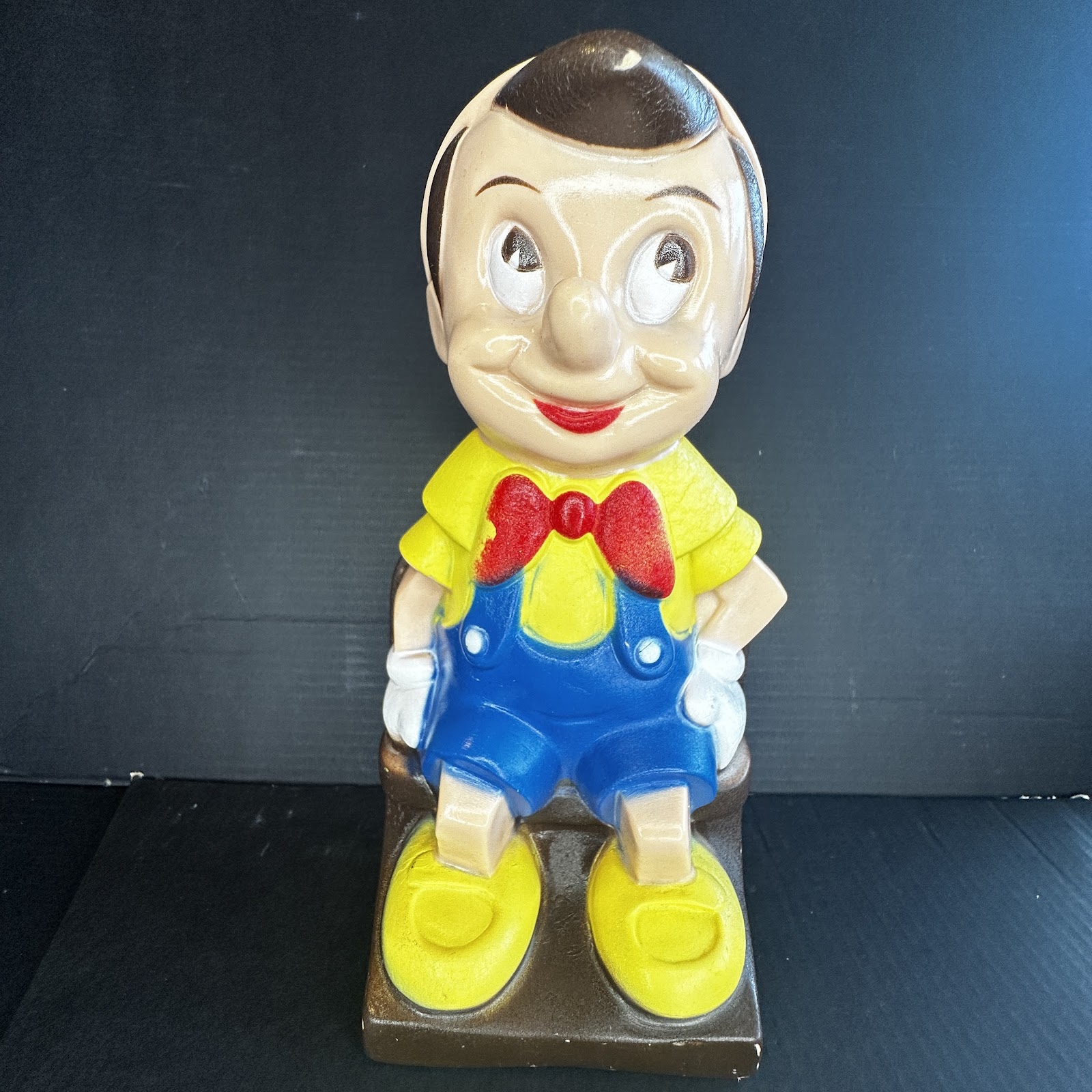
A Little Wooden Boy Frozen in Time
There is something immediately disarming about this ceramic chalkware figure of Pinocchio perched on his little brown bench. Eyes tilted hopefully upward, a wide red bow tie knotted at his neck, yellow shirt tucked into blue overalls fastened with bright white buttons — he looks every inch the earnest, dreaming boy who wished upon a star and got more than he bargained for. Standing between eight and twelve inches tall, he carries the oversized, round-headed proportions that defined mid-century Disney nursery giftware: a style meant to be simultaneously endearing and indestructible enough for a child's bedroom shelf.
This piece comes to us from a larger Disney estate collection — one of those remarkable accumulations built quietly over decades by a devoted fan who understood that the everyday objects of an era carry its spirit just as faithfully as any gallery piece. It arrived exactly as you would hope: a little worn, a little loved, entirely itself.
Pinocchio and the Golden Age of Disney Licensing
Walt Disney's Pinocchio, released in 1940, is widely regarded as a pinnacle of the studio's hand-drawn artistry. Based on Carlo Collodi's 1883 Italian novel, the film introduced audiences to Geppetto's wooden puppet, the cricket named Jiminy, the whale Monstro, and the irresistible lure of Pleasure Island. The film's visual richness — the warm lamplight of Geppetto's workshop, the cold blue dark of the ocean — set a standard that animators still reference today.
By the late 1960s and into the 1970s, Disney's licensing machine was in full stride. The studio's characters had migrated from the cinema into every corner of American domestic life: lunchboxes, bedsheets, lamp bases, and — emphatically — the nursery figurine. Ceramic and chalkware statuary occupied a sweet spot in this market. Inexpensive enough to be gifted at a baby shower, substantial enough to feel like a keepsake, these pieces were produced in enormous quantities by licensed giftware manufacturers and distributed through department stores, gift shops, and Disney park retail channels. The vast majority have not survived intact, which makes well-preserved examples genuinely scarce today.
Reading the Object: Material, Style, and Condition
Chalkware — a catch-all term for plaster-of-Paris and similar cast compositions — was the workhorse material of mid-century decorative figurines. Its slightly matte, chalky surface absorbs paint beautifully, and skilled decorators could achieve the rosy cheeks, crisp white gloves, and clean color blocking that Disney's style guides demanded. The hand-painted finish on this Pinocchio is still vivid: the yellow of his shirt, the deep cobalt of his overalls, the theatrical red of that bow tie all read clearly across the room.
As with virtually every chalkware piece of this vintage, time has left its honest marks. There is minor paint loss and chipping at the base, small scuff marks along the hair and the famously elongated nose, visible seam lines where the mold halves were joined, and slight discoloration in the deeper crevices. None of this is unusual or alarming — it is, in fact, the expected biography of a piece that spent decades in a real home. Collectors of mid-century Disney giftware understand that honest wear is not damage; it is authentication.
The seated pose — Pinocchio on his bench, hands resting, gaze aimed at something just above the horizon — is a quietly poetic choice. It captures the film's central tension: a puppet who is not yet a boy, waiting, hoping, believing. It is a mood, not just a likeness.
Why Collectors Seek Mid-Century Disney Chalkware
There is a growing and passionate community of collectors focused specifically on pre-1980 Disney giftware, and chalkware figurines occupy a prized tier within that world. Several forces drive demand. First, attrition: chalkware chips, cracks, and crumbles far more readily than ceramic, meaning fewer examples survive in displayable condition. Second, design quality: the proportions and color palettes of late-1960s and 1970s Disney licensed goods were tightly controlled against studio style guides, resulting in a fidelity to the animated originals that later mass-market production sometimes lost. Third, nostalgia: for collectors who grew up in the 1970s, these objects carry a specific emotional frequency — the weight of a gift from a grandparent, the memory of a particular bedroom shelf.
Pinocchio as a subject adds a further layer of appeal. He is one of Disney's most cinematically ambitious characters, and his figurine variants from this era are less common than those of perennial favorites like Mickey, Donald, or Cinderella. A seated Pinocchio with this level of painted detail and overall presence is not something that turns up every weekend at the antique mall.
Whether you are assembling a focused collection of Disney chalkware, decorating a mid-century inspired space, or simply looking for the kind of object that rewards a second and third look, this little wooden boy on his bench delivers something rare: genuine character, honestly earned.
Thinking of selling? Get a free, no-obligation offer.
One direct offer on your entire Disney collection — no commission, no auction wait. We help arrange the shipping.