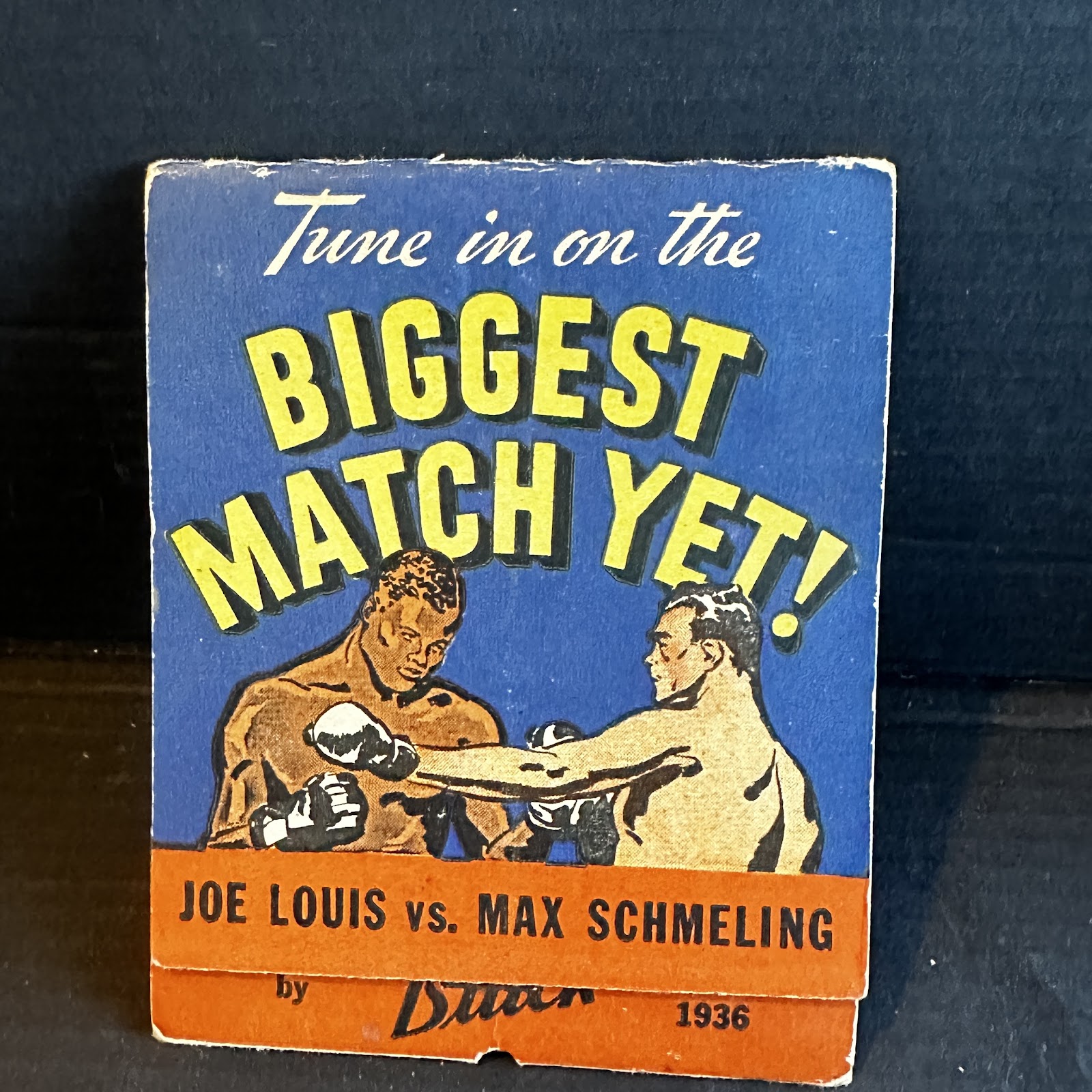
A Tiny Piece of the Biggest Fight of the Decade
Some collectibles are grand — wall-sized, framed, obviously precious. And then there are the small ones, the accidentally precious ones: a folded scrap of cardboard the size of a business card that somehow survived ninety years of purses, coat pockets, kitchen drawers, and estate sales. This matchbook cover is exactly that kind of treasure. Printed to commemorate — or perhaps to capitalize on — the electrifying 1936 heavyweight boxing match between Joe Louis and Max Schmeling, it measures a modest roughly 1.5 inches by 4.25 inches unfolded, yet carries the weight of one of the most culturally loaded sporting events of the entire twentieth century.
The Fight That Stopped the World
On the night of June 19, 1936, at Yankee Stadium in New York City, Joe Louis — the 22-year-old Brown Bomber who had demolished every opponent in his path — stepped into the ring as the heavy favorite against the German challenger Max Schmeling. What followed shocked the boxing world: Schmeling had studied Louis carefully, identified a technical flaw in his guard, and exploited it with ruthless precision over twelve rounds, eventually stopping the young American in what became one of the biggest upsets of the era. The loss was a national gut-punch. Louis had been riding a wave of public adulation, widely seen as a symbol of Black American achievement at a time when the country was still deeply divided by race and still reeling from the Great Depression.
The rematch two years later, in 1938, would write a different ending — Louis knocked Schmeling down three times in the first round in a fight that lasted barely two minutes, a bout that carried enormous political symbolism as Nazi Germany's ideology loomed larger over Europe. But it is the 1936 fight, the upset, the shock, that collectors feel most acutely when they hold an artifact from that night. This matchbook cover dates from that first encounter — a piece of printed ephemera from the moment before the myth was fully assembled, when the outcome was still raw and unresolved.
The Quiet Art of Matchbook Ephemera
Matchbook covers occupy a wonderful and underappreciated corner of Americana collecting. From the 1920s through the 1960s, matchbooks were everywhere — on restaurant tables, in hotel lobbies, tucked into jacket pockets as advertising give-aways. Businesses, events, promoters, and venues printed them by the millions, and yet almost none of them survived. They were used, discarded, rained on, lost. The ones that made it to the present in any kind of shape did so mostly by accident — pressed into a scrapbook, tucked inside a book, forgotten in a box that nobody opened for decades.
Collectors prize boxing-related matchbook covers in particular because the sport generated enormous promotional energy during the Golden Age of American boxing. Fight nights were events — civic spectacles that filled stadiums and drew radio audiences of millions. The ephemera produced around major bouts, from programs and ticket stubs to matchbooks and posters, represents the visual culture of a sporting world that no longer exists in quite the same form. A matchbook from the Louis-Schmeling fight is not just a paper curiosity; it is a tactile link to a specific Friday night when the country held its breath.
This particular cover measures approximately 1.5 inches by 4.25 inches when unfolded — the classic standard matchbook proportion that fits neatly in a palm or a shirt pocket. As with all vintage paper ephemera of this age, condition character is part of the story: the gentle patina of nearly nine decades gives the piece an authenticity that no reproduction can replicate.
Estate Collection Find
This matchbook cover surfaced as part of a larger estate collection we acquired — one of those wonderful, sprawling accumulations built by someone who understood that the small things matter as much as the large ones. Not every piece in a lifetime collection fits neatly into a single category, and this one is a perfect example: a sports artifact, a piece of American social history, a survivor. It found its way to us alongside other memorabilia from the mid-twentieth century, and it deserves to find its way to a collector who appreciates what it represents.
Whether you collect boxing history, pre-war American ephemera, or simply the kind of small objects that carry enormous stories, this matchbook cover is a genuinely rare find. Items this specific, this old, and this intact don't surface often. The 1936 Louis-Schmeling fight is permanently embedded in American cultural memory — and this tiny piece of cardboard was there.
Thinking of selling? Get a free, no-obligation offer.
One direct offer on your entire Disney collection — no commission, no auction wait. We help arrange the shipping.