A Night That Stopped the World
On the evening of June 18, 1936, roughly 60,000 people packed Yankee Stadium in the Bronx while millions more pressed their ears to radio sets across America and Europe. The bout between twenty-two-year-old Joe Louis — the "Brown Bomber" already being talked about as the next great heavyweight — and Germany's Max Schmeling was billed as a straightforward stepping-stone for Louis on his path to the world title. What followed was one of the most shocking upsets in boxing history, and one of the most politically charged sporting events of the pre-war era. Schmeling, dismissed by many American sportswriters, had quietly studied film of Louis's fights and spotted a technical vulnerability. In the fourth round he exploited it with devastating right hands, eventually stopping Louis in the twelfth. The world had never seen Louis knocked down before. By the final bell, the broadcast crackled with stunned silence before the crowd's noise rushed back in.
The Voice on the Air — and the Sponsor Behind It
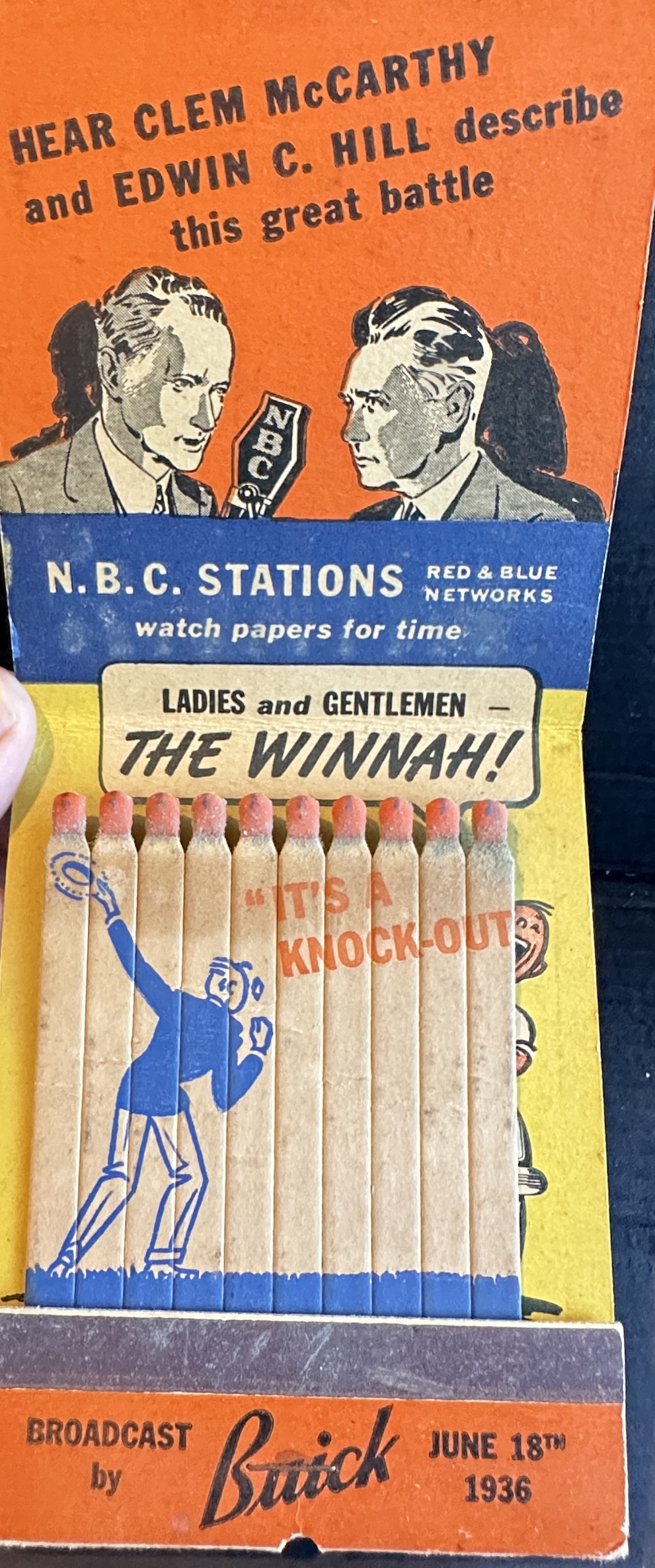
NBC carried the fight to the nation, with the legendary Clem McCarthy calling the action in his crackling, breathless style. McCarthy was the pre-eminent sports voice of his era — the man whose blow-by-blow delivery of heavyweight championship fights made radio feel like a ringside seat. Alongside him was commentator Edwin C. Hill, a prominent broadcaster and journalist of the period whose authoritative delivery added gravitas to major network events. The broadcast was sponsored by Buick, then as now a flagship brand of General Motors, which used major live sports and entertainment programming to reach the rapidly expanding American radio audience. In the mid-1930s, a Buick sponsorship of a nationally broadcast heavyweight title fight was top-tier advertising — the equivalent of a Super Bowl commercial placement today.
To mark the occasion and keep the Buick name in listeners' hands — literally — the company distributed promotional matchbooks tied to the broadcast. This is one of those matchbooks.
The Matchbook Itself
This small artifact measures approximately 4.5 inches high by 1.5 inches wide when unfolded, a standard matchbook form of the era. What makes it exceptional for its age is the survival of a full comb of ten unused matches — the vast majority of matchbooks from this period were, by definition, used and discarded. Finding one with its matches intact is a genuine rarity. The covers carry period graphics and branding linking the Buick/NBC sponsorship to the June 18, 1936 event date. Minor surface oxidation is present, consistent with nearly ninety years of age, but it does not compromise the legibility of the design or the integrity of the matches themselves. This is not a restored or altered piece — it is simply a survivor.
Why Collectors Seek These Out
Ephemera from this fight occupies a fascinating intersection of three distinct collecting worlds: vintage boxing memorabilia, early American radio history, and Depression-era advertising and promotional graphics. The Louis-Schmeling rivalry was one of the defining sports narratives of the 1930s — their 1938 rematch, in which Louis knocked Schmeling down three times in the first round, became one of the most symbolically loaded moments of the pre-war decade, widely understood as America versus Nazi Germany playing out under the lights of a boxing ring. Any artifact tied to either fight carries that historical weight.
Matchbooks as a collecting category have a devoted following. Phillumenists — the formal name for matchbook and matchbox collectors — prize promotional pieces from major cultural events precisely because so few survive. A matchbook handed out at a gas station or bar was ephemeral by design; one tied to a specific nationally broadcast sporting event, with a clear date and named sponsors, is the kind of piece that contextualizes an entire era. Add the survival of the full match comb and you have something that most serious collectors in this space would not pass up.
This piece arrived as part of a larger estate collection — the kind of accumulation that a certain generation of Americans built over decades, tucking away small objects that felt significant at the time and never quite letting them go. Whoever held onto this matchbook across nine decades understood, on some level, that the night of June 18, 1936 was worth remembering. They were right.
Thinking of selling? Get a free, no-obligation offer.
One direct offer on your entire Disney collection — no commission, no auction wait. We help arrange the shipping.