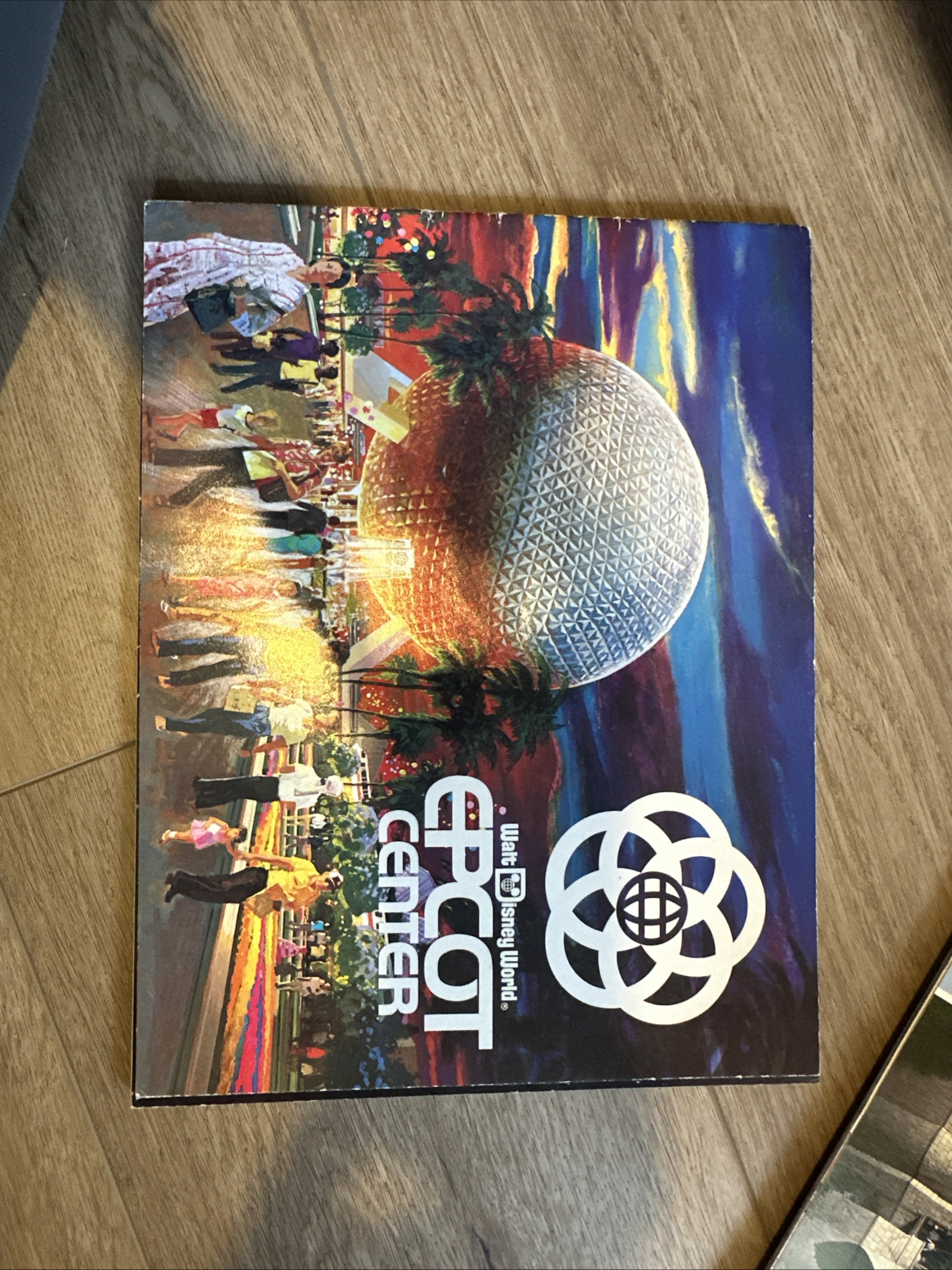
A Portal to Tomorrow, Preserved in Print
Long before EPCOT became the beloved destination of festivals, international pavilions, and cult-classic rides, it opened its gates on October 1, 1982, as something the world had never quite seen: a permanent World's Fair, a living laboratory for optimism about the human future. This large-format souvenir program — measuring a generous 10 by 12 inches — is a direct artifact of that extraordinary opening era, produced under the original Walt Disney Productions / Walt Disney World banner and carrying the distinctive five-ring logo that defined EPCOT Center's early visual identity.
The cover image alone stops a collector in their tracks: Spaceship Earth rendered at sunset, the geodesic sphere glowing against a warm sky in the conceptual-artwork style that characterized Disney's promotional materials of the period. This was not photography; it was vision. Disney's artists used illustration and graphic design to communicate what EPCOT stood for — a gleaming promise rendered in ink and color, populated by stylized park guests who look as though they've stepped out of a brochure for the 21st century.
What "EPCOT Center" Actually Meant
Walt Disney himself conceived EPCOT — the Experimental Prototype Community of Tomorrow — as a functioning city, a place where people would actually live and work under a climate-controlled dome. After his death in 1966, the concept evolved dramatically, but the spirit of bold, forward-thinking ambition survived into the park that finally opened sixteen years later.
The original EPCOT Center branding represented in this program is historically significant precisely because it captures that transitional moment: a park still defined by corporate-sponsored pavilions in Future World (Exxon, United Technologies, Kraft, General Motors) and a World Showcase that had not yet reached its full roster of nations. The five-ring logo, the sans-serif lettering, the confident modernist aesthetic — these are visual codes that Disney fans and design historians recognize immediately as belonging to a very specific, unrepeatable window in time.
By the late 1980s and into the 1990s, the park's identity began to shift. By 1994, the name had been formally shortened to simply "Epcot." Items bearing the original full name and the original logo became, almost overnight, documents of a first chapter rather than a current one.
The Collector's Case: Why Opening-Era Ephemera Endures
Souvenir programs occupy a special niche in Disney collecting. Unlike pins, plush, or figurines, a program is fundamentally a record of intent — the park's official self-description at a given moment in time, curated and printed for guests who wanted to take the experience home. Opening-era programs carry the added weight of historical singularity: they were produced before anyone knew how beloved or how long-lived the park would become.
The large format of this piece — an oversized book rather than a standard pamphlet — signals that it was designed to impress. Disney's Imagineers and marketing teams understood that EPCOT Center was unlike anything in the existing Disney portfolio, and the souvenir materials needed to communicate that gravity. The conceptual artwork style, rather than candid guest photography, keeps the program feeling visionary rather than merely documentary.
This example presents with light edge wear and corner whitening, the honest hallmarks of a piece that has been handled, enjoyed, and kept — not sealed away in a vault. The colors, notably, remain vibrant. The warm sunset tones on that iconic Spaceship Earth image have not faded into the gray-beige that plagues lesser-preserved paper ephemera from the same decade. What you see is essentially the object as a 1982 guest would have seen it, with only the gentlest patina of the intervening decades.
From an Estate Collection to Your Hands
This program came to us as part of a larger Disney estate collection — one of those remarkable assemblages built over years by someone who understood that the parks were not just destinations but cultural events worth documenting. Estate collections like this one are where the most grounded, authentic pieces surface: items bought at the time for love rather than speculation, stored in homes rather than climate-controlled facilities, and carrying with them the quiet evidence of a life spent paying attention to Disney history as it happened.
For the EPCOT collector specifically, the opening years represent a holy grail of sorts. The park has been reimagined, renovated, and rebranded multiple times since 1982 — some changes celebrated, others mourned. But no renovation can reach backward and alter what was printed and distributed in those first seasons. This program is one of the cleaner surviving examples of that era's print culture, and it belongs in a collection that takes the full arc of EPCOT's history seriously.
Whether you display it open to a favorite spread, frame the cover alongside other opening-day memorabilia, or simply keep it flat and protected as a reference piece, this souvenir program is a genuine time capsule — EPCOT Center as Walt's successors dreamed it, before the world had a chance to weigh in.
Thinking of selling? Get a free, no-obligation offer.
One direct offer on your entire Disney collection — no commission, no auction wait. We help arrange the shipping.