A Ticket to Disneyland That Fits in Your Hands
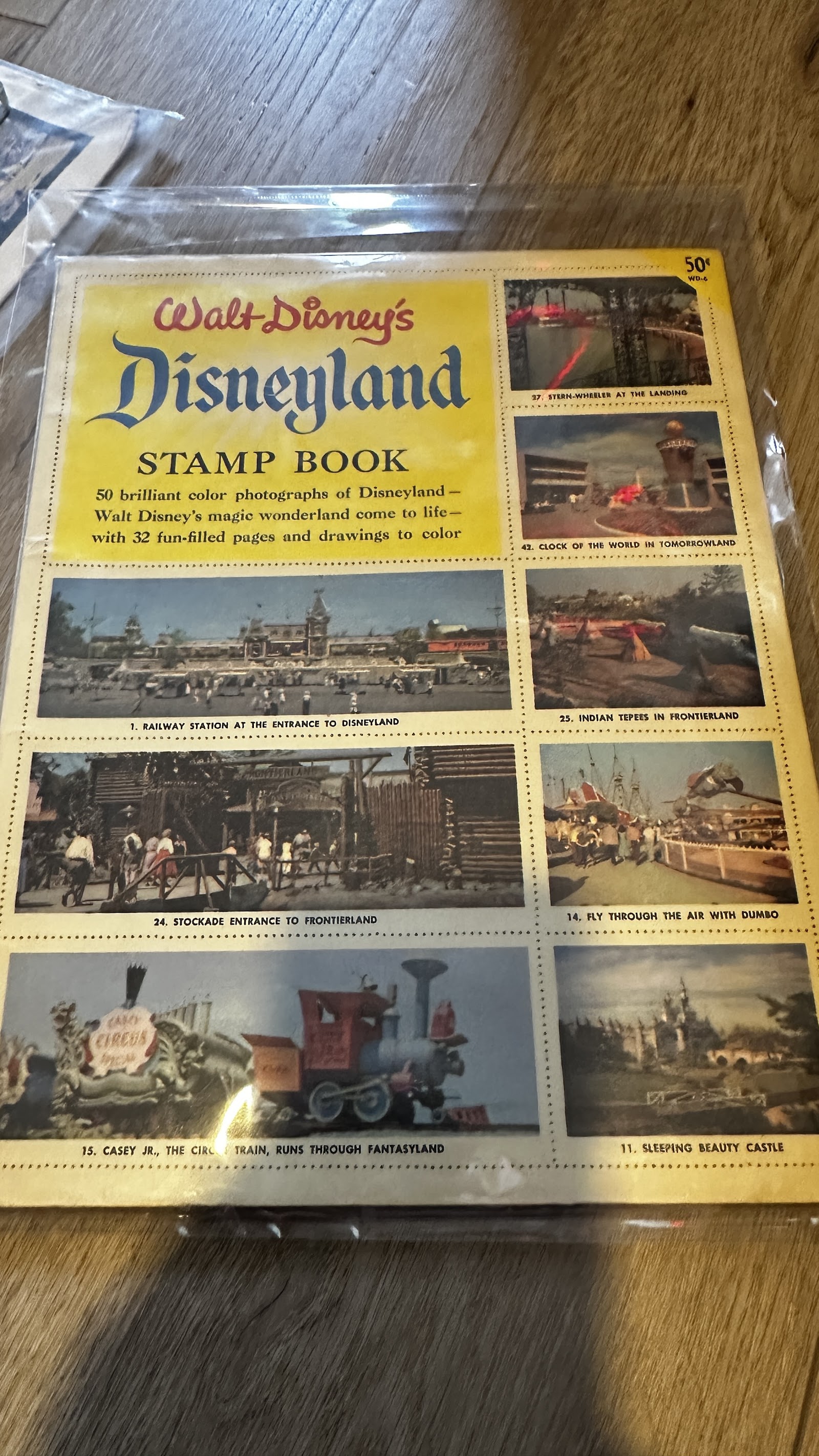
Before the internet, before home video, and long before anyone could pull up a theme park walkthrough on a smartphone, the only way most American families could relive a trip to Disneyland was through a souvenir. Not just any souvenir — something that opened up, something you could hold, something that put the magic back on your kitchen table on a gray Tuesday in November. This oversized stamp book, published by Walt Disney Productions in association with Western Printing and measuring a generous 11 by 8.5 inches, was exactly that kind of object. It is a time capsule of the park's earliest golden era, wrapped in a cheerful yellow cover and brimming with the optimism that defined the Eisenhower age.
The Era This Book Captures
Disneyland opened on July 17, 1955, and the years immediately following were a period of breathless expansion and cultural electricity. Walt Disney himself was deeply involved in every corner of the park, and the attractions that opened through the late 1950s and into the early 1960s reflected his conviction that a theme park could be genuinely educational as well as endlessly entertaining. This stamp book, dated to approximately 1957–1962, sits squarely in that sweet spot. Its 32 pages feature coloring drawings alongside a grid of seven full-color photo "stamps" set against a bright yellow background — a format that was simultaneously an activity book for children and a photographic record for adults.
Among the characters and attractions featured are Dumbo and Casey Jr. — two beloved figures from the 1941 animated feature Dumbo that translated seamlessly into Fantasyland rides at the park. The Dumbo the Flying Elephant attraction, with its spinning pachyderms lifting riders skyward, became one of the most iconic and photographed sights in the park almost immediately after opening. Casey Jr. Circus Train, which winds through the miniature storybook landscape of Storybook Land, carried on the circus-train spirit of the film. Both appear here as they existed in the park's earliest form, before decades of refurbishment changed their details.
Perhaps most historically significant is the book's inclusion of the Clock of the World — an attraction that no longer exists. This timepiece, located near the park entrance in the early years, displayed the current time in cities and regions around the globe. It was a relic of the Tomorrowland-style fascination with world geography and international connectivity that Walt championed throughout the 1950s. Its presence in this stamp book is a quiet reminder of how much the park has changed, and how much ephemera like this serves as the primary visual record of what once was.
Western Printing and the Art of the Souvenir Book
Western Printing and Lithographing Company — later known as Western Publishing — was one of the most prolific producers of Disney-licensed print materials throughout the mid-twentieth century. Their partnership with Walt Disney Productions yielded thousands of titles including Little Golden Books, Big Golden Books, coloring books, activity sets, and precisely this kind of souvenir stamp book. The quality of their color reproduction was considered excellent for the period, and their distribution reach ensured that Disney materials showed up in drug stores, variety shops, and gift counters across the country.
The original cover price of fifty cents (noted as "WD-6" in the publisher's code) situates this book firmly in the era of affordable family entertainment — a deliberate philosophy on Walt's part. Souvenirs from early Disneyland were priced to be accessible, to let a family bring something real home from the experience. Today, that fifty-cent price tag reads as a kind of poetry.
What Makes This a Collector's Piece
For Disney collectors, ephemera from the 1957–1962 window carries particular weight. These are the years before the park became a cultural institution so massive that its merchandise became globally standardized. Items from this window reflect a more handmade, locally-inflected approach to Disney licensing — designs that were produced in smaller quantities, distributed regionally, and used by actual families until they were worn out or lost. Survivors in readable condition are genuinely uncommon.
The stamp book format itself adds another layer of collector interest. The color photo "stamps" on the cover — each a small window into Disneyland as it appeared decades ago — make this as much a historical document as a piece of memorabilia. The coloring pages inside, whether filled in or blank, tell their own story about the child who once held this book. This particular example comes from a larger Disney estate collection, the kind of carefully kept accumulation that preserves objects across generations precisely because someone understood, even then, that these things mattered.
Whether displayed open to its color stamp grid, tucked into a collection of Fantasyland ephemera, or shelved alongside other Western Publishing Disney titles, this stamp book earns its place. It is, in the most literal sense, a piece of the original park — rendered in ink and color on paper, priced at fifty cents, and built to last.
Thinking of selling? Get a free, no-obligation offer.
One direct offer on your entire Disney collection — no commission, no auction wait. We help arrange the shipping.