A Window Into the Golden Age of the Mickey Mouse Club
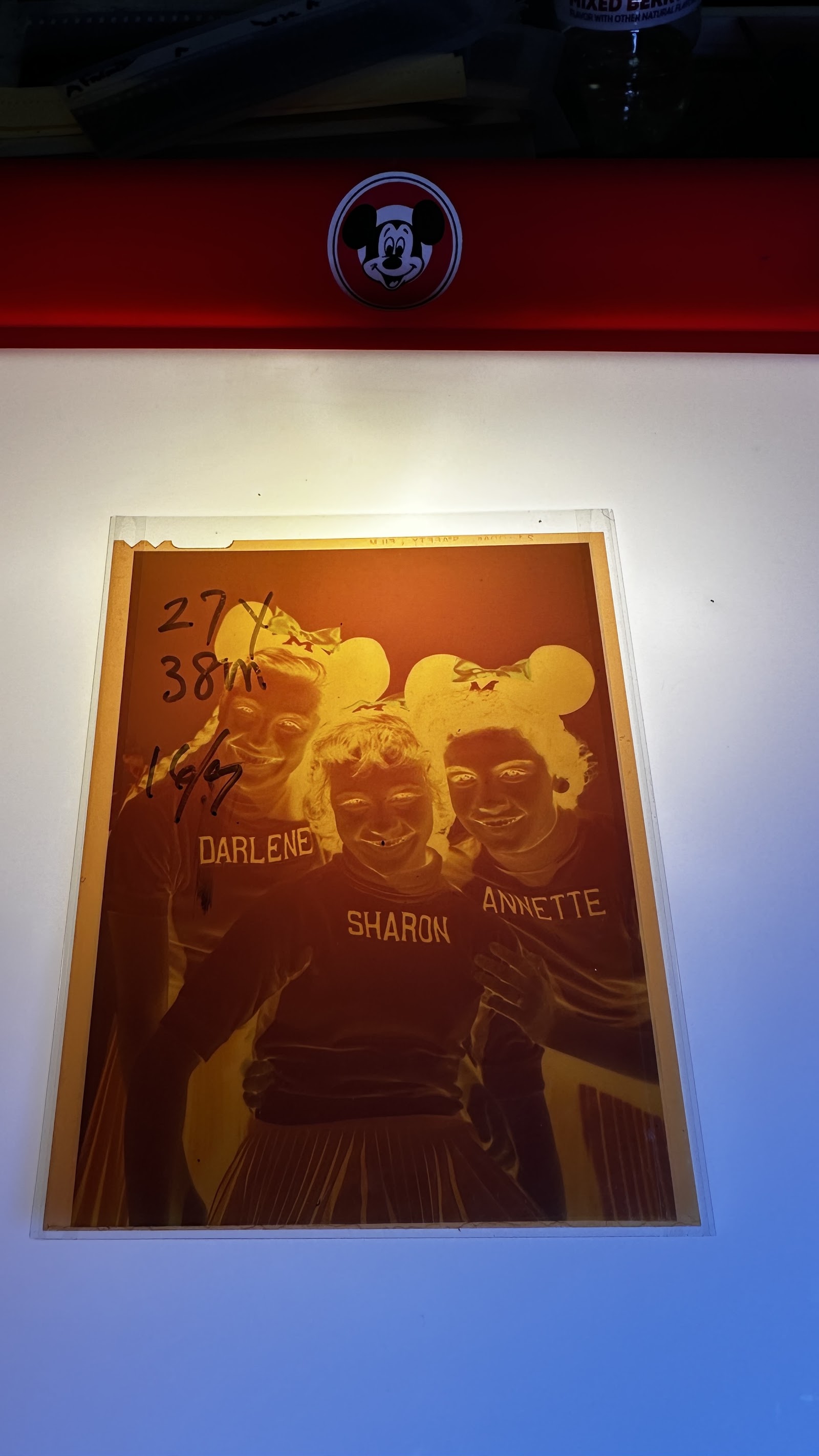
Few artifacts from mid-century American television carry the immediacy of a large-format production negative. This extraordinary piece — an approximately 8x10-inch acetate negative — places you directly inside the production workflow of Walt Disney's landmark children's program, The Mickey Mouse Club, at the height of its cultural moment. The image captures three of the show's most beloved original Mouseketeers: Darlene Gillespie, Sharon Baird, and Annette Funicello, each wearing the personalized sweater and iconic mouse-ear hat that became the visual shorthand of an entire generation's childhood.
This negative arrived as part of a large Disney estate collection, and it stands out immediately — not just for its subject matter, but for what it physically is: a working document from inside the studio, complete with the handwritten grease-pencil crop markings, production annotations, and the visible code "TV 12785" that once directed a printer or photo editor in a busy production office. These are objects that were never meant to leave the building.
The Mouseketeers and the Show That Defined a Generation
The Mickey Mouse Club debuted on ABC on October 3, 1955, airing weekday afternoons and instantly becoming appointment television for American children. Walt Disney himself oversaw its development, and the format — mixing cartoons, serials, talent showcases, and newsreels under the hosting of the young Mouseketeers — was genuinely novel for its era. The show ran in its original form through 1959, producing hundreds of episodes and launching the careers of performers whose names would become household words.
Of the original cast, Annette Funicello emerged as the most recognizable face of the program. Her warmth, natural charisma, and singing voice made her a favorite not only with child viewers but with their parents, and Walt Disney himself took a personal interest in her career, signing her to a long-term personal contract. She would go on to star in the wildly popular Beach Party film series of the 1960s and remained a beloved public figure for decades. Darlene Gillespie was considered one of the most talented vocalists on the show, releasing records on the Disneyland Records label and consistently drawing fan mail rivaling Annette's. Sharon Baird, one of the smallest Mouseketeers, was an acrobatically gifted performer whose energy and precision made her a standout in the troupe's dance and physical comedy segments. Together in a single frame, these three represent the heart of what made the program special.
What Makes This Negative Remarkable as a Collectible
The large-format photographic negative occupies a peculiar and thrilling position in Disney memorabilia collecting. Unlike a publicity still, a lobby card, or even a signed photograph, a production negative is an upstream object — it predates every print that would ever be made from it. The image here is rendered in negative tones: highlights appear dark, shadows appear light, and the familiar faces of the three Mouseketeers take on an almost luminous, otherworldly quality that print photographs simply cannot replicate.
The handwritten annotations are, in their own way, as interesting as the image itself. Notations reading "27Y, 38m, 19 3/4" in the upper left quadrant are consistent with the kind of cropping and printing instructions a photo editor or production coordinator would have applied before sending negatives to a lab or the studio's print department. The grease-pencil markings on the emulsion side carry the literal fingerprints — figuratively speaking — of someone who handled this image professionally in a Disney production environment more than sixty years ago. These marks are not damage; they are provenance.
Edge wear and slight discoloration are present, as is entirely expected and appropriate for acetate film of this age. The image itself, however, remains sharp — a critical factor for a piece whose visual impact depends entirely on the clarity of its subjects. The three Mouseketeers are unmistakably themselves: sweaters personalized with their names, ears in place, the whole mythology of the Club present in a single frame.
From the Estate Collection to Your Hands
This negative comes to us from a substantial Disney estate collection that encompassed decades of material spanning the studio's most creative and commercially explosive periods. Large-format production negatives from the original Mickey Mouse Club run are genuinely uncommon on the open market — the studio retained tight control over its production materials, and most that have surfaced over the years did so in small numbers through estate dispersals exactly like this one.
For collectors focused on the original Mouseketeers, on mid-century Disney television history, or on the broader story of postwar American popular culture, this negative is a primary source document dressed up in extraordinary visual clothing. It is the kind of object that stops people in their tracks: not a reproduction, not a licensed product, not a mass-market collectible — but a thing that was there, held by real hands, in a real Disney production facility, during the years when Mickey Mouse's ears were the most recognized symbol in American children's entertainment.
Whether displayed in archival framing that highlights its negative-image strangeness, or preserved flat in acid-free sleeves as part of a serious collection, this piece rewards careful attention. It is, in the truest sense, irreplaceable.
Thinking of selling? Get a free, no-obligation offer.
One direct offer on your entire Disney collection — no commission, no auction wait. We help arrange the shipping.