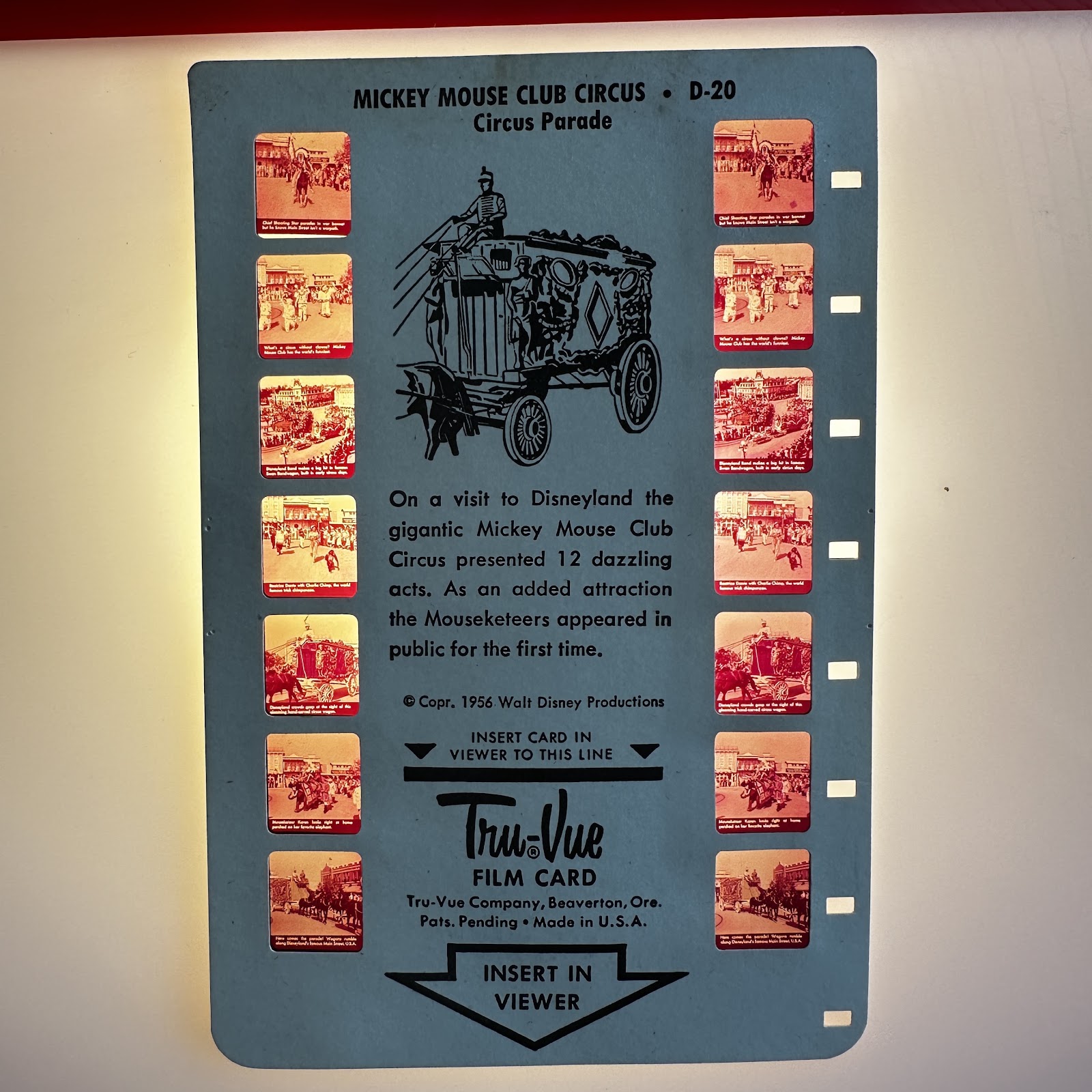
A Window Into the Magic: What This Card Is
Long before home video, before VHS, before streaming, there was Tru-Vue — and for a brief, enchanting window in the 1950s, it was one of the most vivid ways a child could bring Disney magic into their own hands. This Mickey Mouse Club Circus film card, catalogued as D-20, is a genuine artifact of that era: a 5.5" × 3.25" strip of cardstock housing a series of miniature film transparencies, designed to be slid into a handheld Tru-Vue viewer and held up to the light. The result was a sequence of small but breathtaking three-dimensional scenes — a private little theater you could hold between your fingers.
Manufactured by the Tru-Vue Company out of Beaverton, Oregon, this card carries a Walt Disney Productions copyright and documents the Mickey Mouse Club Circus as it came to life at Disneyland. The cardstock is firm, the film transparencies retain their clarity, and the overall condition grades out at Excellent to Near Mint — remarkable for something that passed through countless small hands over seven decades ago.
The Tru-Vue Company and the Art of the Film Card
The Tru-Vue Company carved out a fascinating niche in the American toy and novelty market by marrying the stereoscopic viewing craze of the Victorian era with modern photographic film technology. Their film cards — thin strips of sequential images printed on transparent film and mounted in a cardstock sleeve — were sold alongside dedicated handheld viewers that used a simple lens-and-light system to render each frame in convincing three-dimensional depth. The format predates the more familiar View-Master reel by only a few years, and the two competed directly for shelf space at dime stores and toy counters across the country.
What set Tru-Vue apart, at least in its Disney-licensed titles, was an emphasis on documentary and attraction-based content. Rather than purely animated characters posed on a plain background, cards like D-20 captured real scenes — actual Disneyland circus performances, costumed characters, and the physical spectacle of the park in its earliest years. This gives the format a dual identity: part toy, part historical record.
Mickey Mouse Club and the Disneyland Circus
The Mickey Mouse Club television program launched on ABC in the fall of 1955, the same year Disneyland opened its gates in Anaheim, California. The two properties fed each other in a way that was entirely deliberate: the park and the show shared characters, performers, and a marketing synergy that Walt Disney himself orchestrated with careful precision. The Mouseketeers became household names almost overnight, and Disneyland's opening-era attractions drew directly on the same youthful energy the TV show projected every weekday afternoon.
The Mickey Mouse Club Circus was among the first special events staged at Disneyland, a live circus spectacle that transformed the park into something even more theatrical than its usual self. It was a short-lived but memorable chapter in Disneyland history — which makes visual records of it, like this Tru-Vue film card, all the more significant. This is not generic character merchandise. It is a specific document of a specific moment: the Disneyland of 1955 and 1956, still new, still finding its footing, already electrifying.
Why Collectors Prize This Piece
Tru-Vue Disney cards from the 1950s occupy a sweet spot in the collector market that rewards patience and knowledge. They are old enough to be genuinely scarce, specific enough to be historically meaningful, and small enough to have been routinely lost, discarded, or damaged over the decades. Finding one in Excellent to Near Mint condition — with intact transparencies, crisp cardstock, and no significant fading or delamination — requires real luck or careful curation.
This particular card, D-20, surfaced as part of a larger Disney estate collection, the kind of assemblage that only comes together over a lifetime of deliberate collecting. Estate pieces carry their own provenance in the broadest sense: they speak to someone who understood the value of preservation, who kept a Tru-Vue card in a sleeve rather than a junk drawer. The condition here reflects that care. The cardstock shows its age gracefully, the film transparencies are legible and dimensionally intact, and the overall presentation is the kind that makes a veteran collector lean in for a closer look.
For anyone building a serious collection around early Disneyland history, the Mickey Mouse Club era, or the history of Disney-licensed optical toys, card D-20 is a precise and irreplaceable addition. It is not a reproduction, not a reissue, not a licensed facsimile. It is the thing itself — a small, luminous rectangle of the 1950s that still does exactly what it was made to do.
Thinking of selling? Get a free, no-obligation offer.
One direct offer on your entire Disney collection — no commission, no auction wait. We help arrange the shipping.