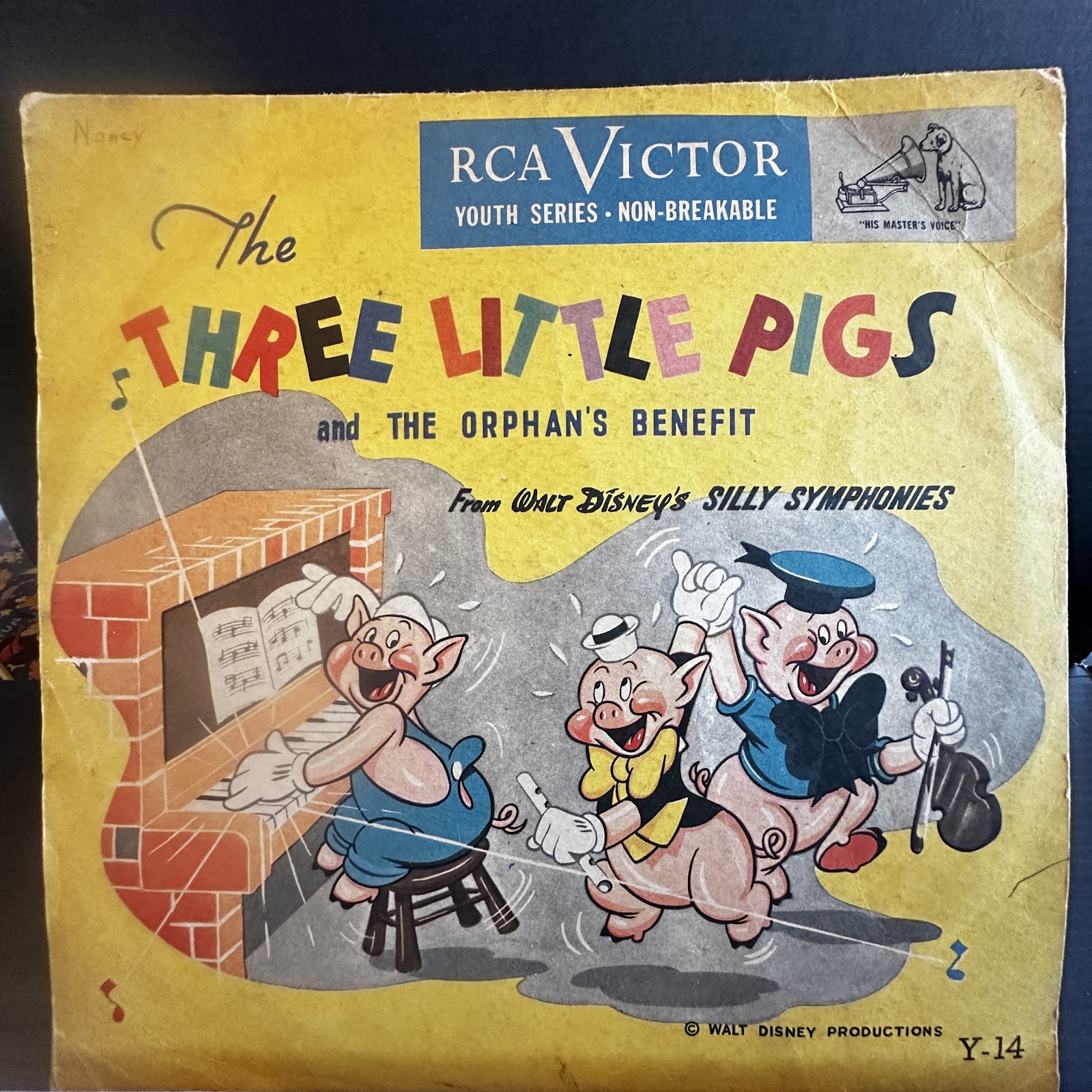
A Window Into Disney's Golden Age of Sound
Long before theme parks, merchandise empires, and streaming libraries, Walt Disney made his boldest statement with sound. The Silly Symphonies series — launched in 1929 as a creative playground built around music and motion — gave audiences something they had never experienced: animated cartoons designed from the ground up to live inside a musical score. This vintage record sleeve, featuring two of the most celebrated Silly Symphonies shorts ever produced, is a tangible artifact from that extraordinary era. Measuring approximately seven to ten inches square, it is a modest object that carries an outsized piece of animation history.
Two Landmarks of Early Disney Storytelling
The two titles represented on this sleeve are anything but ordinary. Three Little Pigs, released in May 1933, was a cultural phenomenon by any measure — a Silly Symphony short that transcended the format and became a genuine social event. Its central song, "Who's Afraid of the Big Bad Wolf?", took on an almost anthemic quality during the depths of the Great Depression, with audiences hearing in the plucky pigs a message of resilience and cheer. The short won the Academy Award for Best Animated Short Film and is widely credited with proving that animated characters could carry real emotional weight. Disney himself cited it as a turning point in how the studio thought about character development.
Orphan's Benefit, first released in 1934, holds its own special place in Disney lore as one of the earliest theatrical shorts to feature the full gang: Mickey Mouse, Donald Duck (in one of his very first appearances), Goofy, Clarabelle Cow, and Horace Horsecollar. The premise — Mickey organizing a benefit show for orphans, only for Donald's attempts at recitation to be hilariously derailed — gave the Studio a framework to showcase its ensemble. The 1941 color remake would update the visuals, but the 1934 original remains the classic. A sleeve pairing these two titles captures a remarkable convergence of early Disney stars.
The Silly Symphonies Record Tradition
Disney's relationship with the recording industry in its early decades was an extension of the Studio's belief that music was inseparable from its films. Record releases tied to Silly Symphonies shorts reached children and families who might only see the films once in a theater — recordings and sleeves like this one were how the magic came home. The Silly Symphonies series name itself carried enormous brand recognition by the mid-1930s, and publishers and licensees leaned into that recognition on every piece of related merchandise and media. A record sleeve was not merely packaging; it was a miniature poster, a piece of graphic design crafted to evoke the warmth and color of the films in a flat, printed format.
Pre-1968 Disney paper goods occupy a particularly cherished corner of the collector market precisely because so few examples survived in presentable condition. Paper is fragile by nature, and items meant for children — records played again and again, sleeves handled by small hands — faced especially hard odds. This sleeve shows the honest wear of its decades, a condition that collectors often describe as fragile with an understanding that fragility in vintage paper is not a flaw but a testament to a life actually lived alongside the families who loved it.
From an Estate Collection to Your Shelf
This sleeve arrives as part of a larger Disney estate collection — a group of records and related paper items that were kept together for generations. Estate pieces like this carry a particular resonance: they were not stored in archive sleeves or managed as investments. They were simply kept, passed along, rediscovered. That chain of custody, however informal, is part of what makes them feel alive in a way that mint-condition warehouse finds sometimes do not.
For collectors building out a Silly Symphonies run, a Golden Age paper goods display, or a focused Three Little Pigs or early Mickey Mouse ensemble, this sleeve is a meaningful addition. It represents not just two films but a moment — roughly 1933 to the mid-1930s — when Disney animation was rewriting what the medium could do, and when Americans were hungry for exactly the kind of warmth and wit these cartoons delivered. Display it alongside companion records, frame it as graphic art, or let it anchor a shelf dedicated to the Studio's first great decade. Whatever the context, it speaks clearly of where it comes from.
Thinking of selling? Get a free, no-obligation offer.
One direct offer on your entire Disney collection — no commission, no auction wait. We help arrange the shipping.