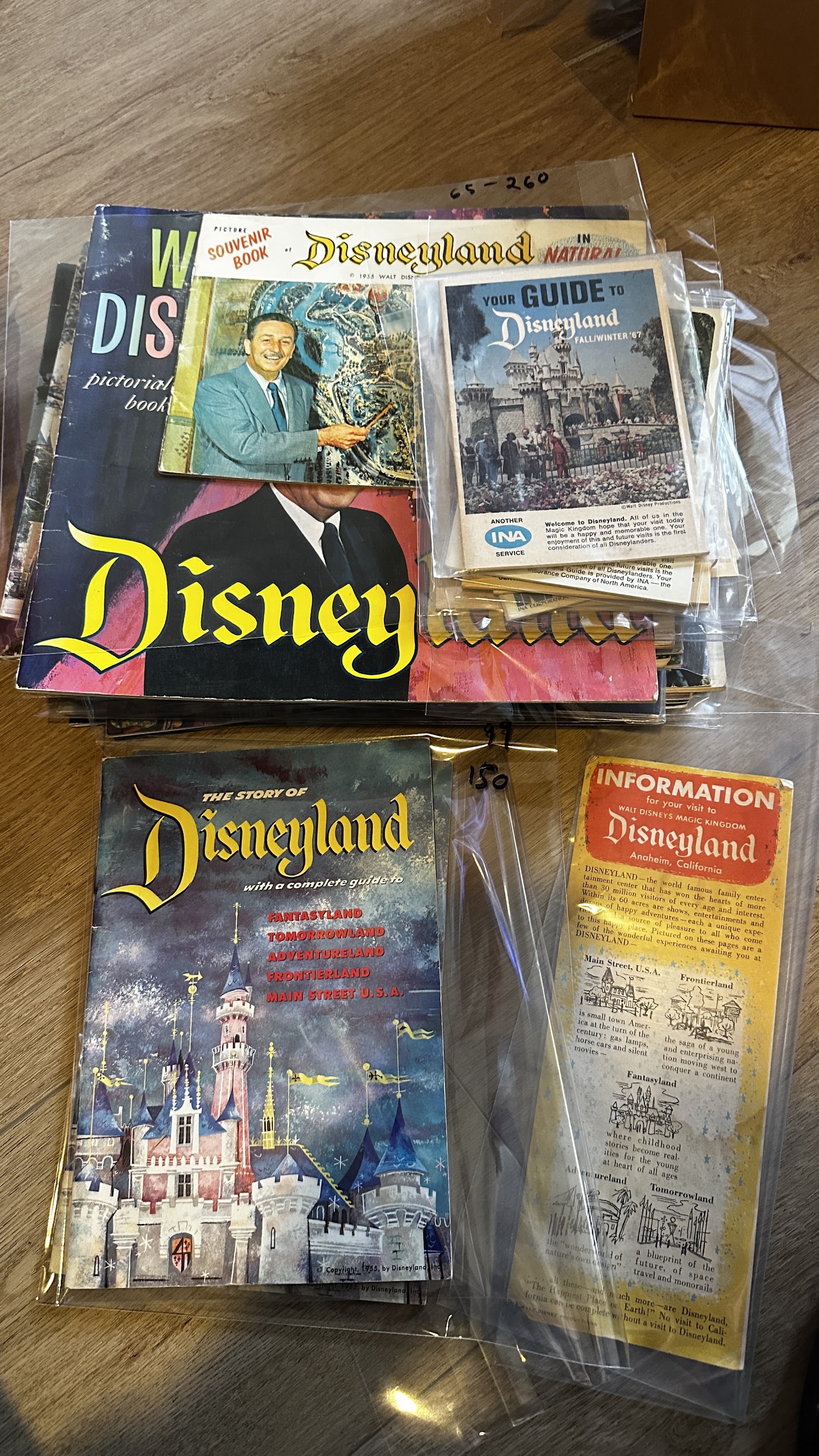
A Souvenir from the Day the Dream Opened
There are a handful of objects in Disney collecting that carry genuine weight — not just because they are rare, but because they represent a singular moment in cultural history. This original 1955 souvenir book for Disneyland, published by Walt Disney Productions in the very year the park opened its gates, is exactly that kind of artifact. It arrived as part of a large Disney estate collection, preserved inside its protective sleeve, its colors still vibrant after seven decades.
Disneyland opened on July 17, 1955, in Anaheim, California — a date that Walt Disney himself called "the happiest place on Earth." The park was unlike anything that had come before it: a themed environment divided into distinct lands, each offering a different mood and story. The souvenir book that guests carried home that year was their tangible connection to the experience, a printed record of a world that had felt almost too large and magical to hold in memory alone.
What the Book Captures
This mid-sized volume opens with one of the most iconic images from early Disneyland iconography: Sleeping Beauty Castle rendered at night, fireworks blooming overhead in stylized arcs of color. That image alone is a time capsule. The castle had only just been completed; Sleeping Beauty's own animated film would not arrive until 1959. In 1955, the castle was simply a promise — a fairy-tale silhouette that told every arriving guest they had left the ordinary world behind.
Inside, the book documents all five original park lands: Main Street, U.S.A., with its turn-of-the-century Americana and horse-drawn streetcars; Adventureland, offering jungle rivers and thatched rooflines; Frontierland, channeling the American West through Tom Sawyer's Island and pioneer imagery; Fantasyland, home to the storybook castles, dark rides, and the beloved characters that anchored Walt's career; and Tomorrowland, where the Space Age was just beginning to feel real. To hold the book is to hold the park as Walt envisioned it at inception — before expansions, before rebranding, before decades of change softened the original edges.
Why Opening-Year Disney Ephemera Matters to Collectors
The 1955 copyright date is not incidental — it is everything. Souvenir publications from Disneyland's opening year occupy a category of their own in Disney paper ephemera. They predate the standardization and mass-production that came with the park's explosive growth through the late 1950s and 1960s. The design language is distinctly of its era: bold, optimistic mid-century illustration, the confident palette of Atomic Age graphic design, typography that feels rooted in postwar American confidence.
For serious Disney collectors, paper ephemera from the 1950s — particularly anything tied to the park's opening — represents a direct connection to Walt Disney's personal vision. By 1955, Walt had spent nearly thirty years building a studio and a mythology. Disneyland was the physical manifestation of that mythology, and the souvenir publications from that inaugural year were the first objects guests could take home to prove they had been there. They are primary sources, in the truest sense: made at the moment of creation, not in retrospect.
The fact that this example has been preserved in a protective sleeve and retains vibrant color speaks to the care a thoughtful collector gave it over the years. Paper from the mid-1950s is notoriously fragile — acidic in composition, vulnerable to light and humidity. A well-preserved example with intact color and structural integrity is meaningfully more scarce than a worn copy.
From an Estate Collection to a New Chapter
This book came to us as part of a substantial Disney estate collection — the kind of assemblage that takes a lifetime to build. Whoever kept this souvenir understood what they had. It was sleeved, stored, and protected through the decades with the quiet diligence of someone who knew that opening-year Disneyland material would matter long after the ticket stubs faded.
The Story of Disneyland souvenir book is a rarity not because it was limited in print run — Disneyland welcomed nearly four million guests in its first year — but because so few copies have survived in this condition. Most were read, shared, bent, and eventually discarded. The ones that remain tell the story of a park and an era that shaped everything that came after in American popular culture. For any collector building a serious Disneyland or Walt Disney Productions archive, an opening-year publication in this condition is not a casual find. It is a cornerstone piece.
Thinking of selling? Get a free, no-obligation offer.
One direct offer on your entire Disney collection — no commission, no auction wait. We help arrange the shipping.