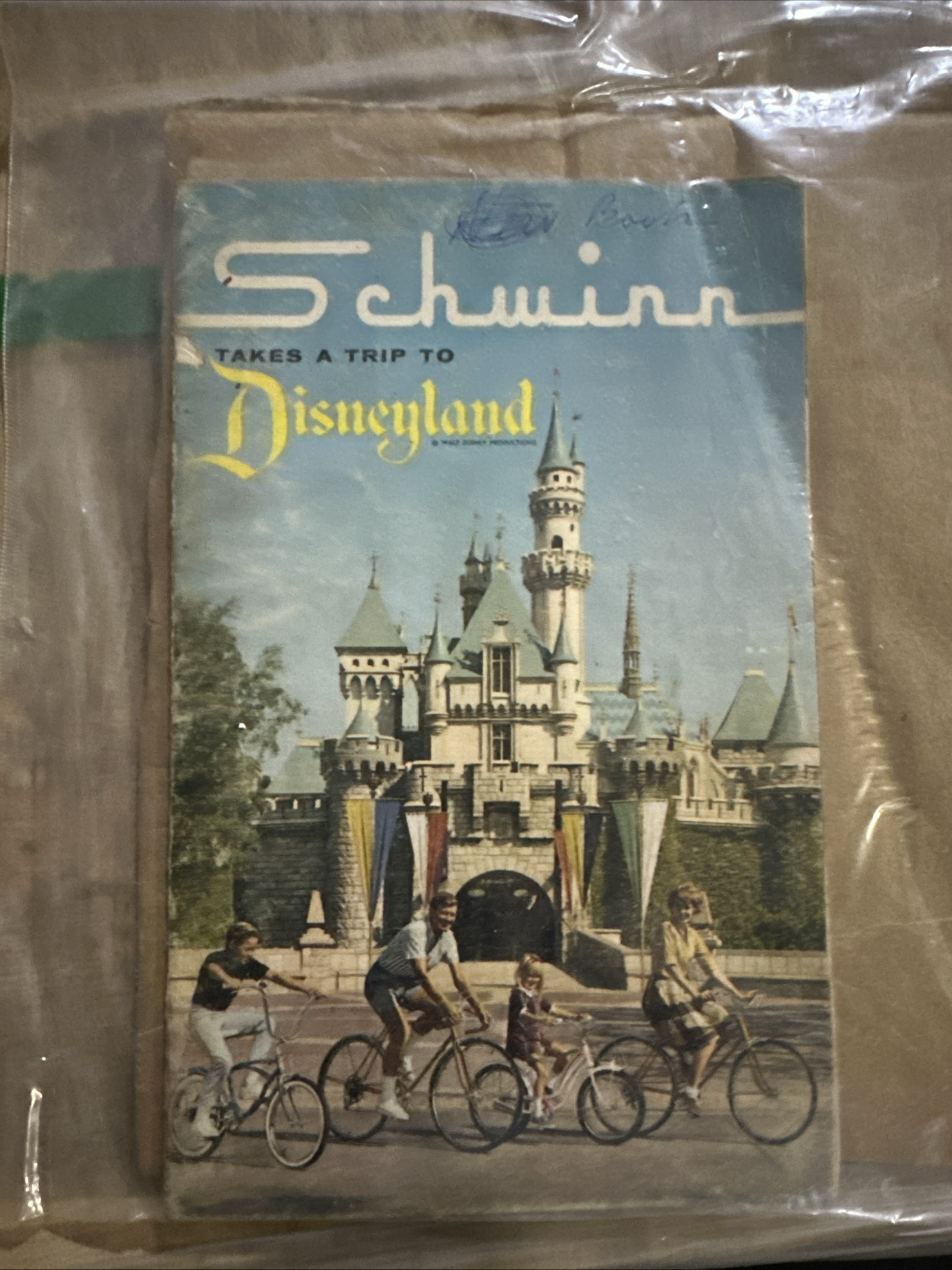
When Two American Icons Rolled Into the Same Dream
There is something quietly extraordinary about a piece of paper that brings together two of the most beloved American brands of the postwar era. This 1965 Schwinn Takes a Trip to Disneyland promotional booklet is exactly that — a collision of chrome handlebars and castle spires, of open roads and Main Street U.S.A., produced at the precise moment when both brands were at the absolute peak of their cultural power. For collectors who love Disney, it is a window into park history. For collectors who love vintage bicycles, it is a gem from Schwinn's golden age. And for those of us who simply love the mid-century American dream, it is close to a sacred document.
The Schwinn–Disney Connection of the 1960s
By 1965, Disneyland had been open for exactly a decade, and Walt Disney's park had already transformed American leisure culture beyond recognition. The Magic Kingdom was no longer a novelty — it was a pilgrimage destination, woven into the aspirational fabric of suburban family life. Schwinn, headquartered in Chicago, had been the dominant name in American bicycles since the 1930s, and in the postwar baby boom its bikes became the childhood status symbol: the Sting-Ray, the Typhoon, the Apple Krate. Getting a Schwinn for Christmas was the kind of moment kids remembered for the rest of their lives.
It was entirely natural, then, that the two brands would find each other. Promotional tie-in materials like this booklet served a dual purpose: they gave bike dealers compelling point-of-sale material that excited young customers, and they gave Disney an opportunity to embed park imagery into everyday American life far beyond the park's gates. A child flipping through this catalog in a Midwest bicycle shop could dream of Disneyland just as vividly as one who had already been there. That was the magic of mid-century promotional publishing — it transported you before you ever bought a ticket or turned a pedal.
What Makes This Booklet Special
This particular piece is classified as a promotional catalog or booklet, and it presents in the kind of honest condition you expect from something that has survived six decades. There is minor edge wear — the honest patina of an object that was handled, treasured, perhaps carried in a school bag or tucked into a dresser drawer. That wear is not a flaw; it is biography. It tells you this booklet was used, which means it did exactly what it was designed to do: it excited a child about bicycles and about Disneyland in the same breath.
The park imagery woven through the piece reflects the Disneyland of the mid-1960s, one of the most visually rich periods in the park's early history. Tomorrowland had just been reimagined with a Space Age sensibility ahead of the 1964–65 World's Fair momentum. New Orleans Square was under construction. The park was alive with ambition and Walt's fingerprints were on every detail. To see that imagery filtered through a Schwinn promotional lens — playful, family-forward, optimistic — is to understand the visual language of an era that has never quite come back.
For the cross-collecting market, this piece is genuinely rare. Schwinn ephemera on its own commands strong collector interest, particularly anything from the Sting-Ray years of the mid-1960s. Disney park ephemera from the same window is equally sought after. A piece that authentically sits at the intersection of both collecting worlds is uncommon, and its appeal reaches two distinct audiences simultaneously — something that tends to make good things happen at auction and in private sales.
From a Disney Estate Collection
This booklet comes to us as part of a larger Disney estate collection, assembled by someone who clearly understood the breadth of what Disney touched during its most creative decades. The best Disney collections are never just about animation cels or plush characters — they are about the full cultural footprint Walt and his company left on American life. A 1965 Schwinn promotional booklet belongs in that story just as surely as a lobby card or a View-Master reel. It proves that Disney was not simply a studio; it was a world that reached into bicycle shops and living rooms and family road trips with equal ease.
If you grew up in the 1960s, this piece will stop you cold the moment you see it. If you collect mid-century Americana, it fills a very specific and satisfying gap. And if you are simply a fan of the early Disneyland story, there is something deeply moving about holding a piece of paper that was designed to make a child dream — and knowing that, against all odds, it made it this far.
Thinking of selling? Get a free, no-obligation offer.
One direct offer on your entire Disney collection — no commission, no auction wait. We help arrange the shipping.