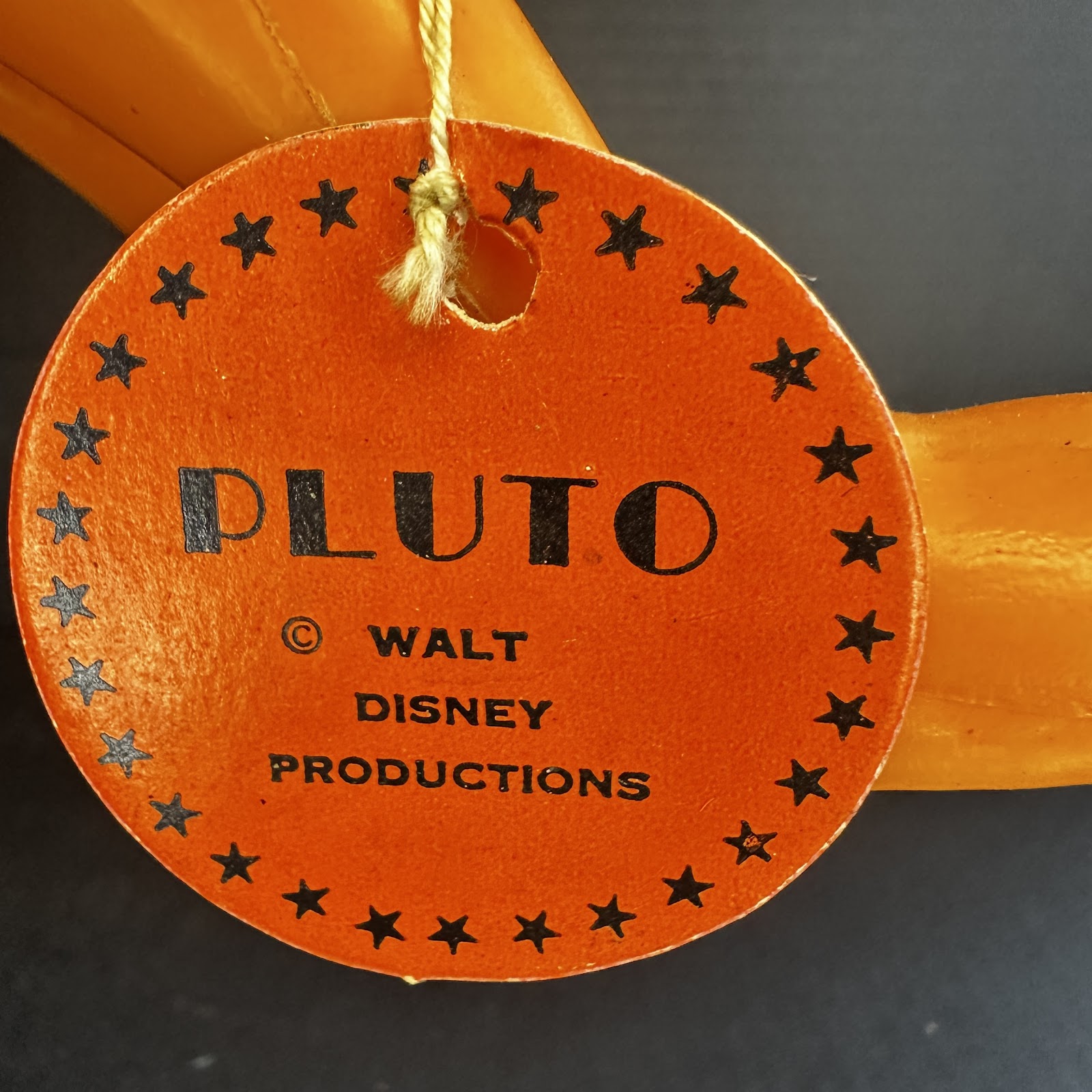
A Tiny Relic of the Golden Age
Long before holograms, barcodes, or QR codes told you a toy was official, a small round hang tag did the job. This Pluto orange hang tag — a die-cut cardstock circle roughly two inches across — is exactly the kind of licensing artifact that made Walt Disney Productions' merchandise machine hum for decades. Punched at the top, threaded with cotton string, and stamped with bold black lettering reading "PLUTO" and "© WALT DISNEY PRODUCTIONS," it is a direct, tactile link to an era when Disney's brand was guarded by ink and cardstock alone.
Dating to the broad span of the 1940s through the pre-1986 copyright period, this tag could have graced any number of plush animals, rubber figures, novelty items, or packaged toys that moved through department stores, five-and-dimes, and mail-order catalogs across mid-century America. The star border motif pressed into the orange stock gives it a festive, almost celebratory quality — a miniature burst of sunshine meant to catch a child's eye at the point of sale. It did its job quietly, then spent the better part of a century tucked away. Now it resurfaces as the collectible it always was.
Pluto: Disney's Beloved Everyman Dog
Pluto made his first screen appearance in 1930, initially as an unnamed bloodhound and soon after as Mickey Mouse's loyal, tail-wagging companion. What set Pluto apart from nearly every other Disney character of his generation was his refusal to speak. While Mickey talked, Donald ranted, and Goofy hollered, Pluto communicated entirely through pantomime — expressive ears, wide eyes, and the full theatrical vocabulary of a very good dog. That commitment to pure physical comedy gave animators a canvas for some of the studio's most inventive gag work throughout the 1930s and 1940s.
By the time merchandise like this hang tag was circulating, Pluto was already a global icon. His bright yellow body, black ears, and perpetual good humor appeared on everything from ceramic figurines to lunchboxes to — yes — the small paper tags that certified a toy as authentically Disney. The Walt Disney Productions copyright mark on this tag is itself a timestamp: that corporate name was in active use from the studio's earliest licensing era through 1986, when The Walt Disney Company became the official trademark holder. Any piece bearing the older mark carries a built-in vintage credential.
The Quiet Art of the Hang Tag
Collectors of vintage Disney ephemera know that paper items are among the most underappreciated survivors of the mid-century licensing boom. Toys broke, ceramics chipped, and textiles faded — but paper tags were typically discarded the moment a child tore open a gift. The ones that survived did so by accident: left attached to a never-opened toy, folded into a drawer, or preserved inside a box stored in an attic for generations. A tag in this condition — showing honest edge wear, slight fraying at the circular border, creasing near the punch hole, and minor ink loss on the lettering — has clearly lived a real life. It is not a reproduction. It is not a warehouse surplus find in pristine condition. It is the genuine article, aged gracefully.
The toning and surface scuffs visible on this tag are exactly what conservators and seasoned collectors call patina — evidence that time has passed and that the object is authentic. For ephemera specialists, that worn cotton string is as eloquent as a signature. Someone once handled this. It hung from something. It was part of a child's world.
From Estate Collection to Your Hands
This tag comes to us as part of a larger Disney estate collection — an assembled group of items gathered by someone who understood that the small things matter. Licensing tags, promotional inserts, character labels: these are the connective tissue of Disney collecting, the context pieces that serious collectors seek out to complement and authenticate the larger objects in their displays.
Whether you collect Pluto specifically, focus on pre-1986 Disney licensing artifacts, or simply love the graphic design of mid-century American commercial paper, this hang tag earns its place. At roughly two inches across, it takes up almost no space — but the history it carries is outsized. Frame it alongside a period plush, tuck it into a shadow box, or let it anchor a dedicated ephemera display. However it lands, it brings with it a direct line back to the decades when Walt Disney Productions was building something the world had never quite seen before, one carefully licensed hang tag at a time.
Thinking of selling? Get a free, no-obligation offer.
One direct offer on your entire Disney collection — no commission, no auction wait. We help arrange the shipping.