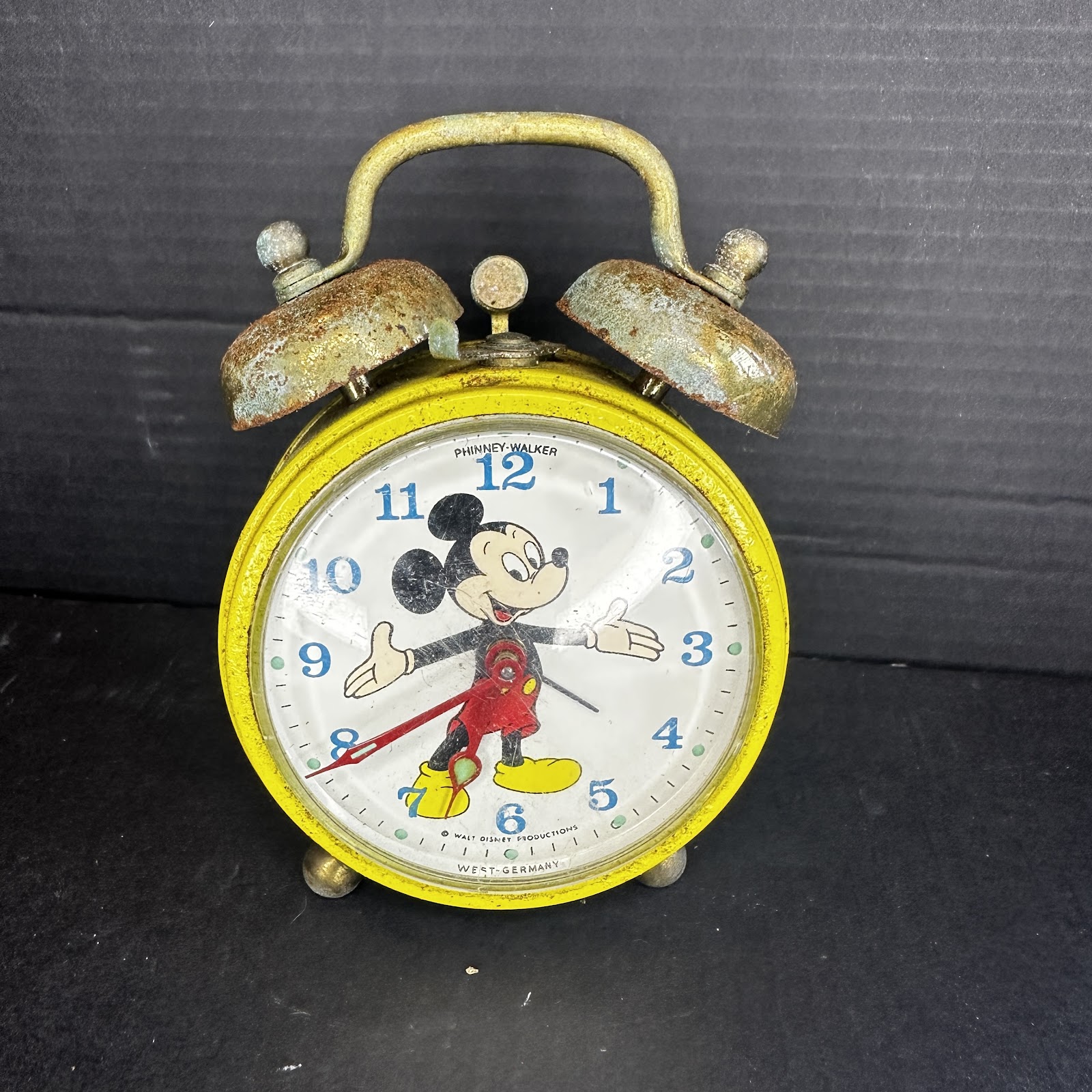
A Morning Wake-Up Call from the Golden Age of Disney Character Merchandise
Long before smart alarms and glowing screens crept onto nightstands, a small yellow clock with bright painted bells and a grinning Mouse face did the job with considerably more charm. This Phinney-Walker Mickey Mouse Twin Bell Alarm Clock, manufactured in West Germany during the 1950s or 1960s, is a wonderfully tactile artifact from a decade when licensed Disney goods were conquering households around the world. At roughly five to six inches tall, it is compact enough to sit on a child's dresser but substantial enough — all metal casing, real glass or hard-plastic lens, twin brass-toned bells on top — to feel genuinely substantial in the hand.
Mickey's Hands as Hour and Minute Hands
The design conceit is as clever as it is charming: Mickey's iconic white-gloved hands serve as the clock's hour and minute hands, pointing out the time from the center of a crisp white dial ringed with blue Arabic numerals. It is the kind of visual pun that only works when the character is as universally recognizable as Mickey Mouse — and by the postwar era, he absolutely was. The bold red alarm hand adds a cheerful accent against the white face, while the sunny yellow metal body ties the whole composition together with the same primary-color confidence that defined Disney graphic design throughout the mid-century. Every element feels considered rather than slapped together, which speaks to the quality standards Phinney-Walker brought to their Disney licensing arrangement.
Phinney-Walker and the West German Clock Trade
Phinney-Walker was an American clock brand whose identity became closely tied to novelty and character timepieces in the postwar decades. Like many consumer goods manufacturers of the era, they sourced production from West Germany — a country whose precision clockmaking industry rebounded remarkably quickly after World War II and soon supplied novelty clocks to the American market at scale. The "WEST GERMANY" stamp on this clock is itself a small piece of Cold War–era history: that specific marking could only have been applied between the end of WWII and German reunification in 1990, anchoring the piece firmly in the postwar consumer boom. For collectors of both Disney memorabilia and vintage horology, that country-of-origin detail is a satisfying authenticating marker.
The broader context matters, too. The 1950s and early 1960s were perhaps the richest period for Mickey Mouse merchandise outside of his initial 1930s wave of popularity. The launch of Disneyland in 1955, the runaway success of The Mickey Mouse Club television program, and Walt Disney's increasingly dominant presence in American popular culture all drove enormous demand for licensed goods. Clocks, watches, lunchboxes, and clothing all carried Mickey's likeness into millions of American homes — and their European equivalents, like this West German example, followed closely behind.
Condition, Character, and the Estate Collection
This clock carries its decades honestly. The twin bells, carrying handle, and legs show significant oxidation and rust, the yellow paint casing has developed chips, the lens carries its share of fine scratches, and the dial face has faded with time. None of this is unusual for a fully mechanical metal clock that has been kept, used, and loved across sixty-plus years. In the world of vintage Disney collectibles, honest wear of this kind is not a disqualification — it is a biography. Every spot of rust on those bells represents a morning alarm answered, a small ritual of childhood or household life conducted in the company of the most famous cartoon character in history.
This piece arrived as part of a larger Disney estate collection, the kind of assembled trove that only comes together over a lifetime of deliberate collecting and genuine affection for the material. Clocks like this one were not bought as investments in the 1950s; they were bought because a child wanted to wake up to Mickey's face, or because a parent wanted to give something joyful. That sincerity of original purpose — the fact that this object was used and cherished — is precisely what makes it resonate for collectors today.
For the Disney memorabilia collector, this clock occupies a particularly satisfying niche: it is decorative enough to display, historically specific enough to anchor a broader collection narrative, and rare enough in its intact mechanical form that finding one at all requires some patience. As a piece of mid-century Americana filtered through a West German workshop and the enduring magic of Mickey Mouse, it is hard to beat.
Thinking of selling? Get a free, no-obligation offer.
One direct offer on your entire Disney collection — no commission, no auction wait. We help arrange the shipping.