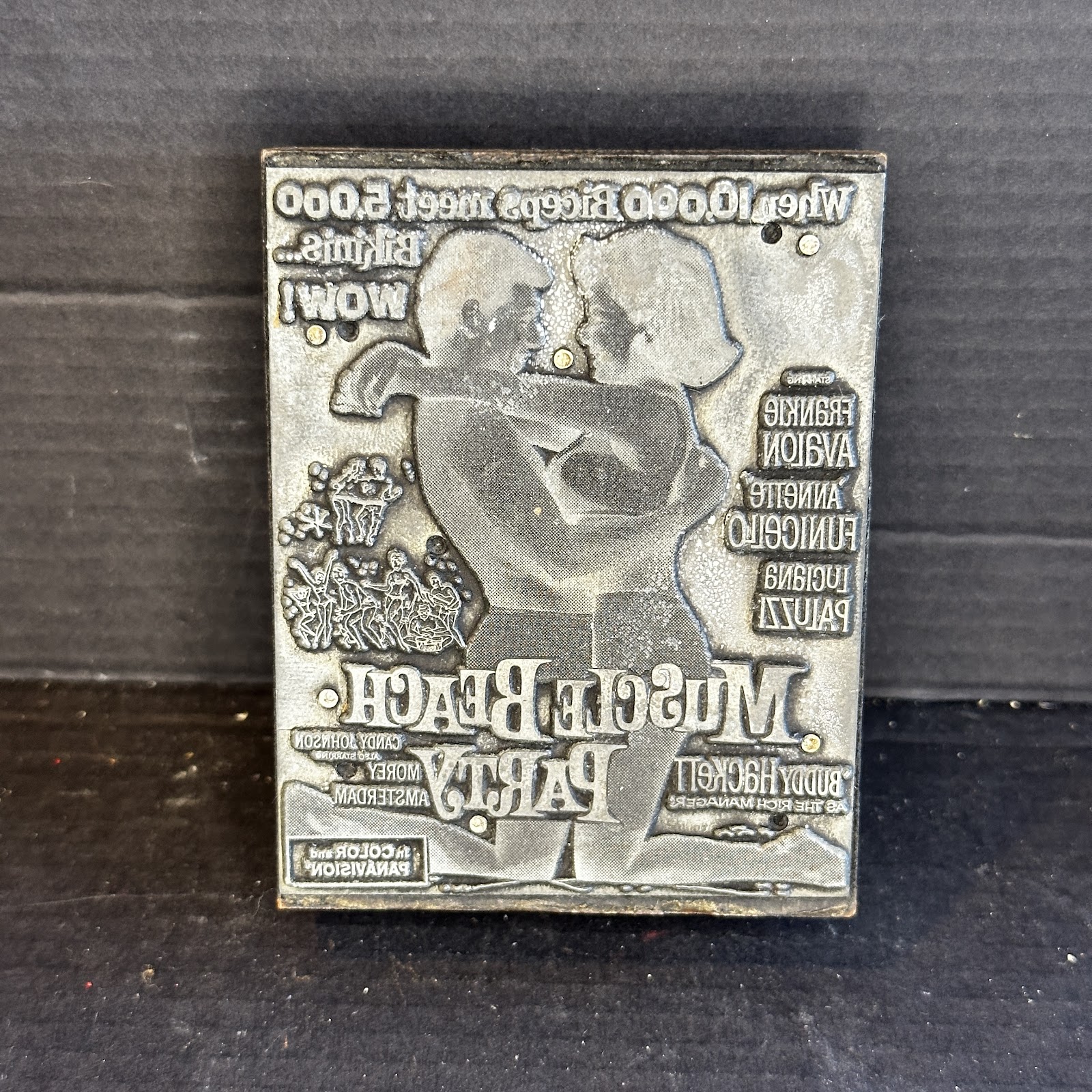
A Relic from the Golden Age of Beach Blanket Cinema
Long before the age of digital marketing, movie studios relied on an army of skilled craftsmen to put films in front of audiences. Printers, engravers, and press operators worked from production printing plates — the physical masters from which theater posters, lobby cards, newspaper ads, and promotional materials were struck. This extraordinary artifact is exactly that: an original metal printing plate mounted on a wood block, used in the production of promotional materials for Muscle Beach Party, American International Pictures' 1964 surf-and-sun comedy that cemented the beach movie as a bona fide genre.
What you are looking at is not a reproduction, a souvenir, or a later tribute. It is a working tool of the Hollywood publicity machine — a piece of equipment that sat in a print shop, likely somewhere in Southern California, and generated the ink-on-paper impressions that sold this film to a generation of teenage moviegoers. These plates were almost never saved. They were melted down, repurposed, or simply discarded when a campaign ended. The ones that survived did so by accident, rescued by a sharp-eyed pressman, a studio archivist, or — as in this case — preserved as part of a larger collection that found its way to us.
Annette, AIP, and the World They Created
Muscle Beach Party arrived in theaters in April 1964 as the second installment in American International Pictures' beach party franchise, following the surprise success of Beach Party the previous summer. Producer Samuel Z. Arkoff and director William Asher had assembled a remarkably durable formula: sun-drenched California beaches, wholesome romance, comedic misunderstandings, and an infectious pop soundtrack. At the center of it all was Annette Funicello, the former Mouseketeer whose girl-next-door magnetism made her the undisputed queen of the genre.
Annette had grown up in front of America's television sets on The Mickey Mouse Club in the 1950s, and her transition to the big screen felt entirely natural. Walt Disney himself reportedly had a soft spot for her career and took an active interest in the films she made during this period, reportedly encouraging her to maintain the wholesome image audiences associated with her. The AIP beach pictures delivered exactly that — fun, sun, and Annette in a swimsuit that Walt is said to have personally approved. She was, in every meaningful sense, a Disney alumna carrying that legacy directly into popular cinema of the early 1960s.
By the time Muscle Beach Party hit theaters, Frankie Avalon had returned alongside her, and the franchise had attracted cameos from figures as varied as bodybuilder Peter Lupus and comedian Don Rickles. The film was a certified hit, and the promotional campaign that supported it — the very campaign this printing plate served — reached audiences through newspapers, trade publications, and theater lobby displays across the country.
What Makes a Printing Plate a Collector's Trophy
The construction of this piece tells its own story. The metal face — likely a zinc or magnesium alloy, standard for letterpress and photoengraving work of the era — is mounted to a wood block base. That block served a precise mechanical purpose: it brought the plate's printing surface to type-high, the standard measurement (0.918 inches) that allowed it to sit correctly in a press bed alongside movable type. This is a fully functional printing tool, engineered to tolerances that feel almost quaint in today's context but represented serious industrial craft in 1964.
The image or text element etched into the metal surface is a direct photographic or hand-engraved negative of the artwork used in the campaign. Every line, every letter, every tonal value was transferred into the metal by a skilled engraver. Running your eye across the surface, you are seeing the same image that press operators saw when they locked this plate into position and pulled the first proof.
For collectors, printing plates occupy a uniquely compelling niche. They are primary sources — not copies of promotional art, but the actual tools that created it. Film and entertainment memorabilia is full of reproductions, licensed replicas, and items of uncertain origin. A production printing plate is none of those things. Its materiality is its authentication: the wear on the wood block, the ink traces in the plate's recesses, the physical heft of metal and wood together all speak to genuine use in a real production environment.
From a Larger Estate Collection
This plate comes to us as part of a substantial Disney-adjacent estate collection assembled over many decades by a devoted collector who understood that the boundaries of Disney history extend well beyond the official studio walls. Annette Funicello's career is inseparable from Disney history — she was one of Walt's own, and her work with AIP in the early 1960s represents a fascinating chapter in which Disney-trained talent shaped the wider culture of American popular entertainment.
Items of this type rarely surface on the open market. Print shops closed, estates were liquidated without fanfare, and these working tools of the publicity trade were not considered collectible in their own time. The survival of a plate this specific — tied to a named film, a known year, and one of the most beloved figures in mid-century American pop culture — is genuinely uncommon. Whether you are a devoted Annette collector, a student of AIP's remarkable run of genre pictures, or simply someone who appreciates the physical craft behind the movies we love, this is a piece with depth, rarity, and real historical texture.
Thinking of selling? Get a free, no-obligation offer.
One direct offer on your entire Disney collection — no commission, no auction wait. We help arrange the shipping.