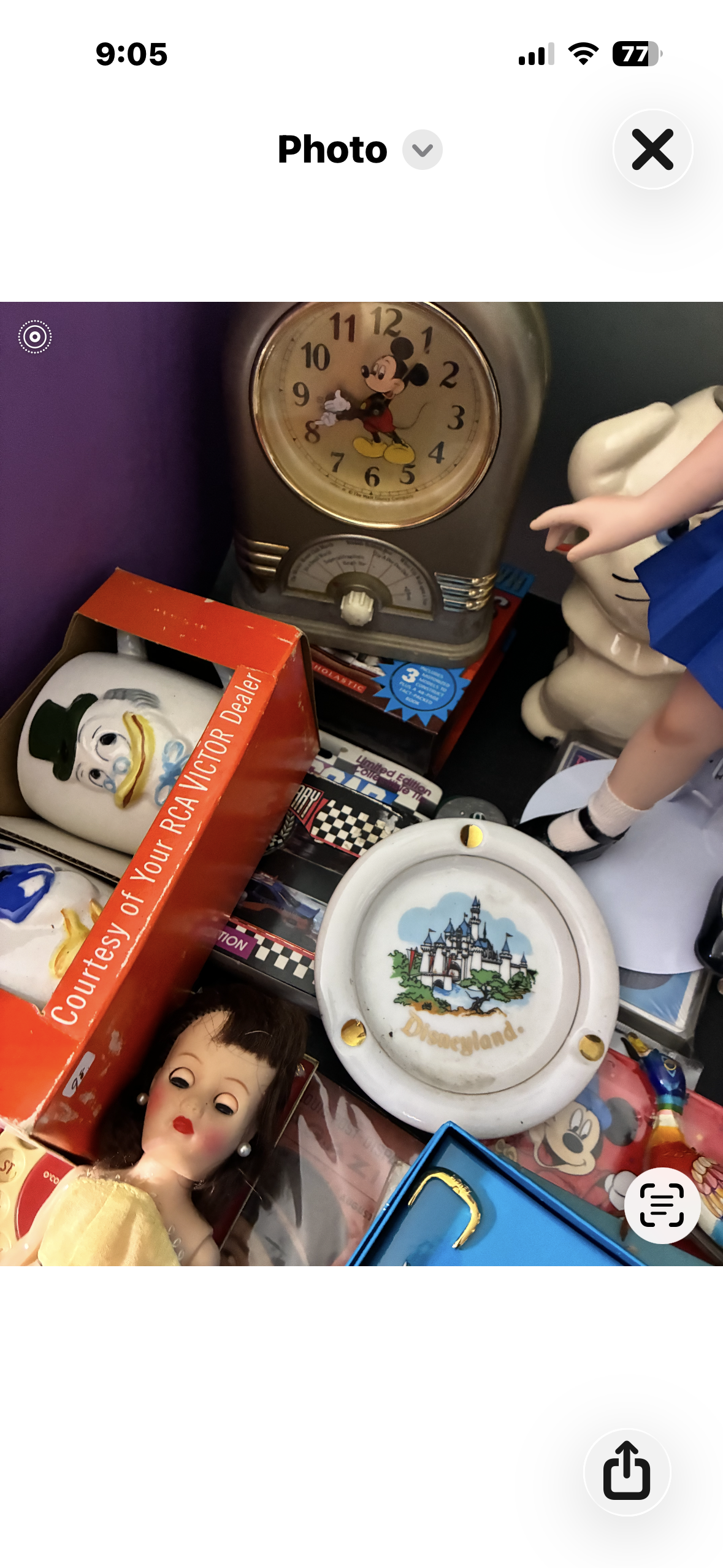
A Tick-Tock Treasure from the Golden Age of Character Clocks
Long before smartphones replaced the bedside alarm, waking up to a favorite character was a childhood ritual millions of baby boomers shared. This Mickey Mouse alarm clock — styled in the retro streamline tradition popularized during the mid-century era — is exactly that kind of time capsule. Manufactured by Bradley in partnership with the RCA Victor brand, it captures a specific and beloved moment in Disney licensing history, when hard plastic and bold graphic design ruled the novelty clock market.
The clock's radio-style silhouette is immediately striking: clean horizontal lines, a rounded top, and a face dial that puts Mickey front and center. This design language borrows freely from the console radios and early television sets that defined postwar American living rooms — objects that carried a sense of optimism, modernity, and family togetherness. Dropping Mickey into that aesthetic wasn't an accident; it was a deliberate appeal to households where the family room and the child's bedroom shared the same cultural vocabulary.
Bradley, RCA Victor, and the Business of Disney Licensing
Bradley Time — a division of Elgin National Industries — was one of the premier Disney licensed clock and watch manufacturers from the 1950s through the 1980s. Their relationship with Disney produced some of the most collectible timepieces of the twentieth century, from simple plastic travel alarms to elaborately cased character clocks. The addition of the RCA Victor branding on this particular piece reflects the cross-promotional licensing arrangements that were common in that era, lending the product an extra layer of consumer-brand authority.
RCA Victor was, of course, one of the dominant names in American consumer electronics, its His Master's Voice terrier logo as recognizable as Mickey's ears. The pairing of two beloved American icons — Mickey Mouse and the RCA Victor name — on a single clock speaks to how savvy Disney's licensing division had become by the 1960s. Disney was not merely selling characters; it was selling a lifestyle association, embedding Mickey into the fabric of the modern American home.
Art Deco Sensibility in a Plastic Age
The Art Deco styling of this clock is worth pausing on. True Art Deco peaked in the 1920s and 1930s, but its influence rippled forward through decades of industrial and product design. By the 1960s, what designers were producing was something closer to a nostalgic remix — streamlined forms, symmetrical composition, and a faith in geometric clarity that felt both retro and forward-looking at once. Hard plastic made these shapes achievable at mass-market price points, allowing millions of households to own something that felt considered and styled rather than purely utilitarian.
Mickey's dial design on this clock is characterful in the way only the best vintage Disney merchandise manages: the graphic treatment of his face, the font choices, the color balance on the clock face all reflect a period when Disney's art department exercised real care over how the character appeared on licensed goods. The result is a clock that reads as distinctly of its era — you can place it within a decade just by looking at it, which is exactly what makes it compelling to collectors today.
Condition, Charm, and the Estate Collection Context
This clock shows the honest surface wear you expect — and secretly hope for — on a piece that has genuinely lived in someone's home for half a century. There is visible tarnishing and surface scuffing on the hard plastic shell, the kind that accumulates through decades of bedroom windowsill living, dusting, and the occasional move across town. None of this diminishes the piece; if anything, it authenticates it. A perfectly pristine example of a 1960s alarm clock invites skepticism. This one does not.
This piece comes to us as part of a larger Disney estate collection — an assemblage of licensed merchandise gathered over years by someone who clearly understood the difference between a character novelty and a genuine artifact of American pop culture. Clocks like this one occupied a unique place in that collection: functional objects that outlived their function and became, through the passage of time, something more interesting than they started as. They are memory objects, the kind that sit in the back of a collector's mind for years before the right piece finally turns up.
For the serious Disney timepiece collector, a Bradley-made Mickey Mouse clock with RCA Victor co-branding from the 1960s–1970s window is a genuinely uncommon find. Bradley produced many clock designs over their Disney partnership years, but the specific combination of this streamline radio form, the Art Deco detailing, and the dual brand identity makes this one stand apart on the shelf. It is the kind of piece that rewards close looking — and that keeps telling its story long after you stop winding it.
Thinking of selling? Get a free, no-obligation offer.
One direct offer on your entire Disney collection — no commission, no auction wait. We help arrange the shipping.