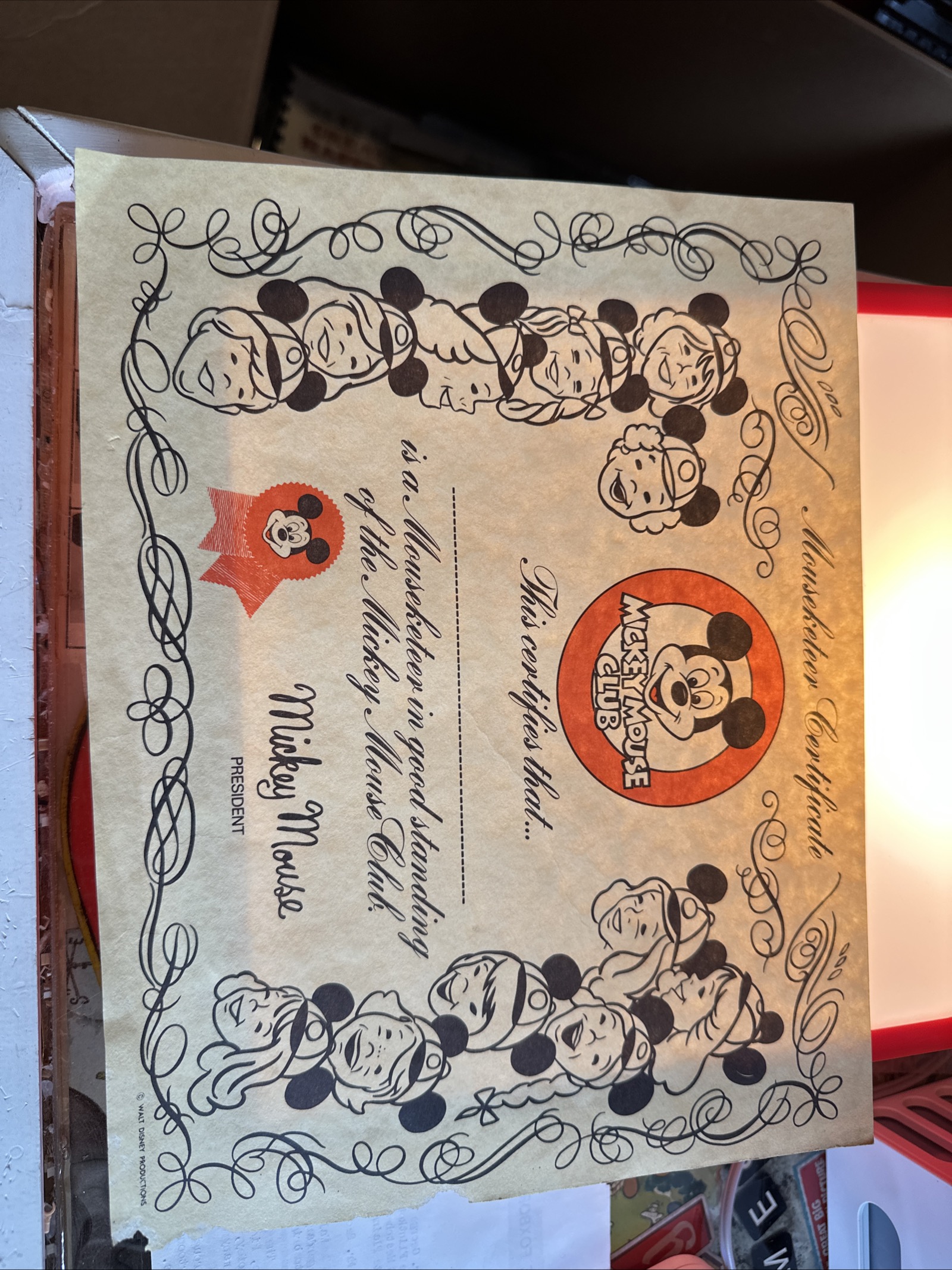
A Document That Once Made Childhood Dreams Official
There is something quietly thrilling about a blank form waiting to be filled in. It holds all the promise of a thing not yet given, a ceremony not yet performed. This Mickey Mouse Club Mouseketeer Membership Certificate — produced by Walt Disney Productions and dating to the golden run of the show between 1955 and 1959 — is exactly that: a promise preserved in paper, never redeemed, still perfect in its anticipation.
Measuring approximately 8 by 10 inches, this horizontal certificate carries the iconic Mickey Mouse logo and is finished with a red ribbon seal, lending it the weight and ceremony of an official document. It is unissued and blank — no child's name was ever inked across the dotted line — which means it survives in a form that most examples from this era simply do not. Minor horizontal fold creases and gentle age toning tell you it has lived a real life; slight corner wear confirms it traveled through the decades without being sealed in a vault. It is aged, but it is honest.
The Mickey Mouse Club and the Mouseketeer Phenomenon
When The Mickey Mouse Club premiered on ABC on October 3, 1955, it arrived not merely as a television program but as a full cultural invitation. Five afternoons a week, children across America sat down with Mickey, Minnie, and a rotating cast of talented young performers — the Mouseketeers — whose oversized ear hats and boundless energy turned them into the first true child celebrities of the television age. Annette Funicello, Bobby Burgess, Darlene Gillespie: these names meant something to an entire generation in a way that is difficult to fully convey today.
Walt Disney understood intuitively that children did not merely want to watch his characters — they wanted to belong to them. The M-I-C-K-E-Y M-O-U-S-E theme song was not just a sing-along; it was a membership chant. And the Mouseketeer certificate formalized that belonging. For a child in 1956 or 1957, receiving an official certificate bearing the Disney imprimatur and a ribbon seal would have felt as significant as any diploma. It was Walt's own hand extended through the screen.
Why Unissued Blanks Are Especially Prized
Collectors who specialize in Disney paper ephemera know a counterintuitive truth: filled-in versions of documents like this are often less desirable than their blank counterparts. A certificate that was actually presented to a child has typically been handled, folded repeatedly, perhaps framed and unframed, exposed to light, or — in the most common outcome — simply lost. Blank, unissued examples were frequently kept in office files, stored flat, and then forgotten in desk drawers or filing cabinets for decades, which is precisely why the condition profile of this piece makes sense. The fold creases are the kind made once when a document is filed; they are not the creases of a cherished keepsake taken out and refolded a hundred times.
This certificate came to us as part of a larger Disney estate collection — the kind of accumulation that happens when someone with genuine passion and proximity to the industry simply kept things over a lifetime. Items like this one were never meant to be collectibles. They were operational materials, studio-produced goods meant to be distributed and then forgotten. That so many were not distributed, and that some fraction of those survivors eventually made their way into collections, is one of the quiet accidents of material culture that collectors live for.
Condition, Character, and What You Are Actually Holding
Let's be precise about what this piece presents. The horizontal fold creases are consistent and expected for a document of this age and format — they do not compromise the legibility of the design or the integrity of the red ribbon seal. The age toning is minor and distributed evenly, the warm amber shift that paper acquires over seventy years in the presence of air and time. Corner wear is slight. Nothing here is a deal-breaker; everything here is a timestamp.
The Mickey Mouse logo anchors the design with the authority that only official Walt Disney Productions artwork of the classic era carries. The red ribbon seal — a detail that elevates this from mere certificate to official document — is intact. At 8 by 10 inches (or the slightly larger 8.5 by 11 variant), it displays beautifully in a standard document frame without any matting gymnastics.
For the collector of Golden Age Disney paper ephemera, the Mickey Mouse Club era represents a particularly vivid chapter: the moment Disney moved from theaters into living rooms and began building the participatory fandom that would define the brand for generations. This certificate is a physical artifact of that moment — not a reproduction, not a later tribute, but an original piece of studio material from the years when the show was actually on the air and the Mouseketeers were household names. It is the kind of thing you put behind glass and let speak for itself.
Thinking of selling? Get a free, no-obligation offer.
One direct offer on your entire Disney collection — no commission, no auction wait. We help arrange the shipping.