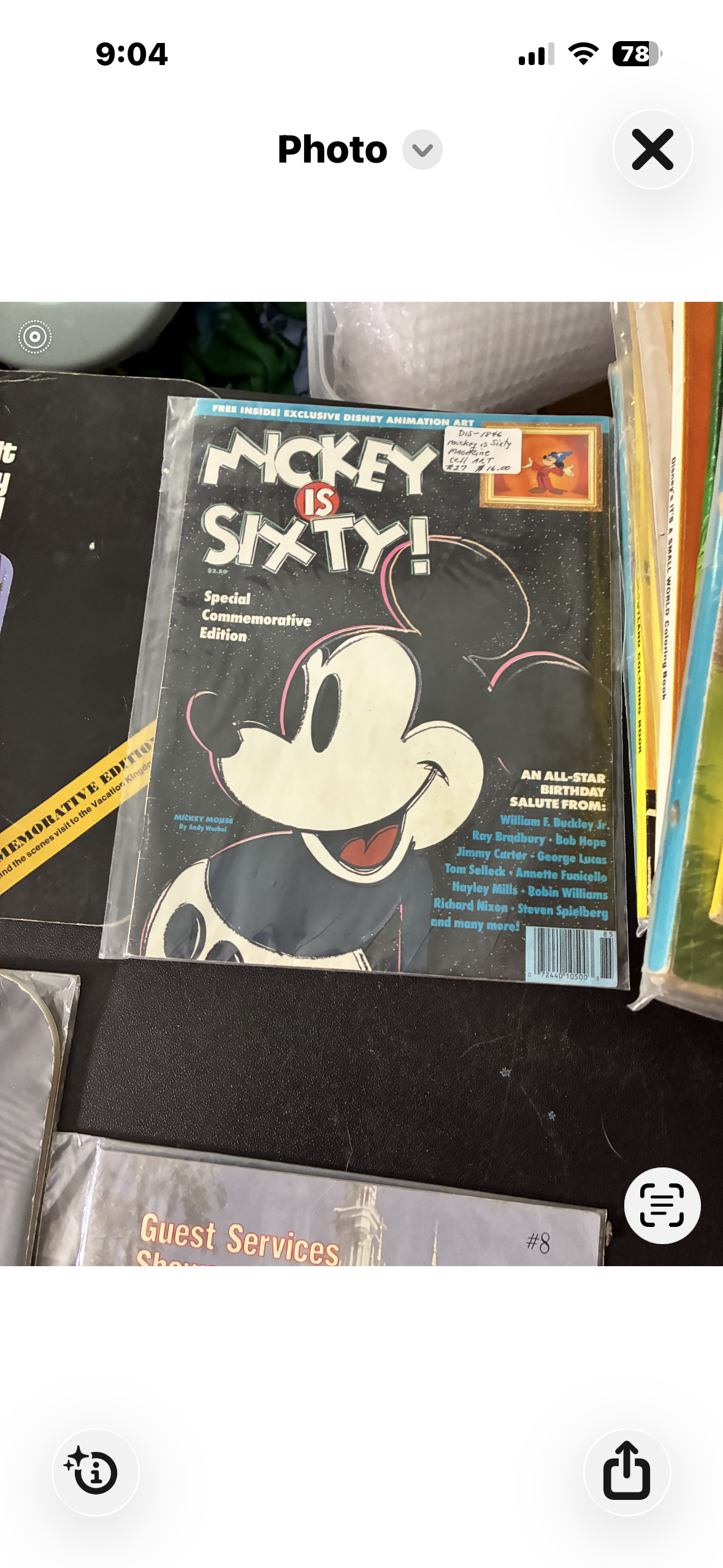
A Birthday Worth Commemorating
Some anniversaries demand a proper celebration, and when Mickey Mouse turned sixty in 1988, the world took notice. Born on November 18, 1928, with the release of Steamboat Willie — the cartoon that synchronized sound and animation in a way that stopped audiences cold — Mickey had by 1988 become not merely a cartoon character but a cultural institution. Six decades of newspapers, merchandise, theme parks, television specials, and movie screens had made him the most recognized face on the planet. This special commemorative magazine, Mickey Is Sixty!, was produced to mark that milestone in style, and it remains one of the most distinctive pieces of Disney print ephemera to emerge from the 1980s.
Andy Warhol and the Art of Mickey
What elevates this publication from souvenir to collectible artifact is the cover: artwork by Andy Warhol. The pairing makes perfect sense in retrospect. Warhol had spent his career finding the sacred inside the commercial — Campbell's soup cans, Marilyn Monroe, Mao Zedong — and Mickey Mouse occupied that same strange territory where mass-market imagery accrues genuine cultural weight. Warhol had explored Mickey as a subject before, most notably in his 1981 Myths series, in which Mickey appeared alongside the likes of Superman, Santa Claus, and the Wicked Witch of the West as an American myth rendered in vivid silkscreen color. Having Warhol provide cover art for Mickey's sixtieth birthday publication was not a gimmick — it was a statement about what Mickey had become: a myth, an icon, a piece of the American unconscious.
For collectors, the Warhol connection alone makes this magazine a crossover piece with appeal far beyond traditional Disney circles. It sits at the intersection of Pop Art history, Disney history, and the broader story of twentieth-century American visual culture. Warhol passed away in February 1987, just over a year before this magazine's publication, which lends the cover art a quiet poignancy — his contribution to Mickey's birthday celebration was one of his final acts of engagement with the iconic imagery he had spent a lifetime interrogating and celebrating.
Celebrity Tributes and the Cultural Reach of Mickey
The interior is equally remarkable for what it reveals about Mickey's standing in American life. The tribute contributors assembled for this publication form an unlikely and genuinely fascinating cross-section of the era: William F. Buckley Jr., the conservative intellectual and television host; Ray Bradbury, the science fiction author who wrote with unashamed love for the mythic power of popular culture; Jimmy Carter, the former President of the United States; George Lucas, the filmmaker who had himself reshaped popular mythology through the Star Wars saga; and Robin Williams, the comedian and actor who understood better than almost anyone how to inhabit a character with total abandon.
That these five figures — a political commentator, a futurist author, a head of state, a Hollywood auteur, and a comedian — all contributed to a magazine celebrating a cartoon mouse speaks volumes. Mickey had long since outgrown his role as a character in animated shorts. He was, by 1988, a shared reference point for everyone who had grown up in the twentieth century, regardless of nationality, politics, or cultural taste. Reading their tributes today is a small time capsule of how the late 1980s understood Disney's most enduring creation.
From Estate Collection to Your Shelf
This copy comes to us as part of a larger Disney estate collection — an accumulation of decades of careful acquisition by someone who understood that the best Disney collectibles are the ones that document the character's place in the wider world, not just in the parks and on the screen. A commemorative magazine like this one was never intended to be disposable; it was produced with the expectation that readers would hold onto it, and many did. Finding one in the kind of shape that still rewards reading and display is a genuine pleasure.
The format — a glossy, full-featured magazine rather than a mass-market program or a simple pamphlet — gives the piece a solidity and presence that holds up nearly four decades later. For a collector drawn to Disney print ephemera, to Warhol's commercial-art legacy, to 1980s Disney history, or simply to the long arc of Mickey Mouse's extraordinary cultural life, this is the kind of piece that earns its place in a collection. Mickey has now been a fixture of popular culture for nearly a century. Sixty, it turns out, was just getting started.
Thinking of selling? Get a free, no-obligation offer.
One direct offer on your entire Disney collection — no commission, no auction wait. We help arrange the shipping.