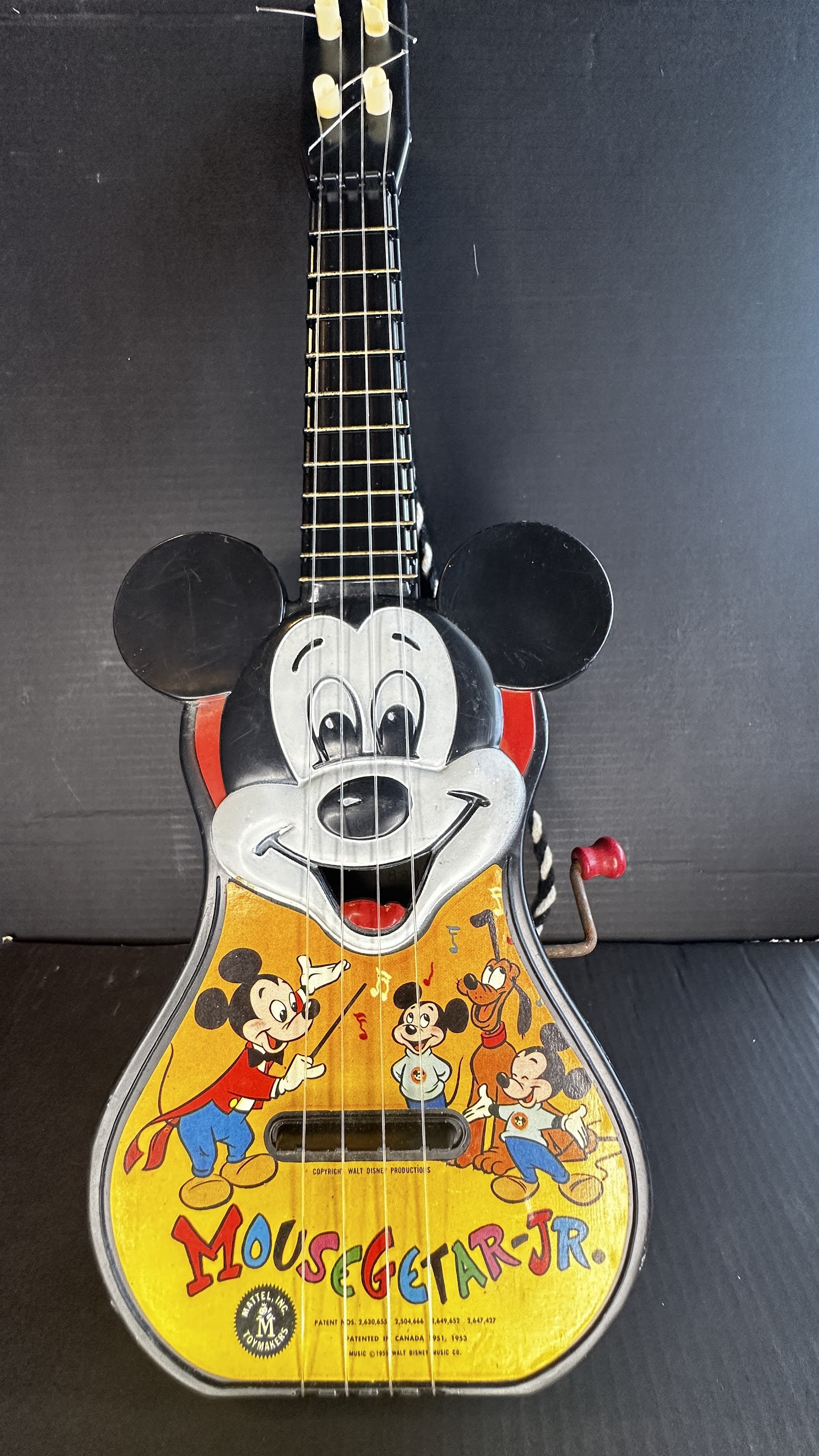
A Tiny Instrument with a Giant Personality
There is something wonderfully disarming about the Mattel Mousegetar Jr. It sits in your hands like a secret — a miniature ukulele whose body is molded in the unmistakable silhouette of Mickey Mouse's head, complete with those great black ears jutting skyward. This is not simply a toy; it is a little monument to the moment when American pop culture, post-war optimism, and Walt Disney's unstoppable ambition all collided in a child's playroom. This example, dating to the mid-to-late 1950s, comes to us from a private Disney estate collection, and it carries with it every year of that remarkable era.
The Mousegetar and the Golden Age of Disney Toys
The mid-1950s were an extraordinary time for Disney merchandise. The Mickey Mouse Club had debuted on ABC television in 1955, instantly transforming Mickey, Minnie, and their circle of friends into daily household presences for a generation of American children. Mattel — then a young but fast-rising Southern California toymaker — was perfectly positioned to capitalize on that enthusiasm. The Mousegetar line emerged from that collaboration, offering children not just a licensed character item but an actual playable instrument with a genuine music-box mechanism inside.
This particular model, the Mousegetar Jr., features a yellow soundboard decorated with vintage character illustrations: Mickey Mouse in his conductor's pose, his nephews Morty and Ferdie Fieldmouse, and the ever-loyal Pluto, all rendered in the crisp, optimistic linework of classic Disney studio art. The neck is black with molded frets, and four strings stretch toward a headstock that invites even the smallest fingers to strum along. But the real magic lives on the side of the instrument: a hand-crank mechanism that, when turned, coaxes a tinkling music-box melody from within — no musical training required, no batteries needed, just the simple delight of turning a handle and hearing Disney.
Engineering a Childhood Memory — The Patents Behind the Play
What makes the Mousegetar particularly fascinating to collectors and historians alike is that Mattel took its engineering seriously. This example bears multiple patent numbers on its body — evidence that the mechanisms inside were genuinely novel for their time. The music box integration, the molded plastic construction, the hybrid toy-instrument design: each element reflected Mattel's investment in durable, innovative playthings rather than disposable novelties. The copyright mark reads Walt Disney Productions, with the music credited to the Walt Disney Music Co., 1955 — grounding this object firmly in the earliest, most electric years of the Disney television era.
Morty and Ferdie Fieldmouse, featured on the soundboard, are themselves a detail that delights hardcore Disney fans. Mickey's twin nephews — less famous than Huey, Dewey, and Louie but part of Mickey's extended family since the 1930s comic strips — appear here in a rare piece of merchandise that acknowledges their place in the Disney universe. For collectors who specialize in deep-cut character representation, that alone sets this piece apart.
Condition, Character, and the Charm of Age
This Mousegetar Jr. presents exactly as you would hope from a seventy-year-old toy that was actually loved. The black molded plastic ears carry surface scratches consistent with decades of handling — not damage, but biography. There is minor paint loss along the edges where small hands gripped it most eagerly, and the strings have the pleasant oxidized quality of aged wire. The hand-crank shows the gentle patina of metal exposed to time, and a fine layer of dust speaks to years spent in a collection rather than on a shelf dusted weekly. None of this diminishes the piece; if anything, it authenticates it. The yellow soundboard illustrations remain clear and vivid, the character artwork as charming and immediately readable today as it was when Eisenhower was in the White House.
Estate pieces like this carry a different weight than items sourced from retail. Someone kept this. Through moves and decades and the ordinary chaos of a life lived, they held onto this small yellow-and-black ukulele with Mickey's ears. That continuity of care is part of what collectors are really acquiring — not just an object, but an unbroken thread back to a specific, irretrievable moment in American childhood.
Why This Belongs in a Serious Collection
The Mousegetar Jr. checks every box that serious Disney collectors value: a major licensed manufacturer, a tight production window tied to a culturally significant era, character art that includes both headliners and beloved secondary figures, and a functional mechanism that gives it a three-dimensional life beyond mere decoration. It is early enough to predate the mass-market saturation of Disney licensing and late enough to reflect the full sophistication of Mattel's mid-century craft.
Whether displayed alongside other Mickey Mouse Club memorabilia, grouped with vintage Mattel Disney toys, or showcased as a standalone icon of 1950s Americana, the Mousegetar Jr. commands a room. It is the kind of object that stops people mid-conversation — small enough to hold in one hand, consequential enough to anchor an entire collection.
Thinking of selling? Get a free, no-obligation offer.
One direct offer on your entire Disney collection — no commission, no auction wait. We help arrange the shipping.