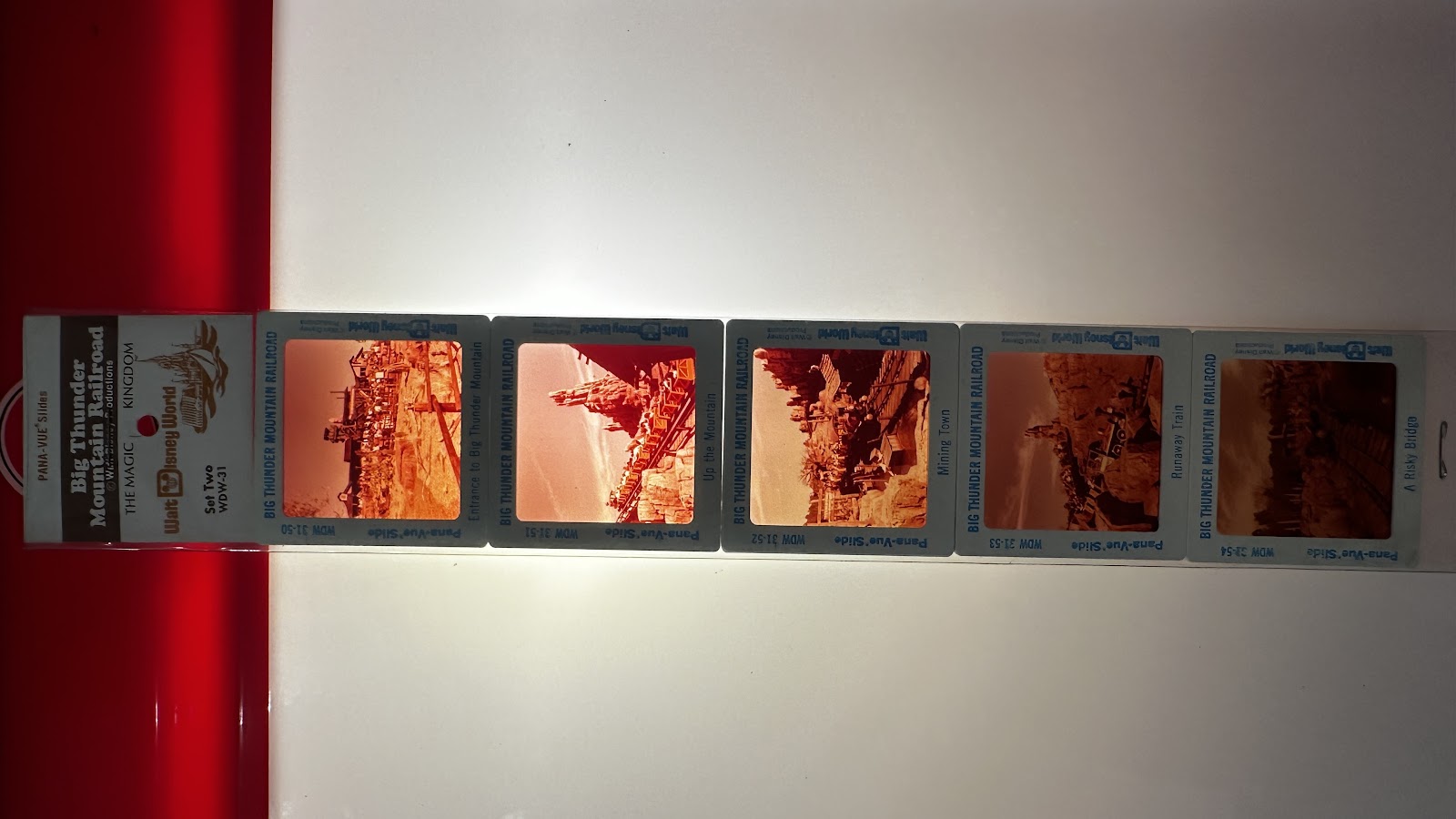
A Window into the Wild West of the Magic Kingdom
Long before the smartphone era turned every theme park visit into an instant digital archive, Walt Disney World guests had a different way of bringing the magic home: the GAF Pana-Vue slide set. This particular set — officially coded WDW-31 and titled Big Thunder Mountain Railroad Set Two — captures one of the most beloved E-ticket attractions in Disney history, right at the dawn of its existence. With five 35mm slides depicting the entrance, the mountain ascent, the mining town, the runaway train, and the iconic trestle bridge, this little cardboard-backed packet is a time capsule from the opening era of a genuine American theme park legend.
The Attraction That Shook the Mountain Kingdom
Big Thunder Mountain Railroad opened at Walt Disney World's Magic Kingdom in 1980, instantly earning its place as one of the park's signature thrill rides. Billed as "the wildest ride in the wilderness," the attraction drew from the rich mythology of the American Southwest — runaway mine trains, haunted canyons, tumbleweed-swept ghost towns, and the kind of restless geological mischief that only Disney Imagineers could conjure in fiberglass and steel. The ride's narrative is anchored in a gold rush setting somewhere in the desert backcountry, where the mountain itself seems to be supernaturally alive, sending locomotives careening through caverns and over rickety bridges at thoroughly undignified speeds.
The early 1980s were a golden era for Frontierland, and Big Thunder fit seamlessly into that rugged, nostalgic landscape. Its opening came just as Walt Disney World was finding its full stride, having passed its first decade and rapidly expanding its roster of major attractions. To hold a set of slides from this precise opening window — dated between 1980 and 1982 — is to hold a record from those formative years, before subsequent refurbishments softened and refined the edges of what was then a spanking-new ride experience.
GAF Corporation and the Art of the Pana-Vue
The GAF Corporation produced these officially licensed slide sets in partnership with Walt Disney Productions throughout the 1970s and into the early 1980s. The Pana-Vue format — individual 35mm slides housed in a neat, themed cardboard sleeve — was designed to be viewed through an illuminated Pana-Vue viewer, the kind of satisfying gadget that rewarded a slow, attentive look rather than a quick scroll. Each slide was a genuine photographic image taken inside the park, meaning these were not illustrations or marketing composites but actual documentary photographs of the attraction as guests experienced it.
The collaboration between GAF and Walt Disney Productions yielded sets covering virtually every corner of the resort, from classic dark rides to parades to resort hotels. Today, these sets form a coherent photographic chronicle of Walt Disney World in its earliest chapters — a record that no official Disney publication quite replicates. The WDW-31 designation places this set within a numbered series that collectors have mapped with considerable care over the years, making it identifiable, cross-referenceable, and genuinely traceable to a specific moment in the park's history.
Why Collectors Seek Out This Set
For Disney memorabilia collectors, the Pana-Vue slide sets occupy a sweet spot: they are small enough to store easily, specific enough to anchor a focused collection, and historically rich enough to reward serious study. A set focused on Big Thunder Mountain Railroad carries particular appeal because the attraction remains one of the most beloved in the entire Disney canon — with devoted fan communities, extensive merchandise histories, and a mythology that stretches across multiple parks on three continents.
What makes Set Two especially appealing alongside the first set is its broader sweep of the experience: the entrance sets the scene, the mountain ascent conveys the scale, the mining town establishes the narrative world, the runaway train delivers the kinetic heart of the ride, and the bridge shot offers one of the most visually dramatic compositions in any WDW attraction of the era. Together they function almost like a storyboard, walking the viewer through the full arc of the experience.
This set comes to us from a larger Disney estate collection — the kind of careful, decades-long accumulation that produced items in this condition. Items from such collections often carry the quiet dignity of having been kept by someone who genuinely loved what they were holding onto. That context adds its own layer of meaning for the collector who brings it home next.
Thinking of selling? Get a free, no-obligation offer.
One direct offer on your entire Disney collection — no commission, no auction wait. We help arrange the shipping.