A Window Into EPCOT's Opening-Era Ocean
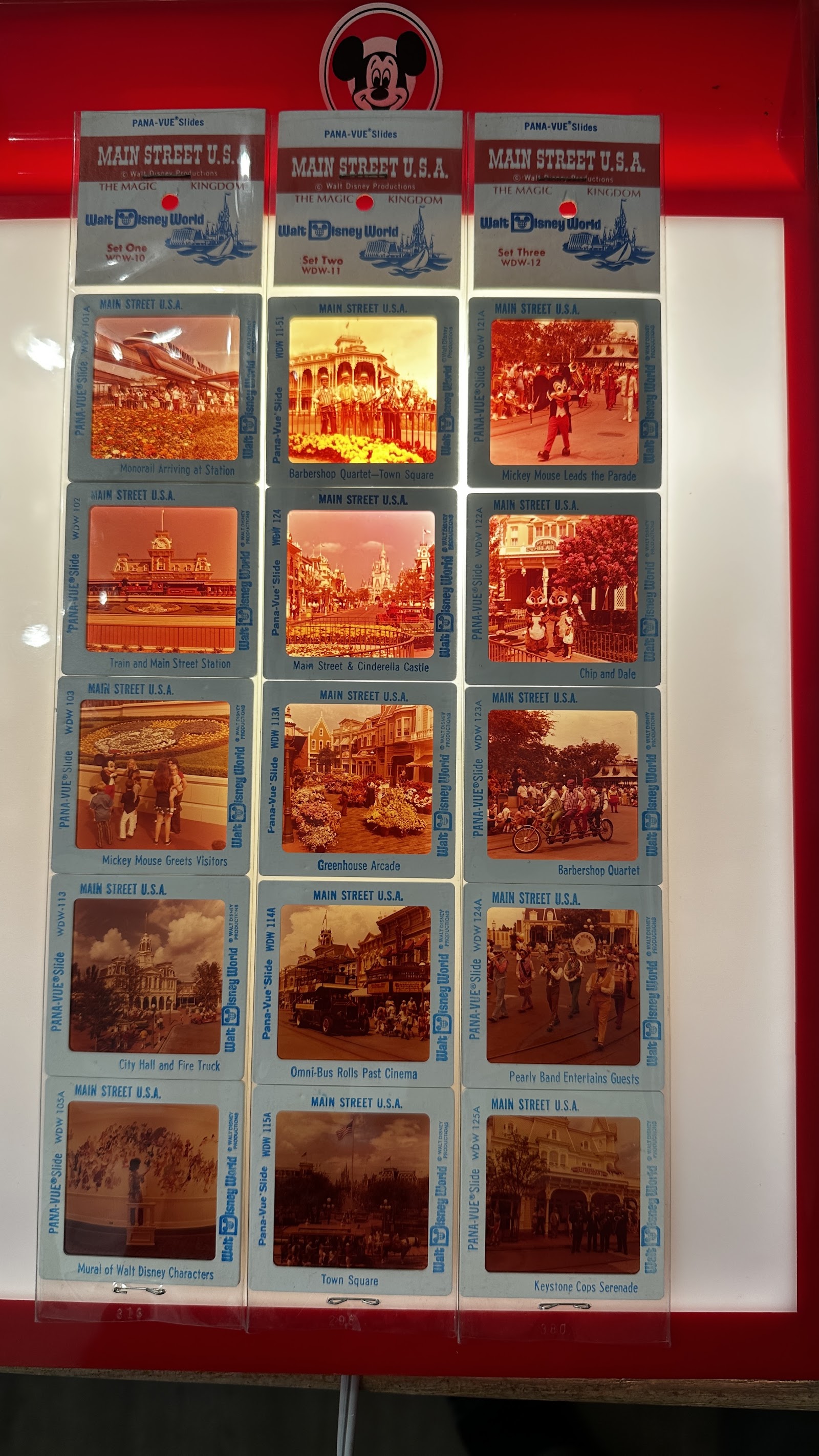
Before flat-screen displays and immersive digital projections became the norm at Walt Disney World, a different kind of visual wonder ruled the souvenir stand: the slide set. These compact collections of 35mm transparencies let visitors carry home a glowing slice of their vacation, holding each cardboard-mounted frame up to the light or dropping it into a handheld viewer to relive the magic. This GAF Pana-Vue set captures one of EPCOT Center's most beloved and scientifically ambitious pavilions — The Living Seas — during its earliest operational years, making it a time capsule of a pavilion that has since been dramatically reimagined.
The Living Seas: EPCOT's Grandest Science Experiment
When EPCOT Center opened in October 1982, it promised guests an optimistic vision of humanity's future relationship with technology and the natural world. Future World's pavilions were backed by corporate sponsors and staffed, in spirit, by the leading minds of their respective industries. The Living Seas, which opened on January 15, 1986, arrived as one of the last original Future World pavilions to debut — and it arrived with a splash. Sponsored by United Technologies Corporation, it housed what was at the time one of the largest man-made saltwater environments on Earth: a 5.7-million-gallon main tank teeming with thousands of sea creatures, from reef fish and sea turtles to sharks and rays.
Guests entered via a dramatic pre-show called "The Sea — A Cruel and Challenging Environment," which set a tone of genuine scientific wonder. They then descended into "Sea Base Alpha," a simulated underwater research habitat where divers worked among the fish in real time, visible through enormous curved acrylic windows. It was participatory science as theme park attraction — and for an entire generation of guests, it was the most genuinely awe-inspiring thing they had ever seen inside a theme park.
This slide set was produced during that opening era, capturing the pavilion as guests first experienced it — before the 2006 transformation into "The Seas with Nemo and Friends," which overlaid the Pixar universe onto the existing infrastructure. The pavilion still exists, and the tank still holds its remarkable marine life, but the corporate-sponsor future-of-science atmosphere of the original is gone. These slides preserve it.
GAF Corporation and the Pana-Vue Format
GAF Corporation was one of the dominant names in consumer photography and optical media for much of the mid-twentieth century. Their Pana-Vue line of slide viewers and coordinated slide sets became a staple of the American tourist experience, sold at national parks, world's fairs, and major attractions throughout the 1960s, 1970s, and into the 1980s. The format was elegant in its simplicity: each set included a handful of professionally photographed 35mm slides in individual cardboard mounts, packaged in a labeled sleeve or box, ready for use in any standard slide viewer or projector. The images were sharp, color-saturated, and carefully composed — genuine photography, not printed reproductions.
At EPCOT, GAF slide sets were among the earliest licensed souvenir products sold throughout Future World and World Showcase. Because the park was designed with educational seriousness as part of its DNA, photographic slide sets fit the atmosphere perfectly. They felt less like tourist trinkets and more like documentation — the kind of thing a parent might genuinely show during a family slide night, narrating the wonders of science and innovation their children had witnessed firsthand.
Why Collectors Seek Out Slides Like These
The appeal of early EPCOT memorabilia among Disney collectors is well-established, and opening-era items from the original Future World pavilions are among the most sought-after pieces in any serious collection. The Living Seas is a particularly rich subject because its first iteration was so deliberately, unabashedly ambitious — and because so little of that original identity survives in the current attraction. A slide set from 1986 to the early 1990s is primary-source documentation of a moment in Disney history that exists now mostly in memory and archival imagery.
Beyond historical significance, there is a tactile pleasure to these objects that digital photography can never replicate. Each slide is a physical artifact — a sliver of color and light frozen in gelatin on a strip of acetate. Held up to a window or dropped into a Pana-Vue viewer, the image glows with a warmth and depth that a screen simply cannot match. They reward slow looking.
This particular set arrived as part of a larger Disney estate collection, the kind of assembled life's work that passionate park-goers built over decades of visits and collecting. Items like this were kept, not discarded — which speaks to the emotional resonance they carried for the people who bought them. Finding a set in coherent condition, with its original packaging, is increasingly uncommon as these fragile paper-and-acetate objects age out of attics and storage boxes.
A Piece of Future World's First Promise
EPCOT Center in its opening decade represented something genuinely unusual in American entertainment: a theme park that asked its guests to care about the future of the ocean, of energy, of transportation, of the imagination itself. The Living Seas was the fullest expression of that ambition — a working scientific habitat disguised as a family attraction. This GAF Pana-Vue set is a small, beautiful relic of that original promise, sized to fit in a shirt pocket but carrying a pavilion's worth of memory inside it.
Thinking of selling? Get a free, no-obligation offer.
One direct offer on your entire Disney collection — no commission, no auction wait. We help arrange the shipping.