The Theme Park That Almost Rivaled Disneyland
Long before Six Flags and Universal Studios competed for the Eastern seaboard's family entertainment dollars, there was Freedomland U.S.A. — a sprawling, ambitious theme park that opened in the Bronx, New York in 1960 and dared to call itself "The Disneyland of the East." That claim was no idle boast. The man behind Freedomland's design was C.V. Wood, the very same developer who had served as the lead planner of the original Disneyland in Anaheim, California. Wood brought the same philosophy of immersive, story-driven zones to the East Coast, organizing Freedomland around chapters of American history rather than Disney characters — but with the same showman's eye for spectacle and the same attention to theming that had made Disneyland a national sensation.
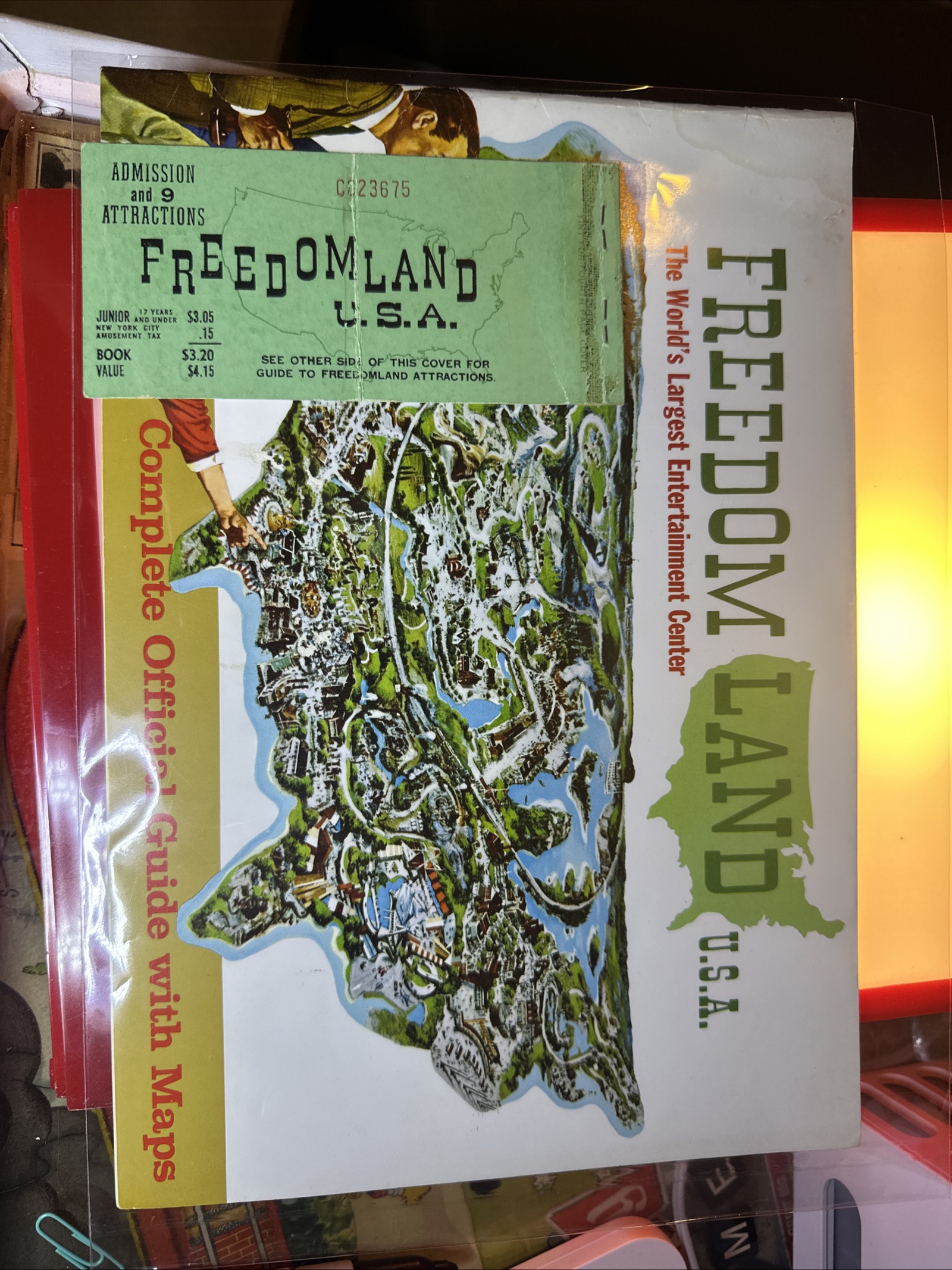
The park was laid out in the rough shape of the continental United States, a gimmick that was clever enough to headline every piece of promotional material Freedomland ever produced. Guests could travel from an 1850s frontier town in the West to a simulation of the Great Chicago Fire in the Midwest to an old New Orleans bayou in the South — all within a single afternoon and a single admission fee. At its peak, Freedomland drew hundreds of thousands of visitors and represented one of the most audacious entertainment investments New York City had ever seen.
What This Guide Represents
This official guide — measuring a generous 9 by 12 inches on paper and cardstock — is a direct portal into that lost world. Complete and intact, it features the bird's-eye-view map style that was standard for mid-century American theme parks: richly illustrated, color-saturated, and packed with the kind of optimistic visual energy that defined postwar leisure culture. The vibrant green and red inks remain well-preserved, a testament to careful storage away from direct sunlight and humidity over the past six-plus decades. The white cover edges show the gentle, honest yellowing that paper of this era naturally acquires, and there is minor corner blunting consistent with a guide that was actually used — carried into the park, consulted at the gate, tucked into a pocket between attractions.
Attached to the guide is the cover from an admission ticket book. The ticket price visible on the cover — $3.20 — helps date this piece to the 1961 or 1962 season, placing it squarely in the park's operational prime before financial difficulties began to mount. The ticket book cover is stapled or clipped to the guide, which may account for small punctures in the paper; there are no major tears, and the guide remains complete. The whole piece is housed in a protective Mylar sleeve, the kind of archival care that speaks to a previous owner who understood exactly what they had.
Why Collectors Seek Out Freedomland Ephemera
Freedomland U.S.A. operated for only four years — 1960 through 1964 — before closing permanently. That short window of operation is the central fact that drives collector demand for anything associated with the park. Disneyland opened in 1955 and never stopped printing souvenirs; Freedomland printed its guides, maps, and ticket books for fewer than half a decade before the presses went quiet forever. What survived did so largely by accident — tucked into scrapbooks, stored in attics, carried home from a single summer visit by a family who never returned because the park was gone the following year.
The Disney adjacency deepens the appeal considerably. C.V. Wood's direct connection to Disneyland's creation makes Freedomland a legitimate chapter in the broader story of American theme park history — and for collectors who focus on the origins and evolution of the Disney experience, Freedomland artifacts sit comfortably alongside early Disneyland park maps, ticket books, and souvenir guides. The two parks share a design lineage, a cultural moment, and an aesthetic vocabulary. Owning a piece of Freedomland is, in a real sense, owning a piece of the road not taken: the East Coast experiment that might have changed the map of American entertainment had circumstances broken differently.
From an Estate Collection, Into Collector Hands
This guide came to us as part of a larger Disney and Disney-adjacent estate collection — the kind of carefully assembled archive that a dedicated enthusiast builds over a lifetime, piece by piece, with an eye for what is genuinely scarce rather than merely old. Guides like this one were not produced in the limited quantities of a signed lithograph or a hand-painted cel, but the combination of perishable paper format, a four-year operational window, and sixty-plus years of attrition has made truly complete, well-preserved examples meaningfully rare. This one has been protected: flat storage, a Mylar sleeve, and the kind of cool, dry conditions that let the colors stay honest and the paper stay pliable.
For the collector building a mid-century American theme park archive, or a Disney history collection that reaches beyond the studio gates into the broader world of immersive entertainment, a complete Freedomland guide in this condition is a significant find. It is a document, a souvenir, and a small act of memory — proof that for four summers in the Bronx, something extraordinary was attempted.
Thinking of selling? Get a free, no-obligation offer.
One direct offer on your entire Disney collection — no commission, no auction wait. We help arrange the shipping.