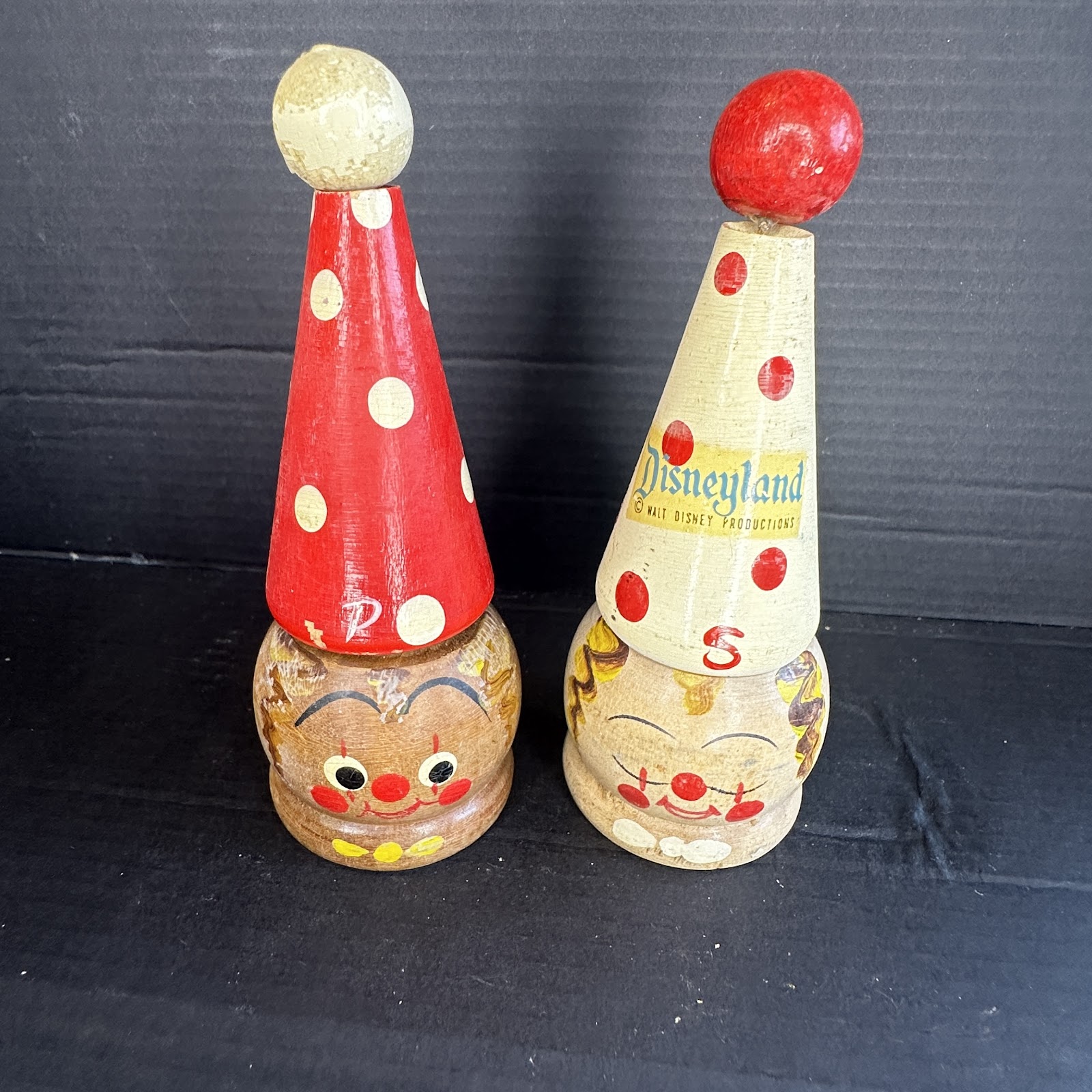
A Pair of Painted Performers from the Early Magic Kingdom
Long before the internet made Disney collectibles globally accessible, the only way to bring a piece of the Magic Kingdom home was to walk through those famous gates yourself. This charming pair of hand-painted wooden clown salt and pepper shakers did exactly that — they left Disneyland in someone's suitcase, or perhaps a brown paper bag swinging from a child's hand, sometime in the 1950s or 1960s. Decades later, they have arrived as part of a larger Disney estate collection, carrying with them the quiet magic of an era when the park was still finding its footing and every souvenir felt genuinely handmade.
The shakers are a matched pair: the pepper shaker in red and white with a yellow base, the letter "P" stenciled on its conical hat; the salt shaker in cream and off-white with a cheery red pom-pom topping its pointed cap. On the salt shaker's body, a small "Disneyland" decal carries the circular © Walt Disney Productions copyright mark — the quiet brand stamp that collectors have come to recognize as a hallmark of legitimacy from this golden window of park merchandising. The conical hat on each shaker is not merely decorative; it is the shaker mechanism itself, unscrewing to reveal the fill opening.
The Circus Spirit at the Heart of Early Disneyland
Clowns have deep roots in the Disney tradition. From the bumbling, lovable clowns of Dumbo (1941) to the circus performers who populated Fantasyland parade floats in Disneyland's earliest years, the big-top aesthetic was woven into the park's DNA from opening day on July 17, 1955. Walt Disney himself had a lifelong fascination with carnival and vaudeville entertainment — it informed the exuberance of early Mickey Mouse shorts and gave Disneyland its character as a permanent world's fair rather than a simple amusement park.
Souvenir vendors in those early years stocked a whimsical assortment of goods that reflected this spirit. Wooden and ceramic figurines, hand-painted and produced in relatively small runs compared to the mass-market plastic merchandise that would come later, occupy a prized category for collectors today. They feel personal in a way that later items do not — the slight irregularities in the brush strokes, the weight of real wood in your palm, the faint imperfections that confirm these were made by human hands rather than extruded by a machine.
Reading the Patina: What Age Looks Like on a Survivor
These shakers have lived a full life, and they show it honestly. Both pieces display age-related paint chipping on their tops and bases — the inevitable result of decades of handling, shelf moves, and the simple passage of time. The surfaces exhibit a fine crazing characteristic of older lacquer finishes, and there is some gentle color fading consistent with ambient light exposure over many years. On the salt shaker, the paper decal label has yellowed and shows edge wear at its margins.
For experienced collectors, none of this diminishes the appeal — quite the opposite. These are not the signs of neglect; they are the biography of an object that has been present in someone's home for sixty or seventy years. The shakers were almost certainly displayed, handled, perhaps even used at a dinner table at some point. That human proximity is part of what makes them interesting. A pristine example sealed in a box tells you very little. A pair like this, gently worn, tells you a story.
What matters most structurally is intact: the wooden bodies are sound, the conical-hat shaker mechanism is present on both pieces, and the copyright decal on the salt shaker — often the first thing to disappear on pieces of this age — remains readable. The Walt Disney Productions mark dates the piece firmly to the pre-1986 era, before the company transitioned its copyright attribution to "The Walt Disney Company," a detail that helps collectors anchor the item in its correct historical window.
Why Park-Exclusive Souvenir Ware from This Era Commands Attention
Disneyland-specific merchandise from the 1950s and 1960s occupies a narrow, desirable lane in the broader Disney collectibles market. Unlike studio-licensed goods distributed nationally through department stores and dime stores, park exclusives were sold only on-site. The universe of surviving examples is naturally constrained: people lose things, things break, the casual souvenir becomes an accidental rarity. Wooden items in particular are vulnerable — they warp, they chip, they get thrown away when a new generation cleans out a family home without recognizing what they have.
This pair survived. They came to us as part of a substantial Disney estate collection — the assembled enthusiasm of a lifetime of collecting — and they carry that provenance with quiet dignity. Whether you are building a focused park-souvenir display, a mid-century kitchen vignette, or a broad survey of early Disney merchandise history, these shakers offer something genuinely difficult to find: an intact matched pair, honestly aged, from one of the most storied decades in Disneyland's history.
A conversation piece for any shelf. A genuine artifact of the park's earliest years.
Thinking of selling? Get a free, no-obligation offer.
One direct offer on your entire Disney collection — no commission, no auction wait. We help arrange the shipping.