A Snapshot of Disneyland at Its Most Adventurous
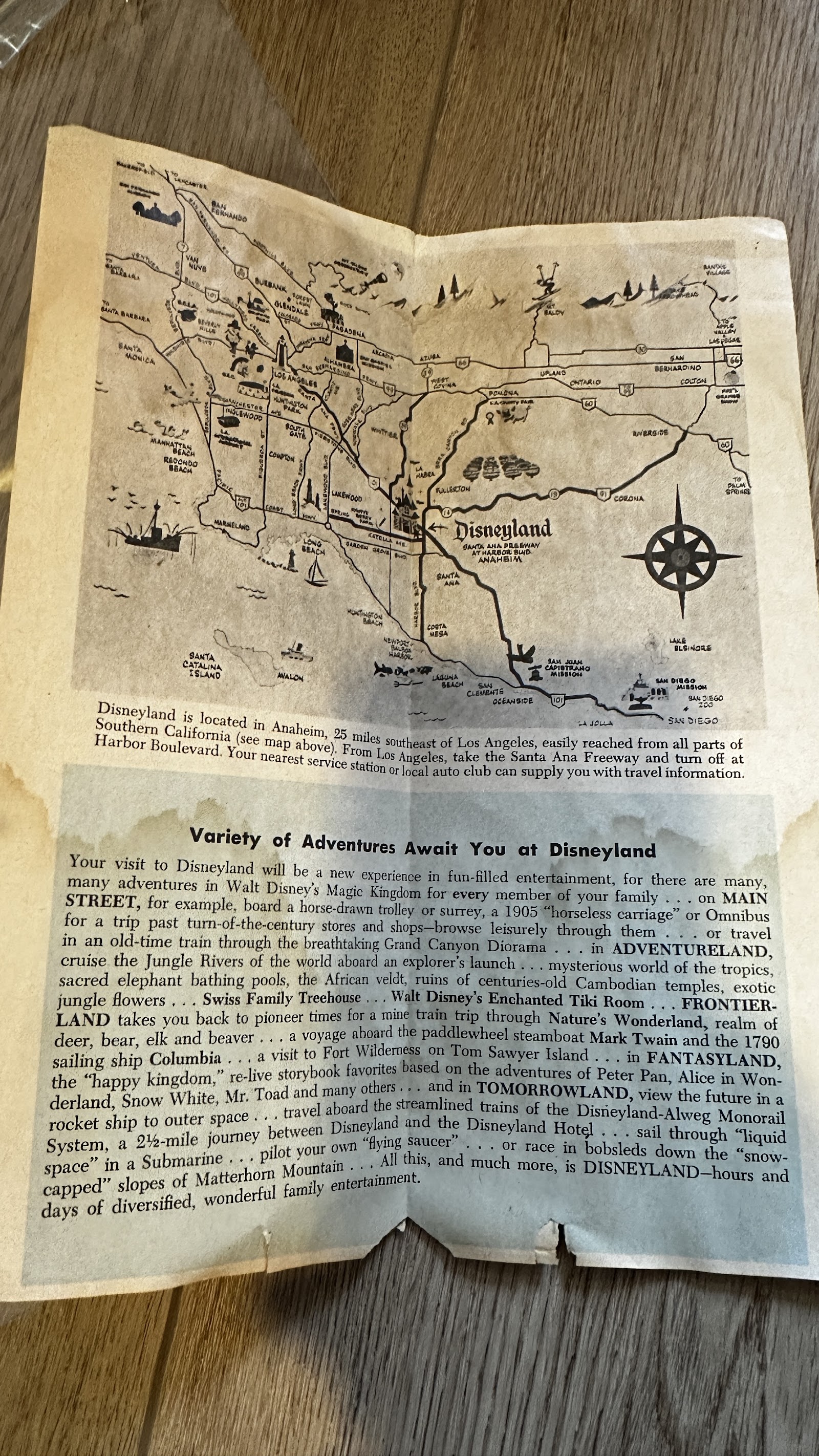
Before the Matterhorn became an icon and before New Orleans Square was even a gleam in Walt Disney's eye, Disneyland was a park in constant, exciting flux. This original fold-out brochure — measuring a compact 4 inches by 9 inches and unfolding to reveal a full pictorial map alongside a guide to the park's attractions — captures the Magic Kingdom at one of its most fascinating and historically fleeting moments: roughly 1963 to 1965, the final years of an attraction lineup that would never exist again.
Printed by Walt Disney Productions during the park's golden adolescence, this is the kind of artifact that serious Disneyland historians and memorabilia collectors search for relentlessly. The guests who tucked these brochures into their jacket pockets or handbags were walking a park that is simply gone. What you hold here is proof it existed.
The Attractions That Made This Era Legendary
Three attraction callouts on this brochure put its date into sharp focus — and each one tells a story of its own.
The Flying Saucers, in Tomorrowland, operated from 1961 until 1966. Inspired by hovercraft technology and the space-age optimism of the early 1960s, they allowed guests to pilot individual cushion-riding saucers around a vast circular arena, steered by the simple physics of body weight. The ride was beloved and perpetually understated in importance — Disney fans know it as one of the park's greatest losses, and its brief operational window makes any brochure mentioning it a dateable, desirable find. (The concept was revived decades later as Luigi's Flying Tires at Disney California Adventure, though that version had its own short run.)
Nature's Wonderland — formally Mine Train Through Nature's Wonderland — was a leisurely narrow-gauge railroad journey through re-creations of the American Southwest: geysers, desert vistas, beaver dams, and a parade of Audio-Animatronic wildlife. It ran from 1960 until 1977, when it was demolished to make way for Big Thunder Mountain Railroad. For many guests of that era, it was a park staple, a slow and gentle contrast to the excitement of other Fantasyland and Adventureland offerings.
The Enchanted Tiki Room, which opened in June 1963, was nothing less than a revolution. Walt Disney's first fully Audio-Animatronic show — and arguably the invention that changed theme parks forever — the Tiki Room filled a small Adventureland theater with singing birds, chanting tiki gods, and swaying tropical flowers. A brochure that mentions the Tiki Room but predates the 1965–1966 additions and reconfigurations helps narrow this piece to a very specific window: shortly after the Tiki Room's debut, while the Flying Saucers were still spinning and Nature's Wonderland trains were still running.
The Object Itself — Character and Condition
This brochure shows its age honestly and beautifully. Significant age-toning warms the paper to the amber and cream hues you'd expect from a printed piece that has lived through six decades. The central fold — the crease that every guest made when they opened the map for the first time, probably standing at the park's front gate — is well-defined and present. Edge tears speak to use: this brochure was handled, consulted, folded back, consulted again. It was a working document for a real Disneyland visit.
The Southern California map printed alongside the park guide is a delight in its own right. Mid-century California cartography had a warmth and optimism that perfectly matched Disneyland's own brand of promise — highways leading to adventure, the park rendered in bright pictorial illustration at the center of a region that seemed, in those years, to be the very capital of the American future.
For collectors, honest wear on a piece this old is not a flaw — it is authentication. A perfectly mint brochure from 1963 would raise questions. This one lived.
From a Disney Estate Collection
This brochure comes to us as part of a larger Disney estate collection — an accumulated lifetime of park visits, purchases, and careful keeping. Whoever saved this piece did so across decades, through moves and storage and the ordinary entropy of a long life. That it survived intact enough to be studied and appreciated today is its own quiet miracle.
Ephemera like this — brochures, maps, ticket books, souvenir programs — sits at the intersection of graphic design history, theme park history, and personal memory. It does not have the visual drama of a hand-painted cel or the sculptural presence of a figurine. What it has instead is rarity born of disposability: these items were meant to be thrown away, and most were. The ones that weren't are irreplaceable primary sources for the history of the world's most studied theme park.
If you are building a collection around early Disneyland history, the Tomorrowland of the space age, the Adventureland of Audio-Animatronics' dawn, or simply the texture of what a day at Disneyland felt like in the Kennedy years — this brochure belongs with you.
Thinking of selling? Get a free, no-obligation offer.
One direct offer on your entire Disney collection — no commission, no auction wait. We help arrange the shipping.