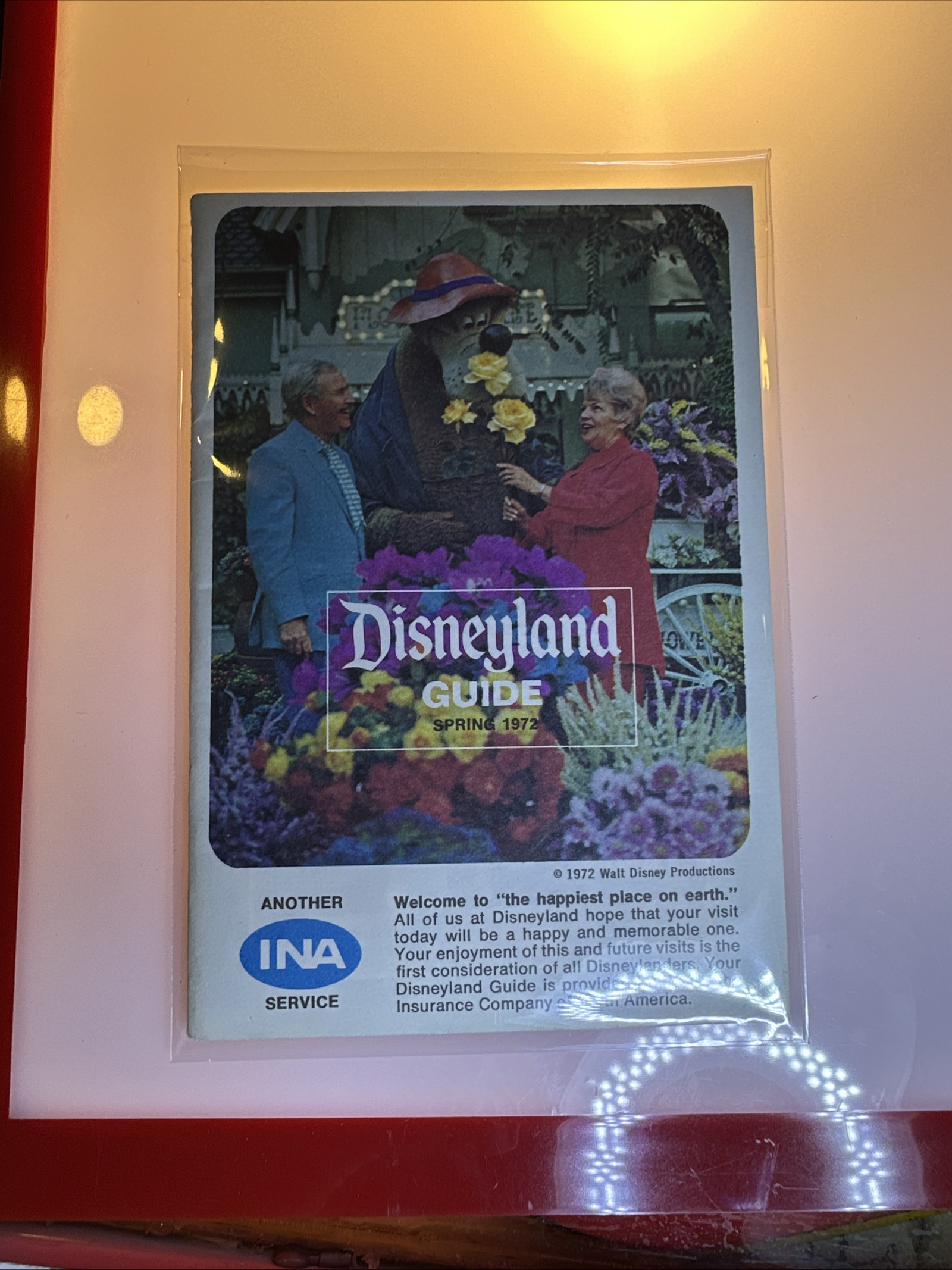
A Pocket-Sized Time Capsule from the Magic Kingdom
Slip this little booklet into your hand and you are holding Spring 1972 — a Disneyland still shaped entirely by Walt's original vision, before EPCOT, before Tokyo, before the era of annual mega-expansions changed the parks forever. This Official Disneyland Guest Guidebook measures a compact four-by-six inches, small enough to tuck into a shirt pocket the way millions of park guests did before smartphones replaced every paper map. Yet within its pages lived the entire geography of the Happiest Place on Earth, printed in the vivid, optimistic graphic style that defined early-1970s Disney print design. The colors remain vibrant, the paper bright white, the spine intact — a condition that speaks to careful stewardship across more than five decades.
Br'er Bear and the Complicated Magic of Song of the South
The cover star is Br'er Bear, the lumbering, lovable antagonist from the 1946 live-action-and-animation hybrid Song of the South. By 1972, the Br'er characters had found a permanent home at Disneyland through the beloved Splash Mountain attraction — or rather, its predecessor experience, since Splash Mountain itself would not open until 1989. The characters lived in the park's cultural DNA through various themed environments long before that landmark flume ride brought them to their widest audience. Br'er Bear, Br'er Rabbit, and Br'er Fox occupied a particular sweet spot in the Disney character roster: beloved to generations of park guests, yet tied to a film the studio kept at careful arm's length due to its fraught racial history. That tension only deepens collector interest today. When Splash Mountain was reimagined as Tiana's Bayou Adventure and the Br'er characters were formally retired from the parks, the market for original Splash Mountain and Br'er-themed ephemera surged noticeably. A 1972 guidebook featuring Br'er Bear front and center now carries the added resonance of documenting a character's park legacy at its height.
INA and the Forgotten World of Corporate Park Sponsorships
One of the most historically rich details on this guide is the INA sponsor logo — the Insurance Company of North America — associated with Carefree Corner on Main Street, U.S.A. Corporate sponsorships were woven deeply into early Disneyland's fabric in ways modern guests rarely appreciate. Companies like INA, Kodak, Carnation, and Bank of America weren't simply advertisers; they were genuine operational partners whose presence shaped the physical experience of the park. Carefree Corner was an information and hospitality stop on Main Street where guests could pick up travel tips, insurance information, and park literature — the kind of gracious, mid-century service touch that Walt personally championed as part of the total guest experience. INA's association with that space lasted for years, and guides like this one are among the few surviving records of exactly how that partnership was presented to guests. For historians of theme park corporate culture, the INA logo is not a blemish — it is primary source evidence.
Condition, Provenance, and the Estate Collection
Paper ephemera from the early 1970s rarely survives in this kind of shape. The typical fate of a guest guidebook was to be folded, stuffed into a back pocket, consulted in bright sun and humid afternoon heat, then either lost in the park or tossed into a junk drawer to yellow for decades. This example beats those odds decisively. There is negligible surface wear, no dog-eared corners, no creases or spine splits, no staining, and no discoloration of any kind. The booklet arrived protected in a clear archival plastic sleeve, suggesting it was recognized as something worth preserving — possibly framed or stored with deliberate care not long after the park visit that yielded it. It came to us as part of a larger Disney estate collection, the kind of carefully assembled trove that only emerges when a dedicated lifelong collector's holdings finally pass into new hands. Pieces like this one were kept not for resale value but for love, and that distinction shows in the condition.
For the paper ephemera collector, the Disneyland historian, or anyone drawn to the Br'er characters before their park retirement, this 1972 Spring guide represents something genuinely hard to replicate: original park documentation in honest, well-preserved condition, carrying both a culturally significant cover image and a sponsor detail that anchors it precisely in a specific moment of theme park history. It is a small object with a large story inside it.
Thinking of selling? Get a free, no-obligation offer.
One direct offer on your entire Disney collection — no commission, no auction wait. We help arrange the shipping.