A Park Frozen in Print
There is something quietly remarkable about a book that was never meant to leave the park. Disneyland: Dreams, Traditions and Transitions is exactly that — a large-format hardcover souvenir volume produced by Walt Disney Publications and sold exclusively inside Disneyland during the early 1990s. You couldn't order it from a catalog. You couldn't find it at a mall bookstore. The only way to bring it home was to walk through those famous wrought-iron gates, drift past the flower-bed Mickey on Main Street, and spot it on a shelf somewhere inside the Happiest Place on Earth. That origin story alone sets it apart from every generic souvenir magnet or commemorative cup produced in that era.
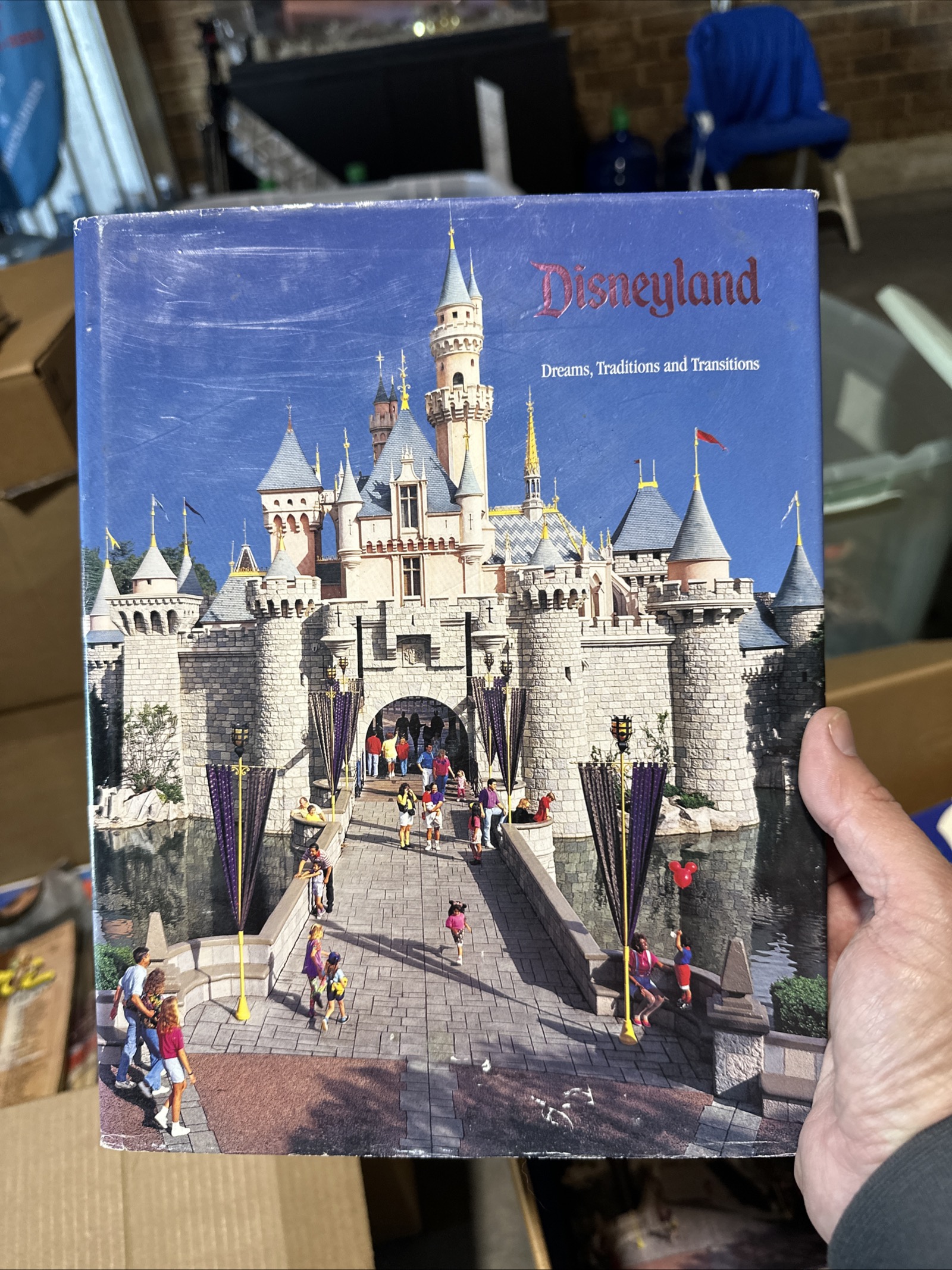
The volume spans approximately 11.5 by 9 inches and sits in the satisfying weight class of a true coffee table book — somewhere between one and a half and two pounds of glossy, full-color pages bound between hardboard covers printed directly on the boards, with no dust jacket ever issued. The cover image of Sleeping Beauty Castle rising against a blue California sky, a red Mickey Mouse balloon drifting upward in the foreground, is an instantly recognizable piece of Disney visual iconography. It captures the park in its most aspirational, postcard-perfect register.
The "Transitions" Era at Disneyland
The early 1990s represent a genuinely fascinating chapter in Disneyland's history, and this book documents it with an insider's perspective. The park was in the midst of what Disney itself called a period of transition — new lands were being imagined, classic attractions were being reimagined, and the question of how to honor Walt's original vision while modernizing for a new generation was very much alive. Tomorrowland was beginning to feel its age. New Orleans Square and Fantasyland were beloved anchors. Euro Disneyland (now Disneyland Paris) had just opened in 1992, bringing fresh scrutiny to what "Disneyland" meant as a concept and a brand.
Internally, the company was navigating the aftermath of the Michael Eisner-era expansions that had brought enormous new energy — and new tensions — to the parks. The word "transitions" in the title was not marketing fluff; it reflected a real institutional awareness that the park was evolving, and that the stories and architecture behind it deserved to be documented before they shifted further. Books like this one served as both celebration and archive.
Architecture, History, and the Story Behind the Story
What distinguishes this volume from a simple photo collection is its emphasis on architecture and the deep history of the park. Where most souvenir books of the era leaned heavily on character imagery and ride photography, this title explored the design philosophy that made Disneyland physically unique — the forced perspective on Main Street U.S.A., the berm that blocks the outside world from view, the way Walt and his Imagineers used scale, color, and scent to manufacture emotion. These were ideas that serious Disney historians and theme-park designers were only beginning to articulate in accessible language, and finding them in a book sold inside the park itself was unusual.
For collectors interested in Disneyland as a place rather than just a franchise, this kind of primary-source documentation is invaluable. It captures how Disney wanted guests to understand the park at a specific moment in its life — not the sanitized version of history you'd get decades later, but the living, self-aware institutional voice of the early 1990s.
Condition, Character, and the Estate Collection
This copy arrived as part of a larger Disney estate collection — the kind of accumulated archive that forms when a devoted fan spends decades bringing pieces home from the park, keeping them on shelves, and treating them as the artifacts they are. It shows honest shelf life: there is notable surface scuffing and wear on the blue sky area of the cover, bumping and some whitening along the bottom corners and spine edge, and light linear scratches consistent with years of display. These are the marks of a book that was owned, not warehoused.
Importantly, the interior holds up beautifully. Colors remain vibrant throughout — no sun fading, no water staining, no foxing. The spine is intact and the binding is sound. For a book printed directly on boards without a protective dust jacket, surviving three-plus decades in this condition speaks to how it was cared for. Collectors who intend to display this piece rather than read it will find the cover wear acceptable at a distance; those who want a reading copy will find the interior genuinely satisfying.
For Disneyland historians, parks enthusiasts, or anyone who walked through those gates in the early 1990s and remembers the particular light of that era, this is a document worth having. It is one of those pieces that makes a collection feel like a collection — specific, storied, and irreplaceable.
Thinking of selling? Get a free, no-obligation offer.
One direct offer on your entire Disney collection — no commission, no auction wait. We help arrange the shipping.